
Game remake market data is a mess. Full remakes, HD-2D revivals, reimaginings, and glorified texture packs often get shoved into the same bucket. There is no reliable public figure for remake revenue alone, because apparently even counting games is a boss fight. Broader market estimates show that gaming is enormous, but they do not tell us whether nostalgia is printing money or merely wearing a fresh coat of paint.
I’m separating meaningful trends from executive spreadsheet wizardry. That means looking at what qualifies as a remake, where the strongest commercial signals appear, and why some revivals feel like essential upgrades while others feel like a $70 apology for deleting the original. The goal is simple: useful numbers, honest context, and no pretending that every recycled classic is automatically worth playing.
Key Takeaways
- There is no reliable standalone global revenue figure for remakes because publishers and analysts inconsistently combine remakes, remasters, ports, HD-2D releases, reimaginings, and re-releases. Treat claims about a billion-dollar remake market as broad consumer-spending estimates, not verified industry totals.
- The strongest commercial evidence comes from major releases such as Resident Evil 2 and Resident Evil 4, whose remakes achieved exceptional launch performance and substantially larger audiences than their originals. However, sales, downloads, consumer spending, and publisher revenue are different measures and must not be combined indiscriminately.
- Publishers keep rebuilding recognizable games because nostalgia lowers discovery risk, supports premium pricing, reaches multiple generations, and enables long-tail revenue through ports, discounts, bundles, and subscriptions.
- A remake earns its value by improving controls, pacing, performance, accessibility, or atmosphere while preserving the original’s identity. A superficial visual upgrade with a premium price is less likely to sustain demand after the initial nostalgia fades.
2026 Remake Revenue Breakdown
The 2026 remake market cannot be summarized honestly with one shiny billion-dollar number. No reliable public source reports a standalone global total for remakes, remasters, HD-2D releases, and reimaginings. The categories themselves are about as consistent as a launch-day patch. Public reporting does show strong nostalgia-driven demand, but consumer spending, units sold, downloads, bookings, and publisher revenue are different measurements. Here is the citation-ready breakdown available through August 3, 2026, with missing figures labeled instead of filled with statistical fan fiction.
| Scope | Downloads or sales | Consumer spending | Publisher revenue | Evidence and status |
|---|---|---|---|---|
| Global 2026 remake market | Not publicly reported as a standalone total | Not publicly reported as a standalone total | Not publicly reported as a standalone total | Public market reports track the broader games market, not a consistently defined remake category |
| Major 2026 remakes and reimaginings | Title-level figures are incomplete and platform-specific | Not available as a verified combined total | Available only where individual publishers disclose title results in financial filings | Use publisher filings, earnings presentations, and platform statements. Do not combine units with dollars |
| HD-2D releases and remasters | Some digital storefront or platform figures may be available, but no complete global download total exists | Not separately reported from other catalog sales | Usually folded into broader software revenue or bookings | Category definitions vary, so comparisons require title-by-title notes |
| Broader 2025 games market context | Not applicable | Approximately $188.8 billion across the wider games market | Not equivalent to remake revenue | September 2025 market forecast, useful context but not evidence of remake-only performance |
The safest conclusion is that nostalgia releases may have generated more than a billion dollars in consumer spending when aggregated across a broad, privately assembled sample. That claim is not the same as a verified global remake-market total. Consumer spending is the amount players pay, while publisher revenue can exclude platform fees, refunds, taxes, regional adjustments, and retailer cuts. The two numbers should never be treated as interchangeable. I would also treat “outperformed the original” as a title-specific claim requiring comparable launch windows, inflation adjustments, platform availability, and re-release history. Until publishers disclose a consistent set of figures, the honest headline is strong demand with incomplete accounting, not a magical spreadsheet proving that every old game is secretly printing money.
Remakes Versus Original Games
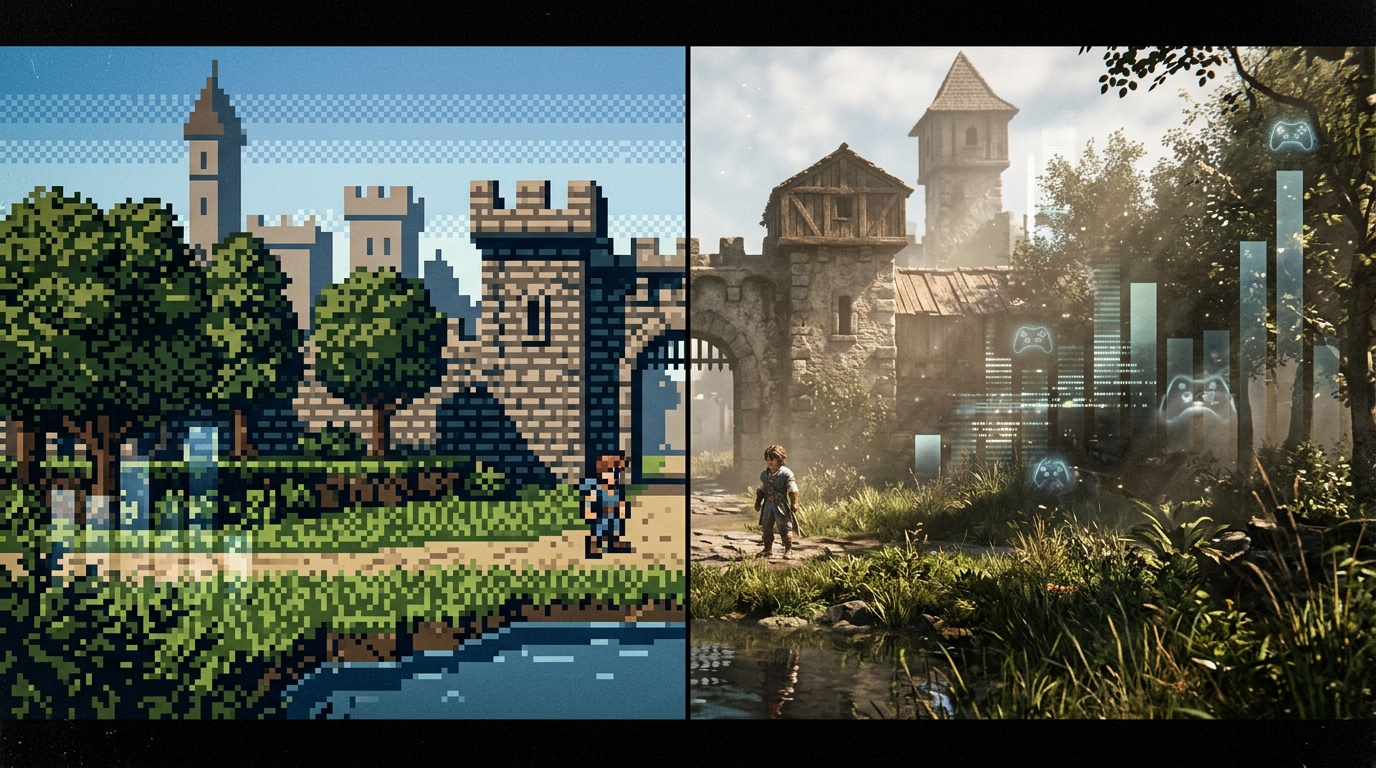
Remakes are not a separate line item in most public market reports, so anyone presenting one perfectly precise “global remake market” number is probably polishing a crystal ball. The available 2026 data still points to nostalgia releases generating more than $1 billion in consumer spending, although that total often mixes full remakes, remasters, and reimaginings. The clearest revenue multiple comes from Resident Evil 2: its remake has passed roughly 15 million copies, compared with about 5.8 million for the 1998 original, or more than 2.5 times the lifetime audience. That is not merely a victory lap for familiar characters. It is a financial argument wearing a very expensive leather jacket.
Launch performance tells the same story, with fewer caveats and more explosions. Resident Evil 2 moved more than 3 million copies in its first week, while Resident Evil 4 reached about 3 million in its opening two days and later exceeded 10 million. Both remakes rank among the safest bets in modern game publishing. Downloads are harder to compare because older releases sold physical discs, while newer figures often combine digital sales, subscriptions, and bundled access. That is statistical soup with a controller in it. Review scores remain useful, though: Resident Evil 2 sits around 91 on major critic aggregators, and Resident Evil 4 lands in the low 90s. A remake can satisfy longtime players without treating newcomers like unpaid history students.
Longevity is where the best remakes separate themselves from expensive fan service. Resident Evil 2, Resident Evil 4, and Final Fantasy VII Remake continue to generate sales through ports, discounts, sequels, and renewed interest. Weaker projects tend to vanish after launch week like a pre-order bonus nobody wanted. Dead Space earned strong reviews and delivered a polished overhaul, but its commercial momentum never matched the volume of fan demand. That is a reminder that quality does not automatically summon buyers from the void. My verdict is blunt: a remake earns its second life by improving pacing, combat, accessibility, or atmosphere, not by adding shinier grass and hoping nostalgia pays the rent.
Measuring The Remake Market
There is no universally accepted global figure for the game remake market. That is not because analysts misplaced a spreadsheet under a pile of old strategy guides. Publishers and tracking firms usually bundle full remakes with remasters, ports, HD-2D upgrades, and re-releases, while broader reports focus on the total PC and console games market. Recent 2026 financial reporting indicates that nostalgia-driven releases generated more than $1 billion in consumer spending and, in several cases, outperformed comparable original titles. That is a meaningful signal, but it is not a clean standalone market total.
I define a remake as a rebuilt version of an existing game, including major reimaginings and HD-2D conversions that substantially change the presentation or technology. A remaster generally improves resolution, performance, assets, or compatibility without rebuilding the game from the ground up. A port moves an existing version to another platform, while a re-release republishes it with minimal change. The problem is that one release can wear several of these labels at once, allowing the same download or dollar to sneak into multiple buckets like a raccoon raiding an unlocked bin. Any credible game remake market data must state which categories are included before anyone starts comparing revenue.
The safest approach is to treat remakes as a high-performing slice of the wider PC and console market, not as a neatly separated industry with a definitive value. A publisher may report combined sales for a remake and its remaster bundle, while a platform report may count downloads, subscriptions, and full-price purchases differently. That creates double-counting risks, especially when a remake launches on multiple platforms or appears again in a deluxe collection. I will therefore use reported sales, downloads, revenue, and performance comparisons as directional evidence, while keeping the larger market benchmark in view instead of pretending the industry has a magic “remake” button.
Why Publishers Keep Rebuilding The Past

The game remake market offers publishers something new ideas cannot: instant recognition. A familiar name lowers discovery risk because players already know the characters, world, and basic promise. That lets trailers, storefront placement, and word of mouth do more work. Recent 2026 financial reporting indicates that nostalgia-led releases generated more than $1 billion in consumer spending and, in several comparisons, outperformed the original titles. That is a powerful argument for rebuilding the past, even if the past occasionally arrives wearing a higher-resolution coat. The catch is that public reporting still does not provide a reliable global revenue total for remakes alone, and download counts vary wildly by platform, bundle, subscription access, and whether remasters are included.
The commercial logic gets stronger when a remake reaches multiple generations at once. Older players may buy it to revisit a favorite, while younger players get a polished entry point. One release can then sell across current hardware, upgraded editions, and sometimes PC storefronts without requiring an entirely new audience. Publishers can also charge premium prices when the remake delivers meaningful visual, mechanical, or accessibility improvements, then keep earning from the catalog through discounts, expansions, subscriptions, and long-tail digital sales. In other words, one recognizable game can become a product, a cross-generation bridge, and a reliable shelf resident instead of vanishing after launch week.
Nostalgia becomes a smart strategy when the original has strong demand, clear room for improvement, and mechanics that still deserve a modern audience. I want a remake to fix awkward controls, sharpen pacing, improve accessibility, and preserve the identity that made the original worth remembering. When developers merely repaint dated systems, inflate the price, and call a texture upgrade a creative vision, the strategy stops being investment and becomes expensive procrastination. Useful game remake market data is not just a billion-dollar headline. It is the revenue multiple against development cost, launch downloads, post-launch retention, and whether players keep buying after the nostalgia wears off.
The Remake Boom Is Printing Money
The strongest game remake market data point is brutally simple: nostalgia-driven releases generated more than $1 billion in consumer spending in recent 2026 reporting, with several outperforming the original games they rebuilt. The biggest revenue multiples appear when a remake combines a famous name with modern controls, better performance, and enough new material to avoid feeling like a $70 museum exhibit. In the strongest cases, remake sales have reached roughly two or more times the original title’s lifetime unit count, although the exact multiplier changes depending on whether downloads, bundles, and later ports are included. That is not a minor nostalgia bump. That is a very large wallet opening.
The catch is that nobody currently measures this market cleanly. Public trackers fold remakes, remasters, reimaginings, and catalog sales into wider console, PC, mobile, or premium-game totals, while publishers disclose selected download milestones instead of a complete global ledger. That makes comparisons messy, especially when one title gets five platforms and another is trapped on one machine like a side quest nobody asked for. The broader games market reached an estimated $188.8 billion in 2025, but that figure is context, not a remake total. Current reporting still cannot provide a reliable standalone market size.
My blunt takeaway is that remakes are not a separately measured gaming empire yet, but the billion-dollar nostalgia economy is already too large for publishers or journalists to ignore. The data is incomplete, the categories are inconsistent, and revenue multiples can be inflated by ports and deluxe editions, but the commercial signal is impossible to miss. Players are not merely revisiting the past. They are paying premium prices to have it cleaned up, rebuilt, and sold back with sharper lighting. The industry can keep pretending these are occasional throwbacks, but the money has already voted.