We all love a trip down memory lane, but lately that path is paved with full-priced disappointments and AI-upscaled textures that somehow look worse than the original polygons. This is the golden era of lazy game remasters. Publishers slap a “Definitive Edition” sticker on a dusty codebase and expect us to applaud their minimal effort. Instead of fixing ancient bugs or modernizing clunky controls, they usually just crank up the contrast and break the frame rate. It isn’t game preservation. It feels more like a digital mugging.
You know the industry has lost the plot when a random modder in a basement does a better job than a multi-million dollar studio. We are seeing “upgrades” that actually remove content and introduce glitches that weren’t there when the ink was fresh on the original script. It is a cynical cash grab designed to prey on your nostalgia while delivering a product that barely functions on modern hardware. If they can’t be bothered to polish the game, you shouldn’t be bothered to open your wallet.
Frequently Asked Questions
1. How is a game port different from a remaster?
A port moves a game to a different platform, while a remaster also updates parts of its presentation or performance. A port can be nearly identical to the original, so a new platform or store listing alone does not mean the game has been improved.
2. Does releasing a remaster mean the original game will disappear?
A remaster does not automatically replace the original, but availability depends on the publisher, platform, and licensing deals. Some older versions remain playable or purchasable, while others get delisted, so check your platform’s store and compatibility information before assuming the original will always be easy to find.
3. Are community mods a safe substitute for a remaster?
Community mods can improve an older game, but they are unofficial and their quality varies. Check that a mod supports your game version, back up saves before installing it, and be cautious with mods used in online games, where altered files may cause problems or violate the game’s rules.
Key Takeaways
- Publishers are frequently releasing “Definitive Editions” that are technically inferior to the originals, often introducing new bugs while failing to fix ancient ones.
- Cost-cutting reliance on AI upscaling destroys distinct art styles, turning gritty textures into smeary, “melted wax” visuals that lack the soul of the source material.
- High-profile failures like the GTA Trilogy and Silent Hill HD Collection demonstrate how lazy porting can actively ruin a game’s atmosphere and mechanics.
- Gamers should stop pre-ordering low-effort ports and stick to original versions or community mods until studios invest in proper quality assurance.
Remasters, Remakes, and the Difference That Matters
A remaster should make an existing game look and run better while keeping its core design intact. A remake is a much bigger job: it rebuilds the title, often replacing its systems, assets, and sometimes entire levels. The labels get blurry in marketing, which is convenient when a publisher wants remake money for remaster effort. Our test is simple: does the new version respect what made the original work, and does it deliver something worth paying for?
There are better ways to revisit old games. Mafia: Definitive Edition, released in 2020, is a full remake of the original Mafia, with a rebuilt city, updated combat, and new performances. That does not make every change perfect, but at least the scale of the project matches the promise. Tony Hawk’s Pro Skater 1 + 2 also rebuilt its classics with modern controls and a sharp visual update while preserving the fast, satisfying skating that made them popular. Those are actual efforts, not a filter and a price tag.
AI Upscaling and the Lazy Texture Trap
Nothing screams “quick cash grab” quite like a studio deciding that hiring actual human artists is too expensive for their budget. Instead of meticulously redrawing assets to match modern resolutions, developers are increasingly relying on automated AI upscaling tools to do the heavy lifting for them. It is the digital equivalent of photocopying a photocopy and pretending it is a brand new masterpiece. They feed a crunchy, pixelated texture from 2002 into an algorithm and hope the computer figures out what those gray squares were supposed to be. The result is rarely the crisp, high-definition update we were promised in the marketing trailer.
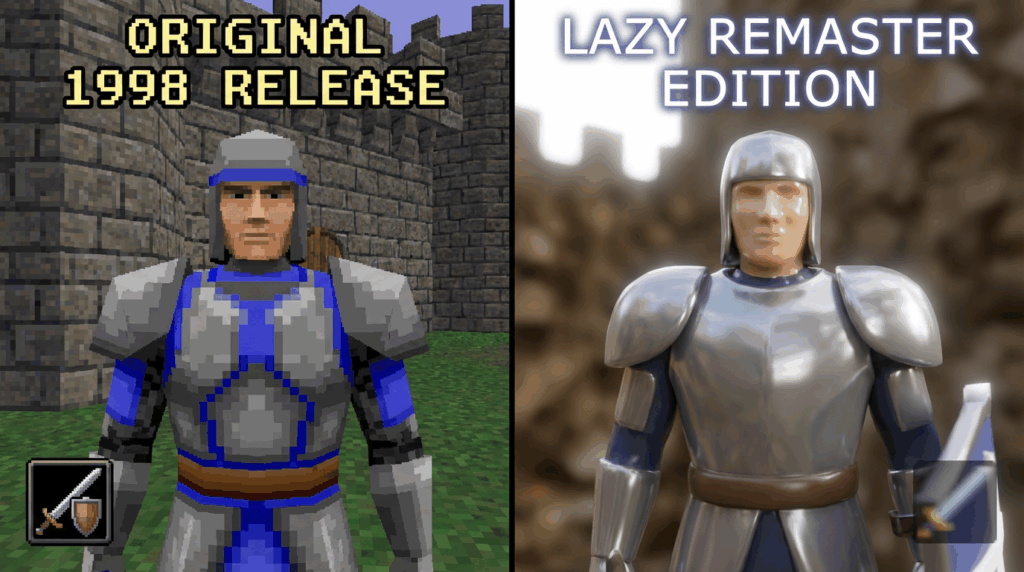
When you let a machine guess what details should look like, you inevitably end up with the infamous melted wax effect that plagues so many modern ports. The gritty concrete of a noir city or the weathered face of an RPG hero gets smoothed over until everything looks like it was left out in the sun too long. All the intentional artistic choices, like film grain or specific texture work, get scrubbed away in favor of a sterile and unnatural smoothness. It turns distinctive art styles into blurry, smeary messes that look worse than the jagged originals ever did. You aren’t playing a remaster at that point. You are playing a generic hallucination of what the game used to be.
This corner-cutting technique is a slap in the face to fans who just want to experience their childhood favorites without needing a CRT monitor. Publishers are charging full price for what amounts to a glorified Instagram filter applied to code that is old enough to vote. If the modding community can produce handcrafted texture packs for free in their spare time, multi-million dollar studios have zero excuse for this laziness. We deserve proper restorations that respect the source material, not these low-effort upscale jobs that strip away the soul of the game. Keep your wallet closed until they actually put in the work to earn it.
Grand Theft Auto and the Defective Edition Disaster

If you want to see the absolute nadir of the remaster trend, look no further than Grand Theft Auto: The Trilogy – The Definitive Edition. Rockstar took three of the most influential games in history and treated them with the same respect a dog treats a fire hydrant. Instead of a loving restoration, we got a sloppy mobile port upscaled by an AI that clearly had no idea what a human face looks like. It wasn’t just a disappointment. It was a direct insult to everyone who grew up memorizing the streets of Vice City. Calling this mess “Definitive” is the kind of corporate gaslighting that deserves its own wanted level.
The technical state of this launch was so bad it honestly felt like an elaborate prank. The rain effects were essentially a blinding white filter that made the game unplayable, while the improved draw distances just revealed how small the maps actually were. Then there were the character models. They transformed iconic gangsters into terrifying, smooth-skinned cartoons with fingers like twisted sausages. Even the background textures were a disaster, featuring misspelled store signs that were clearly run through an automated upscaler without a human ever checking the work. It takes a special kind of laziness to automate the soul out of a game.
This debacle perfectly encapsulates why gamers are suffering from such intense remake fatigue right now. Publishers seem to think they can slap a fresh coat of paint on a classic and charge full price, regardless of the actual quality. While patches have slowly scraped some of the muck off, the first impression remains a permanent stain on Rockstar’s previously pristine record. If you want to experience these titles, do yourself a huge favor and hunt down the original versions. You are better off playing with blocky hands than enduring a remaster that actively hates its source material.
Silent Hill and the Destruction of Atmosphere
Konami’s handling of the Silent Hill HD Collection stands as the absolute gold standard for how to insult your own legacy. In the original games, that oppressive fog wasn’t just a clever trick to hide the PlayStation 2’s inability to render distant objects. It was the very soul of the horror experience. By dialing back the mist to show off their high definition textures, the developers inadvertently revealed the literal edge of the world. You aren’t staring into a mysterious abyss anymore. You are looking directly at the unfinished void where the level designers stopped working. It turns a psychological nightmare into a cheap behind-the-scenes tour of a half-baked set.
This disaster happened largely because Konami famously lost the final source code for the original games and forced the remaster team to work with broken, unfinished beta versions. It proves that major publishers view game preservation with the same level of care that a toddler shows a ham sandwich. Instead of properly archiving their cultural milestones, they toss the code into a dumpster and then act surprised when the remaster runs like a PowerPoint presentation. We paid full price for a product that was technically inferior to the discs sitting on our dusty shelves. It is the ultimate proof that these companies will happily sell you a broken memory just to make a quick buck.
What a Worthwhile Remaster Actually Does
A good remaster is not required to reinvent gaming. It should make the old experience accessible and dependable: stable performance, compatible controls, readable menus, and options for modern displays. If the original relied on fog, grain, or a particular color palette, those choices should survive the trip to newer hardware. The aim is to improve the presentation without sanding down every rough edge that gave the game its character.
Burnout Paradise Remastered is a useful comparison. Released in 2018, it brought Criterion’s open-world racer to newer platforms with visual upgrades and included add-on content. It is not a ground-up remake, and it does not pretend to be one. That clarity matters. Before buying any rerelease, check what it actually changes, whether multiplayer or downloadable content is included, and how it performs on the platform you own. A glossy trailer is not a compatibility report, no matter how confidently it swerves around the question.
Vote With Your Wallet, Not Your Nostalgia
It is time we stop acting like desperate consumers grateful for whatever scraps the industry tosses our way. Every time you pre-order a lazy upscale that barely functions, you are personally funding the next disaster. Publishers will keep serving up lukewarm leftovers as long as we keep eating them with a smile. Save your cash for developers who actually care about preserving art rather than just exploiting your childhood memories. We have to close our wallets until they decide to open a quality assurance department.
There is a grim irony in realizing your scratched PS2 disc from 2004 runs better than the forty-dollar remaster on your PS5. Modern ports frequently butcher the artistic intent by slapping high-resolution textures on low-poly models that were never meant to be seen in 4K. The fog that hid the technical limitations was actually part of the atmosphere, not just a hardware crutch. Removing the grain and grit makes everything look like plastic toys in a sterile medical facility. Sometimes the best way to experience a classic is on a CRT TV, not through a chemically sanitized filter that strips away the game’s soul.
A Quick Check Before You Buy
Look past the word “Definitive” and ask what is actually in the package. Does the listing explain the visual and performance changes? Are the original sound effects, missions, and licensed tracks still there? Have launch problems been fixed, or is the latest patch note mostly a polite way of saying the game no longer crashes quite as often? On PC, compare the store page and patch history with details about the Steam version, rather than trusting a handful of carefully chosen screenshots.
Then wait for credible performance reports and reviews after release. There is no prize for pre-ordering a game that will still be available next week, and nostalgia does not make a broken frame rate charming. If a remaster removes features, changes the art without a good reason, or costs more than a clearly substantial remake, let it sit. One missed sale is not a tragedy. Another half-finished port getting rewarded is how we end up with the next one.