The best PSP games start with God of War: Chains of Olympus, which sits at the top of Metacritic’s all-time PSP list with a 91 Metascore. Grand Theft Auto: Chinatown Wars follows at 90, and Persona 3 Portable lands third at 89. Critics clearly spent a lot of time with that little handheld. Then you check GamesRadar’s ranking, which crowns Lumines at No. 1 and puts Metal Gear Solid: Peace Walker second. Both lists are useful. Neither is gospel.
Here’s why that matters if you’re new. Sony’s 2011 figures put PSP hardware at 70 million units and the UMD catalog at more than 3,200 titles, so the library is big enough to swallow your free time whole. Metacritic tells you what reviewers thought. GamesRadar tells you what an editor would actually want to play. Neither tells you which games still hold up, and neither tells you which ones are worth the money. So we’re going to sort the good from the merely famous and say plainly which games deserve your battery life.
Key Takeaways
- Metacritic and GamesRadar answer different questions, so God of War: Chains of Olympus tops the critics’ PSP list with a 91 Metascore while Lumines takes the editorial crown.
- Lumines is the cheapest way to test a PSP puzzle game, with an estimated $10.59 for a complete copy and a round that fits between two bus stops.
- Metal Gear Solid: Peace Walker is the game to clear a free weekend for, since its campaign runs about 30 hours and rewards patience before you judge it.
- Persona 3 Portable is a gamble at an estimated $123.50 complete, so players should try cheaper titles first and check recent completed sales before buying any physical PSP copy.
- Anyone with a PS Vita, PS3, or old PSP download history should check that library before spending a dime, because Sony ended PSP Store purchasing in 2021 but previously bought content can still be redownloaded.
Which PSP Games Do the Critics Rank Highest?
Metacritic’s all-time PSP list says critics value God of War: Chains of Olympus most, giving it a 91 Metascore. Grand Theft Auto: Chinatown Wars follows at 90, and Persona 3 Portable takes third at 89. Metacritic also ties Lumines and Metal Gear Solid: Peace Walker at 89, so the top of the list is less a podium than a crowded elevator.
The editorial ranking flips the order. It puts Lumines first and Metal Gear Solid: Peace Walker second, and it makes for a much more interesting argument over dinner. Lumines launched on March 22, 2005. It’s a puzzle game with 24 levels and four gameplay modes, and it’s the kind of game that eats your evening while you tell yourself it’s just one more round.
Peace Walker, which arrived June 8, 2010, is the opposite experience. The editorial list describes it as a 30-hour game, which is a serious commitment for a handheld. If you have a commute and a free weekend, that’s a perfect pairing. You’ll also lose a lot of Saturdays to base building, so plan accordingly.
Here’s the lesson hiding in those two lists. A Metascore measures critical consensus. It tells you how many reviewers liked a game enough to say so, which is handy for spotting games nobody seriously disliked. An editorial pick measures taste. Someone sat down, decided what they’d want to play again, and put their name next to it. Neither one is wrong. They’re answering different questions.
So the right starting point depends on what you want. If you’re a newcomer who wants the safest possible first purchase, start near the top of the Metacritic list, where God of War: Chains of Olympus is the most defensible choice on the board. If you want something you can pick up for ten minutes and still feel clever about, Lumines is the obvious pick. If you want a long adventure that will absorb a season of your life, Peace Walker is the one to clear your calendar for.
How Big Was the PSP Library, Anyway?
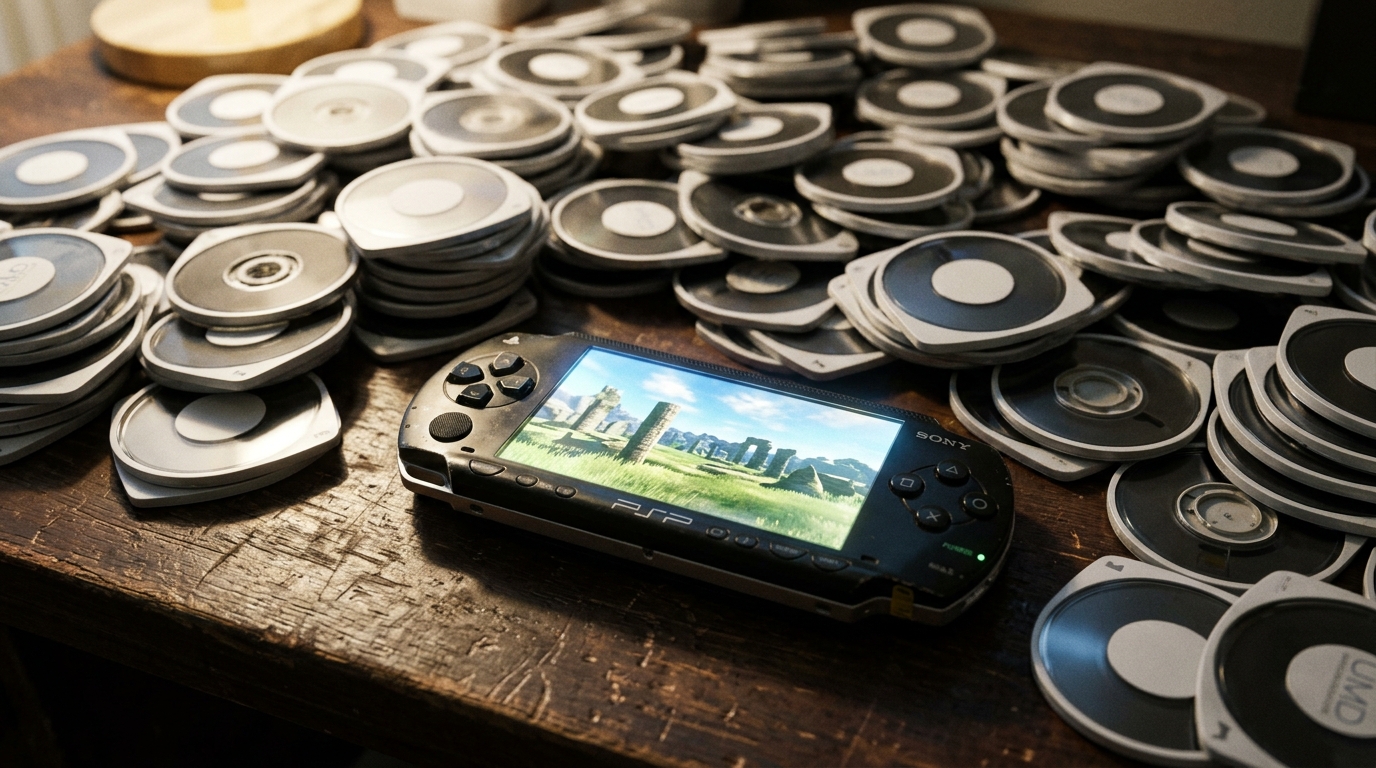
The PSP library was enormous, and Sony’s own numbers make that clear. By the end of March 2011, cumulative software sales had reached 298 million. This handheld wasn’t living off a handful of hits. Somebody bought a lot of games for it, and plenty of them were bad.
The machine didn’t launch everywhere at once. It arrived in Japan on December 12, 2004, reached North America in March 2005, hit Asian territories in May 2005, and finally landed in Europe and other PAL territories in September 2005. Each region got its own wave of releases, its own store shelves, and its own bargain bins. A game that was big in Tokyo could take months to show up in a European shop, so the catalog grew in pieces that nobody saw whole.
That’s the real problem with a library this size. Most of it is filler, and filler comes in the same nice case as the good stuff. You can’t just grab a random UMD and hope for the best. The odds are about as good as buying a used car from a guy who keeps saying “trust me.”
Trial and error is a terrible way to find your next favorite game. It costs money, time, and the occasional weekend you’ll never get back. A curated list does the boring sorting for you. It tosses the forgettable and points you at the games that still earn their place in your bag.
Scores help, but they only tell part of the story. A Metascore can tell you reviewers liked a game, and an editor’s pick can tell you someone enjoyed it enough to recommend it. Neither tells you whether a game still holds up when you’re the one holding the handheld on a bus. That takes actual play, and it’s the part we care about.
Our Picks for the Best PSP Games
Our ranking starts with the scores but doesn’t stop there. We put the games that respect your time at the top, and we ranked them by how well they hold up in a waiting room, not a dark bedroom with an hour to kill.
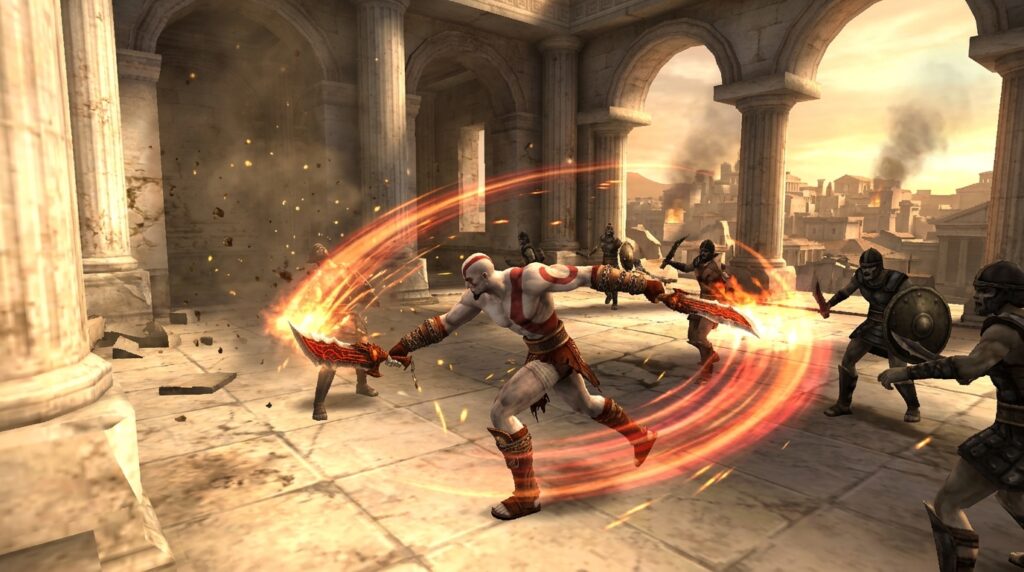
1. God of War: Chains of Olympus. It sits first on Metacritic’s all-time PSP list with a 91 Metascore, and for once the critics aren’t overselling it. The combat is tight, the combos are satisfying, and the enemies hit hard enough that you can’t button-mash your way through every room. Kratos is the angriest man in ancient Greece, and the game lets you take that anger out on a parade of mythological monsters in short bursts. It’s the best fit on this list for handheld sessions. You can clear a level between two train stops and still feel like you accomplished something.
2. Lumines: Puzzle Fusion. Lumines is the one we’d hand to a skeptic. It has 24 levels and four gameplay modes, and it makes you feel clever while you’re really just stacking colored blocks to a beat. Metacritic ties it with Metal Gear Solid: Peace Walker at 89, and the game earns that respect without needing a story to prop it up. It’s a perfect pocket game because you can start a round in the time it takes a kettle to boil. The danger is that “one more round” has no natural stopping point, so set a timer if you have anything else to do.
3. Metal Gear Solid: Peace Walker. Peace Walker has a Metascore of 89, and its campaign runs about 30 hours, which is a serious commitment for a machine that fits in a jacket pocket. It’s a stealth game at heart, with the series’ signature sneaking, hiding in cardboard boxes, and long conversations you’ll either love or skip. Playing it on the PSP also gives you a full Metal Gear experience without needing a console hooked up to your TV. Plan for long sessions, because the base-building side will happily eat your Saturdays.
4. Grand Theft Auto: Chinatown Wars. With a Metascore of 90, it’s the second-highest-rated game on the Metacritic list, and it’s a genuinely big open-world game that somehow works in short bursts. You can run a few missions, drive across a city that feels alive, and stop whenever you like. The top-down view and the map keep the scope manageable, which is more than you can say for open worlds that treat your patience as a resource to drain. It doesn’t demand hours of your undivided attention, and that’s exactly why it works here.
5. Persona 3 Portable. Persona 3 Portable earns its 89 Metascore by asking for something most games on this list don’t: time. It’s a long role-playing game with a school calendar, social links to build, and a dungeon-crawling structure that rewards patience and planning. If you like to settle in, meet characters, and let a story unfold over dozens of hours, this is one of the best ways to do it on the PSP. It’s also a slow burn, and the early hours can feel like homework before the hooks catch you.
Honest warnings matter as much as praise, so here’s who should skip each one:
– God of War: Chains of Olympus: Skip it if you want slow, contemplative games or hate combat that rewards rhythm over strategy. – Lumines: Puzzle Fusion: Skip it if you want a story, characters, or any reason to stop playing when the timer runs out. – Metal Gear Solid: Peace Walker: Skip it if you get bored with stealth, dislike long cutscenes, or only have short gaming windows. – Grand Theft Auto: Chinatown Wars: Skip it if you want a tight, linear experience and feel uneasy with open worlds that let you wander off course. – Persona 3 Portable: Skip it if you want fast, bite-sized play or can’t stand a game that makes you wait for its good stuff.
Which Genres Does the PSP Do Best?
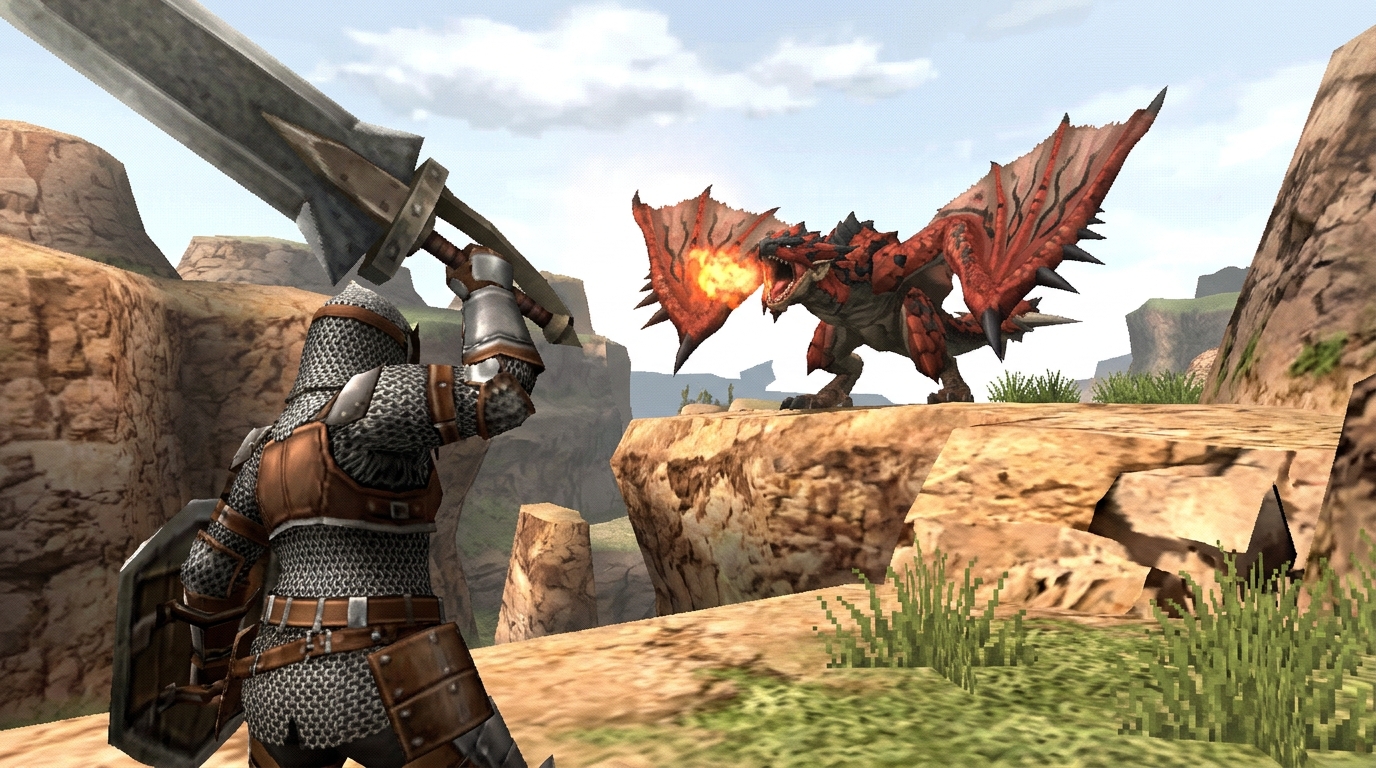
The PSP does racing, action-adventure, and long role-playing games best, and its Monster Hunter-style grind is where it really stands apart. Nobody bought this machine for one kind of game, and that variety is why almost every taste finds something worth playing.
Racing is a strong place to start. Ridge Racer is the arcade pick, built around speed and drifting, and it’s the kind of game you can jump into for one race while the kettle boils. Midnight Club: L.A. Remix trades closed circuits for city streets, and its nighttime traffic makes every corner feel like a bad decision waiting to happen. Gran Turismo PSP is the grown-up option. It rewards patience, tuning, and respect for your car collection, and it cares far more about your lap times than your wrecks.
Action and adventure have a strong showing too. God of War: Ghost of Sparta carries Kratos’s brutal combat onto a handheld screen without asking you to lower your standards. Grand Theft Auto: Liberty City Stories takes the open-city formula and shrinks it to a size that fits on a train. You can take a mission, ignore the rest of the map, and still feel like you’re doing crime properly.
Role-playing is where the library asks for more time. Crisis Core: Final Fantasy VII follows Zack Fair in a prequel that hits harder than most handheld spin-offs have any right to. Its battles are fast and its story is surprisingly sad, a combination you don’t expect from a game you can play in a waiting room. Monster Hunter Portable 3rd is a different beast entirely. You hunt giant monsters, carve up their remains, forge better gear, and then go hunting again with slightly sharper weapons. If you enjoy that loop, it will swallow your weekend. If you hate repeating the same fight until the drops cooperate, it will feel like a second job with worse pay.
That mix is the real strength of the PSP catalog. Every genre gets its own shelf, and the games on it don’t all want the same kind of attention. Handheld sessions suit some genres better than others, so match the game to the gap in your day:
– Racing: short races fit a commute, while full career modes need a quiet evening. – Action: level-sized chunks work well when you only have a few minutes. – Role-playing: games with frequent save points let you stop without losing everything. – Monster Hunter-style grinds: quests run long, so they suit free weekends better than rushed lunch breaks.
Play a racer in a spare ten minutes and it feels complete. Try to start a Monster Hunter quest in the same window and you’ll spend the whole time staring at the clock.
How Much Do Top PSP Games Cost Now?
Most top PSP games are cheap to collect, with one big exception. Persona 3 Portable is the expensive outlier, while Lumines and God of War: Chains of Olympus cost far less. Here are the October 2026 estimates:
– Lumines: about $5.49 loose and $10.59 complete – God of War: Chains of Olympus: about $20.49 loose and $29.99 complete – Persona 3 Portable: about $90 loose and $123.50 complete, based on historical completed sales
“Loose” means the disc alone, the UMD with no case and no manual. “Complete” means the game with its original case and manual, which is how most collectors want it. The gap between the two numbers is the cost of the packaging, and for some games that gap is small. For Lumines, the case and paper are worth about five dollars. For Persona 3 Portable, they’re worth more than thirty.
So why does the spread vary so much? Three things drive it: condition, rarity, and demand. Condition is the obvious one. A disc with scratches is worth less than one that spins clean, and a cracked case or missing manual drags the complete price down fast. Rarity is trickier. Some titles sold in huge numbers and turned up in every bargain bin, so plenty of copies are floating around. Others had smaller runs or were released in regions where fewer people bought them, so fewer copies survived in good shape. Demand ties it together. Persona fans are a devoted crowd who will pay for a complete copy on the shelf, and that loyalty pushes the price up no matter how many copies exist.
Treat every number here as a snapshot. Prices are estimates, and they move as collectors buy, sell, and lose interest. A title can climb after a re-release announcement or drop when a new edition shows up on a digital store. If you’re planning a purchase, check recent completed sales before you commit, because an estimate is only a starting point.
Can You Still Buy PSP Games Today?
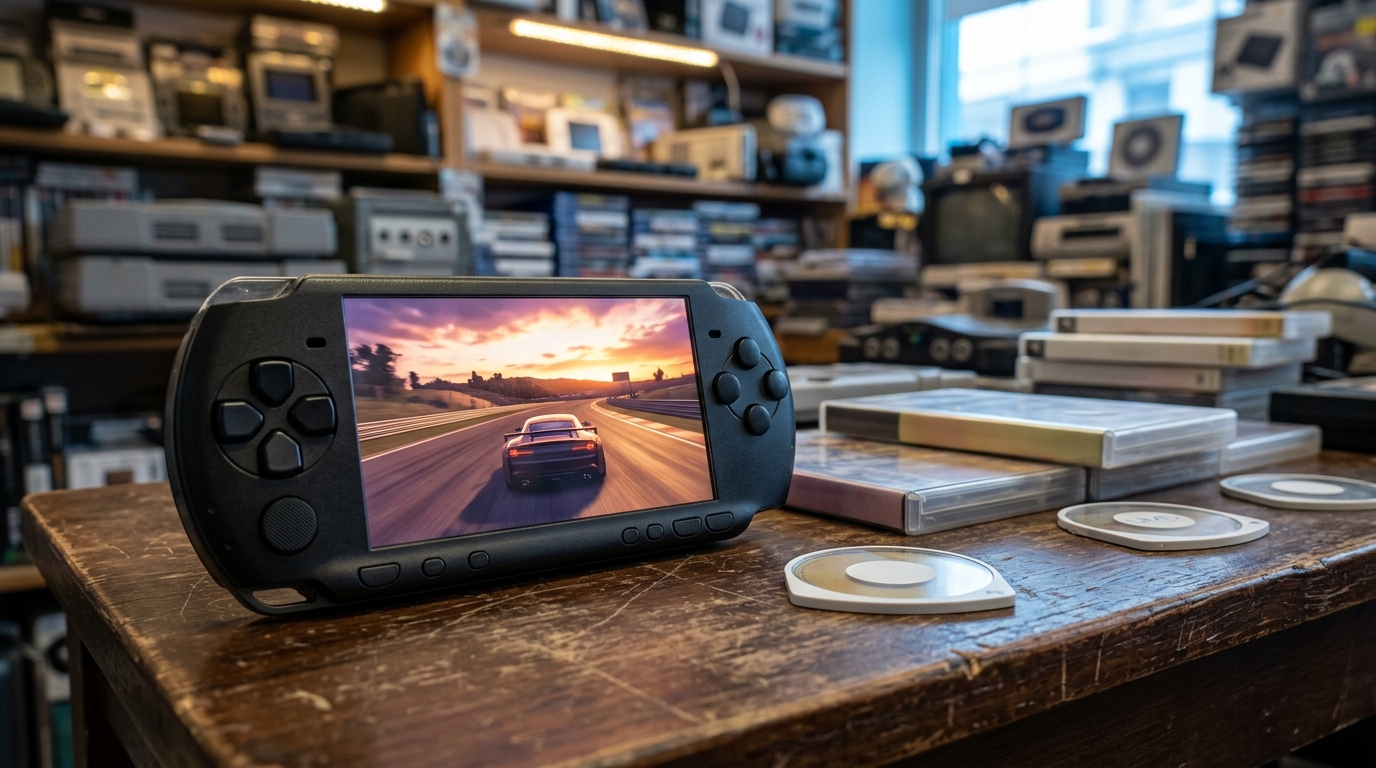
Not through the handheld itself. Sony shut down PSP purchasing in 2021, but a few routes still work, and they’re narrower than the old store ever was.
Sony announced that PSP commerce functionality would retire on July 2, 2021, and that PSP Store searches and in-game purchases would end on July 6, 2021. The news came through the PlayStation Blog in April 2021, and it was about as dramatic as a shop closing its till but leaving the lights on.
Your old purchases haven’t vanished. PlayStation Support confirms that you can still download PSP content you previously bought, so a game sitting in your account history is still yours to redownload. Check that history first, because a game you already paid for is the cheapest one you’ll ever play.
The second route is smaller. PSP titles that stayed on the PlayStation 3 and PlayStation Vita stores can still be bought and played. Availability is handled title by title, so the game you want might be listed on one store and missing from the other. Don’t assume a game is gone just because the PSP Store went quiet.
The practical result is simple, and a bit annoying: new buying routes are narrow, so check your existing library first. Start with a short list:
– Your download history for PSP content you already bought – The PS3 and PS Vita stores for titles that are still listed – Any UMD discs already sitting in your collection
Anything beyond those places takes more work and more patience. For most people, a shorter shopping list beats a long hunt, and the library you already own is probably bigger than you remember.
Ways to Play PSP Games Right Now
You don’t need a museum-grade setup to play these games, but you do need to pick a route, and each one has its own annoyance. Here’s how we’d work through the options, from least fuss to most.
- If you already own a PS Vita, start there. The handheld can run PSP software, and Sony’s PS Vita user guide explains that PSP titles can be downloaded straight from the PlayStation Store onto the device.
- If you don’t have a Vita but own a PS3, download the PSP game to the PS3 first. From there, copy it over to a PS Vita. It’s an extra step, but it works for titles still available on those stores.
- If you want to play on a PC or phone, install PPSSPP, an emulator that runs PSP games supplied as ISO or CSO files. Its official FAQ confirms the project doesn’t distribute those game files, so you’ll need to supply your own copies from discs you already own.
- If you’d rather play on a TV, buy the PS4 or PS5 version of Jeanne d’Arc from the PlayStation Store. The US store listing shows a July 16, 2024 release date and a $9.99 price, with up-rendering, rewind, quick save, and custom video filters included.
Jeanne d’Arc is a re-release, not the original PSP version, so don’t expect the handheld build with its original hardware limits. The upgraded features are a real improvement, but they change how the game feels, and that’s worth knowing before you compare it to your old memories.
Before you hand any of these games to a younger player, check the ESRB rating. The Entertainment Software Rating Board’s ratings guide defines Mature 17+ as content that may include intense violence, blood and gore, sexual content, or strong language. It’s a recommendation about suitability, not a legal age requirement, so the call is still yours. God of War: Chains of Olympus, for example, is all about violence, and nobody needs a rating board to tell them that.
Where to Start Your PSP Backlog
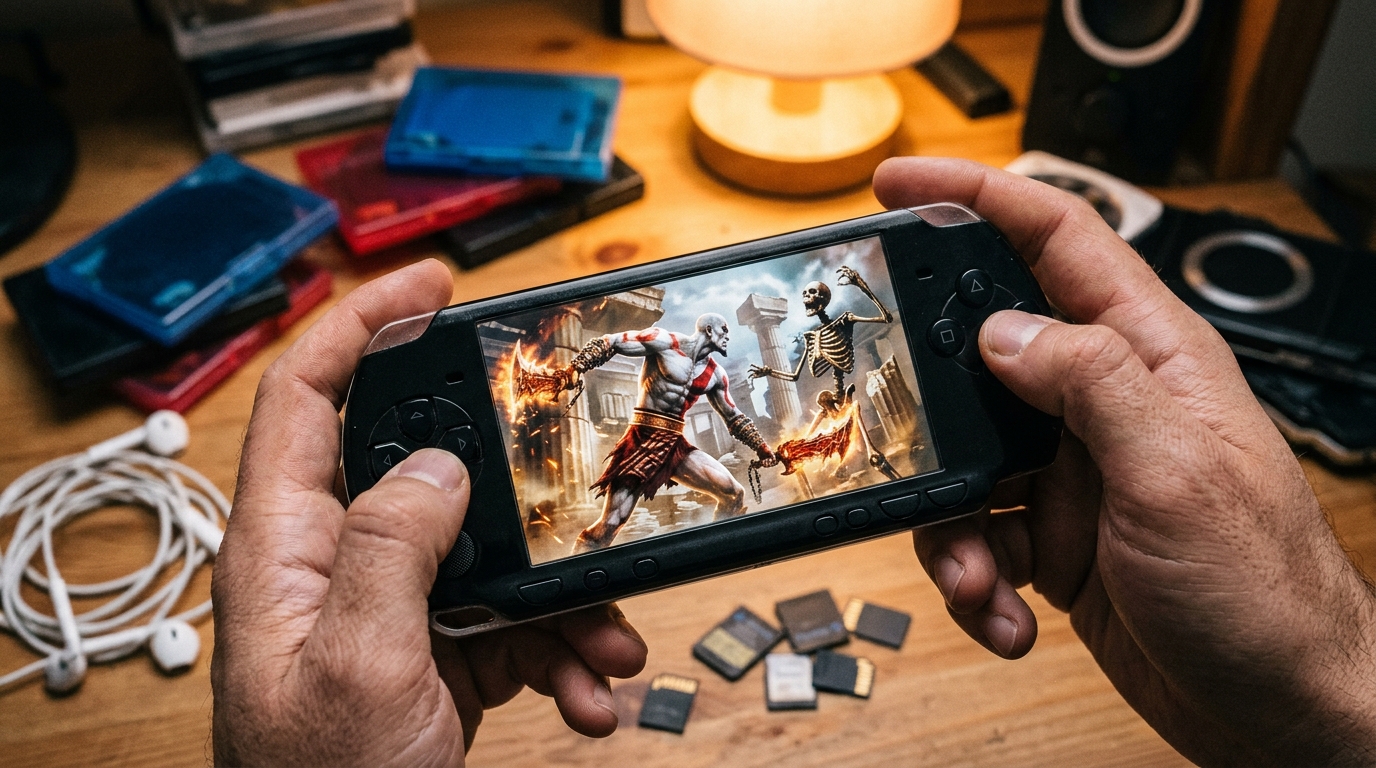
If your free time comes in slices, start with Lumines. A round fits between two bus stops, and it’s estimated at about $10.59 complete, so a bad guess won’t hurt much. If you have a free weekend and a stubborn streak, start with Metal Gear Solid: Peace Walker. Its roughly 30-hour campaign will keep you busy for weeks.
Before you buy any physical copy, check the price guide. Compare the loose and complete estimates, then look at recent completed sales before you commit. A missing case costs you a few dollars on Lumines, but on Persona 3 Portable that gap can be the difference between a bargain and a regret.
Then check the PS3 and PS Vita stores for PSP titles that are still listed, and scroll through your own download history. Many players already own a game they’ve forgotten about, and that copy costs nothing.
Most backlogs are a monument to optimism. Yours doesn’t have to be one. Play the games you already own, buy the one you actually want, and resist the urge to collect the rest of the 3,200-title catalog just because it’s there.
Picking Your First PSP Game
Start with the gap in your week, not the list. If you have a Vita or a PS3 and a spare ten minutes a day, buy Lumines first. At an estimated $10.59 complete, it’s the cheapest way to find out whether a handheld puzzle game can hook you.
If you have a free weekend and a long attention span, go straight to Metal Gear Solid: Peace Walker. Give it a few sessions before you decide. The campaign runs about 30 hours, so judge it by the first few missions, not the first ten minutes.
Don’t buy Persona 3 Portable on a whim. Its estimated $123.50 complete price is more than most people want to gamble on a game they haven’t tried. Play something cheaper first, then decide whether you want to spend that money on a slow-burning role-playing game.
Finally, pick one game and finish it before you start a second. Backlogs grow when every purchase starts a new project. One finished game will tell you more about your taste than any ranking, including ours.