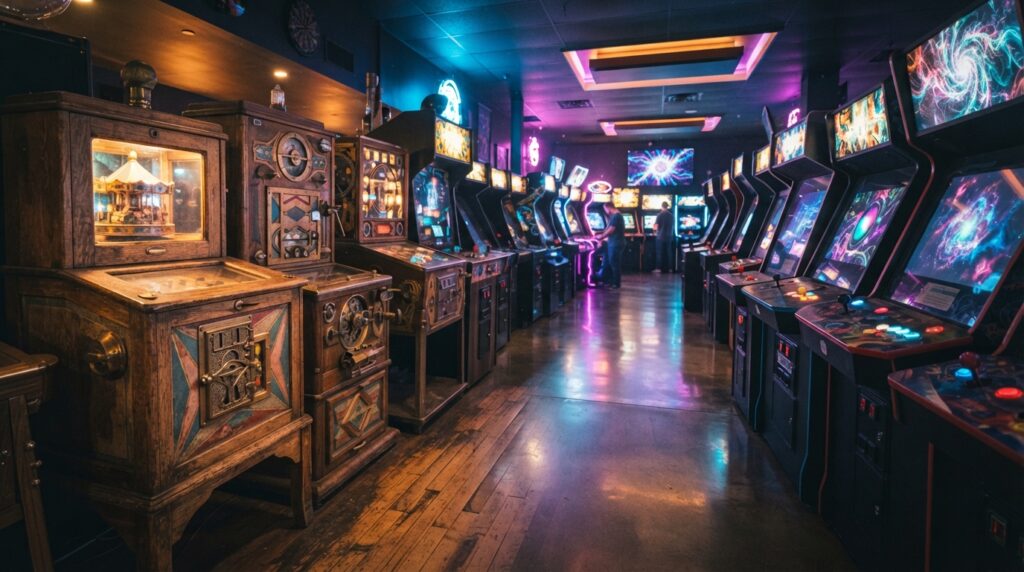
Arcade game history is the story of how a pocketful of coins became a global obsession. I’ve followed the trail from clunky mechanical attractions and pinball machines to pixelated cabinets, roaring racing rigs, and games that demanded both reflexes and rent money. These machines were simple to learn, brutal to master, and perfectly designed to make “one more game” sound financially reasonable.
The real magic was never just the graphics. It was the spectacle, the competition, and the strange joy of gathering around a machine while someone absolutely wrecked the high-score table. Arcades pushed controls, sound, multiplayer, and 3D technology in directions home hardware often couldn’t match. They also proved that gaming’s oldest business model is still remarkably effective: make the player lose quickly, then let them blame their friends.
Key Takeaways
- Arcade gaming evolved from mechanical amusements and pinball into electronic coin-operated experiences built around simple rules, short sessions, escalating difficulty, and repeat play.
- The late 1970s and early 1980s established arcades as a global cultural force through landmark games such as Space Invaders, Pac-Man, Donkey Kong, and Galaga, with high-score tables turning play into public competition.
- Specialized cabinets and physical controls—including steering wheels, light guns, trackballs, dance pads, and linked machines—made arcade gaming a social, spectator-driven experience that home systems struggled to replicate.
- Although home consoles and computers caused traditional arcades to decline, the format survived by emphasizing experiences rather than convenience through fighting games, rhythm titles, racing simulators, redemption centers, esports venues, and location-based VR.
Introduction To Arcade Game History
Arcade game history begins long before glowing screens, with mechanical amusements, penny machines, and pinball tables built to separate spare change from its owner. These early attractions established the essential deal: pay a coin, learn the rules quickly, and try not to look devastated when the machine wins. By the 1970s, electronic cabinets turned that simple transaction into interactive games. Early releases such as Computer Space and Pong proved that a screen, a few controls, and ruthless scoring could keep people queued around the block.
The late 1970s and early 1980s became arcade gaming’s loud, colorful golden age. Games such as Space Invaders, Pac-Man, Donkey Kong, and Galaga transformed cabinets into cultural landmarks, while high-score tables turned ordinary players into local celebrities, or at least the person everyone blamed for hogging the machine. Designers also realized that cabinets did not need to be identical boxes. They introduced steering wheels, light guns, trackballs, joysticks, and increasingly elaborate controls. The best machines were easy to understand in seconds but difficult to master before your wallet entered a medically concerning state.
What made arcades especially important was the way their business model shaped game design. Short sessions, escalating difficulty, limited lives, and score chasing encouraged replay, competition, and the eternal promise that the next quarter would be different. Those mechanics became the foundation for modern games, even after home consoles and computers began stealing players away from the arcade floor. The classic arcade did not disappear so much as mutate, surviving through rhythm games, racing cabinets, redemption machines, and other attractions designed to make standing still feel like a missed opportunity.
Mechanical Amusements To Pinball
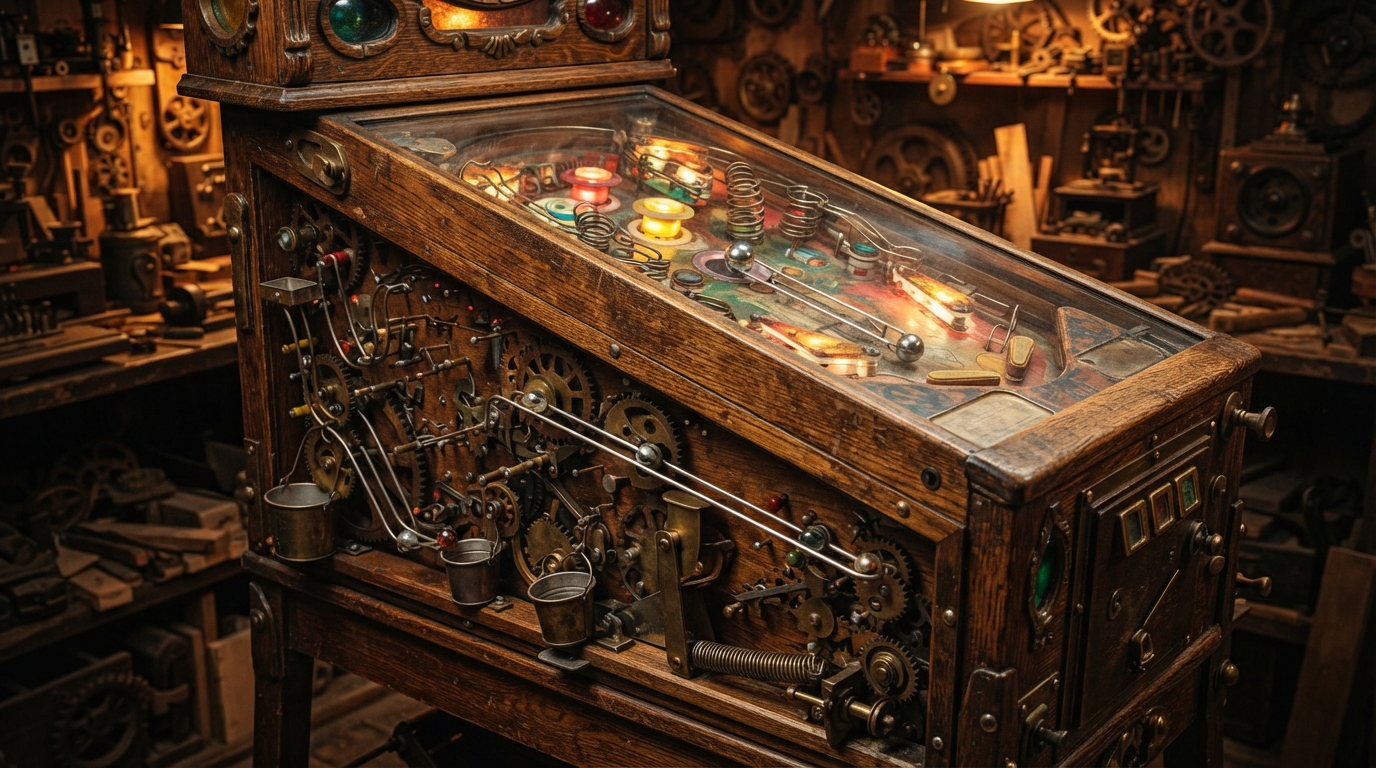
When I trace arcade game history back to its roots, I find less neon and more penny-powered mechanical weirdness. Penny arcades filled public spaces with fortune-telling machines, peep shows, novelty tests, and games that promised a tiny miracle for the price of a coin. A machine might reveal your romantic future, measure your grip, or loudly announce that your strength was “adequate,” which is a polite way of saying “please try again.” These amusements established the basic arcade bargain: pay a little, do something immediately, and get a result before your attention wanders.
Early mechanical games turned that bargain into something players could actively control. Bagatelle-style tables evolved into coin-operated pinball machines, using springs, bumpers, bells, and scoring systems to transform a simple ball into a miniature stress event. The addition of flippers in the late 1940s made pinball more skillful and less like watching gravity conduct a rigged experiment. I love this period because the machines did not need elaborate instructions or cinematic cutscenes. They just flashed, clattered, and dared you to beat your last score.
Pinball also helped create the operating model that later arcades perfected: compact cabinets, repeatable play, short sessions, and instant feedback. Every light, sound, bonus, and near miss encouraged players to spend another coin, because apparently losing in public becomes acceptable when a machine plays a triumphant jingle. That loop made coin-operated entertainment attractive to venue owners and taught designers that a game could be simple to learn while remaining difficult to master. Before electronic cabinets took over, these mechanical amusements had already built the blueprint for arcade play.
Coin Op Video Game Revolution
Arcade game history took a sharp turn when electronic games escaped university labs and started demanding quarters. Spacewar! provided the blueprint, proving that players would happily wrestle with complicated controls if the reward was blowing up a tiny spaceship. In 1971, Computer Space brought that idea into a commercial cabinet, though its controls were less “pick up and play” and more “please read this manual before panicking.” It was an important first step, but the real coin-op revolution needed something simpler.
Pong solved that problem with two paddles, one ball, and absolutely no excuse for not understanding the objective. Its minimalist design made every match instantly readable, while the rising speed turned a basic tennis simulation into a test of reflexes and wounded pride. I could learn the rules in seconds, lose in minutes, and immediately blame the cabinet, the angle of the ball, or my allegedly defective eyesight. That quick loop showed arcade designers the winning formula: simple controls, short sessions, and just enough difficulty to make another coin feel like a reasonable financial decision.
Space Invaders then turned high-score chasing into a full-blown arcade religion. Its descending aliens grew faster as players cleared each wave, creating pressure that made even a single button feel like a tactical weapon. Players were not merely trying to finish a game. They were trying to leave initials on the leaderboard and establish local dominance over whoever had the most free time and loose change. That combination of escalating difficulty, memorable cabinet design, and public competition transformed arcades into cultural landmarks, proving that the best coin-op games did not need sprawling stories when surviving one more minute was dramatic enough.
Cabinets Controls And High Scores
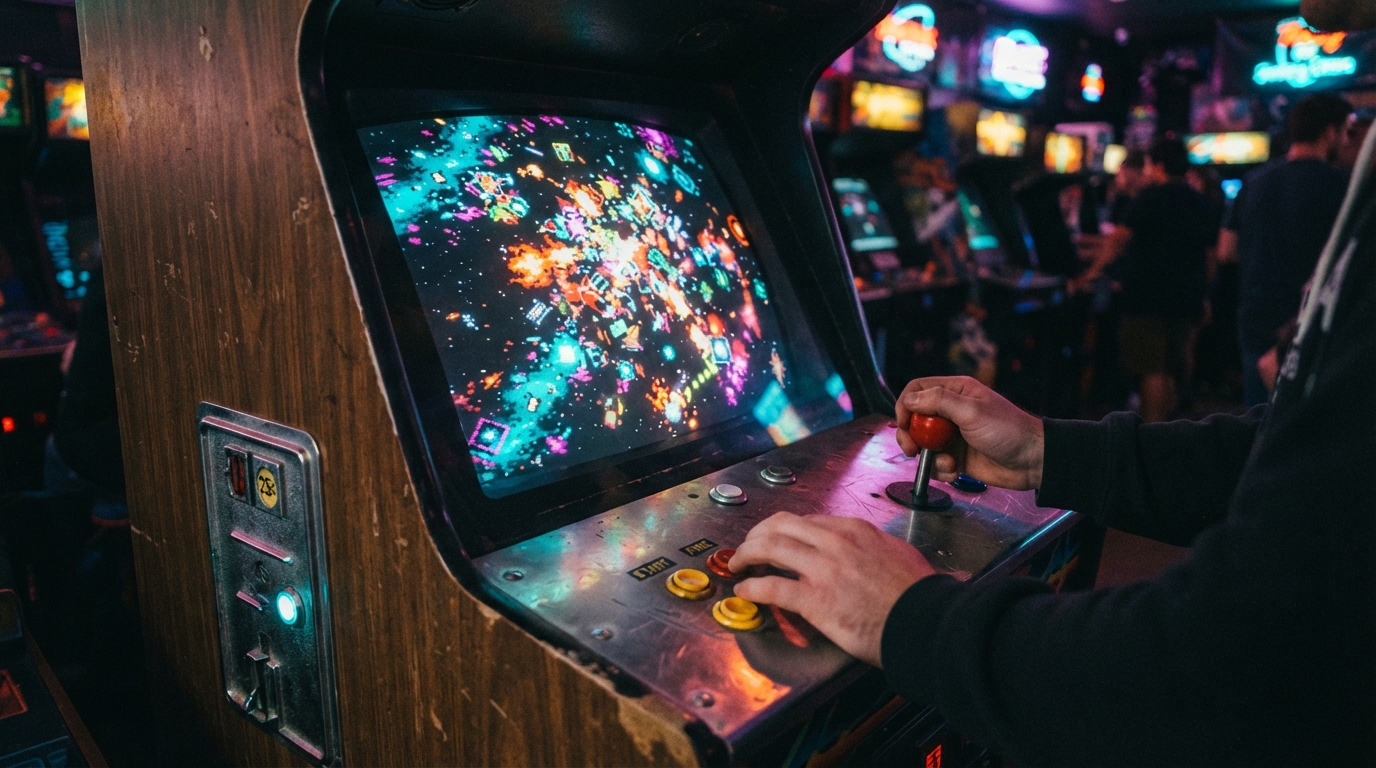
Arcade cabinets turned playing a game into a physical event, not just a thumb workout on the couch. Pac-Man’s upright cabinet, bright maze, and simple joystick made the machine instantly approachable, while Donkey Kong used chunky controls and a towering screen to make every jump feel like a public examination. Specialized hardware pushed the idea further, with steering wheels for racers, light guns for shooters, trackballs for frantic movement, and joysticks that demanded more commitment than gently nudging a plastic stick. Home systems could imitate the graphics, but they often could not recreate the satisfying clunk of a real control panel or the subtle fear of strangers watching you waste your last coin.
The cabinet also changed multiplayer from a feature into a spectator sport. Street Fighter II made dedicated controls, precise buttons, and local competition central to the experience, turning a pair of players into a tiny gladiatorial event with an audience waiting to judge every questionable fireball. Linked machines let racers and fighters compete side by side, while later rhythm games such as Dance Dance Revolution made the player’s entire body part of the controller. I could sit at home and play a port, sure, but nobody applauded when I successfully stepped on a glowing arrow in my living room.
High scores gave arcade games their most durable hook because the real objective was often beating the person whose initials were already hogging the leaderboard. Short sessions, escalating difficulty, and limited lives created a brutally efficient loop: learn the pattern, improve your score, lose spectacularly, insert another coin. The scoreboard turned ordinary locations into miniature rivalries, where a familiar name could inspire admiration, irritation, or both before lunch. That competitive pressure helped define arcade game history. The cabinet was not merely where the game lived. It was part controller, part stage, and part very expensive ego meter.
Arcade Decline And Reinvention
Arcade game history hit its first major wall in the early 1980s, when too many lookalike cabinets crowded venues and players got tired of feeding coins into machines that barely deserved the electricity. The crash exposed a business built on constant novelty, limited space, and an alarming number of games that felt like homework with a joystick. Home consoles and personal computers improved quickly, offering cheaper repeat play without fluorescent lights, sticky floors, or a stranger achieving an impossible high score beside you. Traditional arcades lost their dominance, but the machines did not vanish overnight. They simply had to prove they were more than expensive furniture with speakers.
The reinvention started by making arcade play harder to replicate at home. Redemption centers added prize tickets, while racing cabinets, light guns, dance pads, drums, motion platforms, and linked multiplayer systems turned gaming into a physical event instead of a couch activity. Fighting games built local communities around rivalries, rematches, and the ancient arcade tradition of blaming the controller after losing. Rhythm games made timing look glamorous, which is impressive considering most of us move like malfunctioning coat racks. These formats kept coin-operated design relevant by selling an experience, not just a screen and a set of buttons.
Today, arcade culture survives in family entertainment centers, esports venues, retro collections, and location-based VR attractions. The business model now often depends on food, prizes, memberships, and social spaces, because high scores alone do not pay the rent unless the champion is also ordering nachos. That shift has changed the arcade, but it has not erased its core ideas: instant action, specialized controls, short sessions, and competition anyone can understand within seconds. I see that as reinvention rather than surrender. The arcade stopped trying to beat home gaming at convenience and started winning where home gaming still struggles, by making play feel like an event.
Arcade Games Lasting Legacy
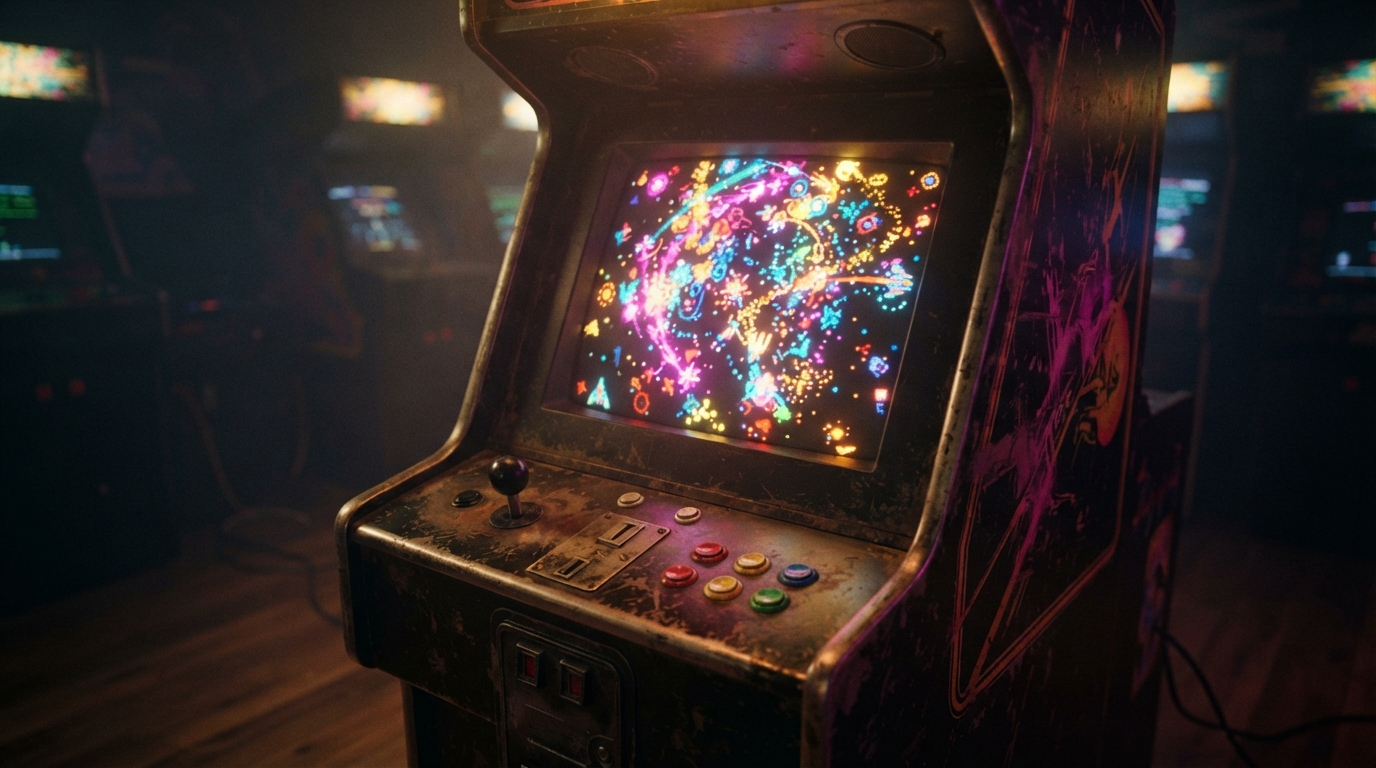
Arcade game history still matters because it taught designers to make the point immediately. A player had seconds to understand the goal, read the screen, and decide whether to spend another coin or pretend the machine was “rigged.” That pressure created remarkably clean design, from instantly recognizable enemies to score systems that turned simple actions into personal challenges. Modern games still borrow that clarity whenever they use readable visual language, tight feedback, and goals that make sense before the tutorial has finished overexplaining them.
The old cabinets also proved that controls could be part of the experience, not just a way to move a character around. Steering wheels, light guns, joysticks, dance pads, drums, and motion platforms made each game feel physically distinct, which is more memorable than waving a thumb at another nearly identical menu. I still think a great arcade control scheme can teach a modern game more than a thousand skill trees, especially when every button press has an obvious consequence. Tactile design forces developers to stop hiding weak ideas behind settings screens and glossy trailers.
Most importantly, arcades made competition public, immediate, and gloriously unforgiving. High-score tables turned ordinary players into local celebrities, while linked cabinets and crowded floors created social multiplayer before the internet made it possible to insult strangers from the comfort of a sofa. The cabinets may be less common now, but their fingerprints remain in leaderboards, short challenge runs, rhythm games, racing setups, and every system designed to make us say, “One more try.” That is the lasting legacy of arcade game history, and yes, I am still feeding coins into the machine like it owes me rent.
How Arcades Conquered the World
Arcade game history began with mechanical amusements and pinball before electronic cabinets turned coin-operated play into a global phenomenon. By the late 1970s and early 1980s, games such as Space Invaders, Pac-Man, and Donkey Kong had made short sessions, simple controls, and high scores impossible to ignore. The formula was brutally effective: learn the rules in seconds, lose your final life minutes later, then insert another coin because pride is apparently a valid business model. Local arcades became social spaces where players competed, shared strategies, and treated leaderboard bragging rights like international diplomacy.
What makes arcade history truly important is how much modern game design still borrows from it. Specialized cabinets introduced steering wheels, light guns, dance pads, drums, motion controls, and linked multiplayer, proving that games did not have to sit quietly under a television. As home consoles and PCs improved, traditional arcades declined, but the format survived through rhythm games, racing attractions, redemption machines, and immersive location-based experiences. I see arcade games as the industry’s great efficiency experts: they taught designers to make every second count, every failure sting, and every victory worth trying one more time.