
If you still buy physical game discs, congratulations: you’re an endangered species clinging to a plastic-bound past. The disc console extinction rate isn’t just accelerating; it’s a full-blown execution. Industry trackers report U.S. physical game spending plummeted an embarrassing 87% from its $11.6 billion peak in 2008 down to a pathetic $1.5 billion in 2025. Back in 2009, gamers devoured 292 million physical units, but by mid-2026, that figure collapsed to a pitiful 37 million. The disc drive is officially on life support, and publishers can’t wait to yank the power cord.
With over 90% of the global market’s $188.8 billion revenue now swallowed whole by digital downloads, subscriptions, and microtransactions, physical media is no longer the standard, it’s an inconvenient relic. Corporate suits despise discs because they can’t remotely delete them from your shelf or stop you from reselling a used copy to afford rent. We traded actual product ownership for pure convenience, and now we pay full price for glorified long-term rentals that vanish whenever a licensing deal expires. You can clutch your steelbooks all you want, but the industry has already carved the tombstone.
Key Takeaways
- U.S. physical video game software revenue cratered 87% from its 2008 peak, with digital downloads, subscriptions, and microtransactions now capturing over 90% of global market revenue.
- Platform holders like Xbox and PlayStation are accelerating the death of disc media by removing optical drives from core hardware revisions, leaving Nintendo as the lone holdout for physical cartridges.
- The shift to digital delivery strips away true product ownership, forcing consumers into temporary license agreements that leave purchases vulnerable to remote delisting and server shutdowns.
- Eliminating physical discs allows publishers to maximize profit margins and dictate storefront pricing while gutting traditional brick-and-mortar retail stores and second-hand markets.
The Hard Data Driving Disc Console Extinction
I have watched physical game media get dragged out to the woodshed over the past decade, but the actual body count is even uglier than I imagined. Back in 2008, physical video game sales in the United States peaked at a staggering 11.6 billion dollars, a glorious era when shelf space actually mattered and game cases came with thick, colored manuals. Flash forward to 2025, and industry tracking firms report that physical software spending collapsed to a pitiful 1.5 billion dollars. That is an absolute 87 percent cratering of an entire retail ecosystem in less than two decades. Publishers did not just pivot away from plastic discs; they threw them into an incinerator and asked us to clap for the eco-friendly digital future.
| Market Metric | Historical Peak (2008-2009) | Current Market (2025-2026) | Overall Shift |
|---|---|---|---|
| U.S. Physical Software Revenue | $11.6 Billion (2008) | $1.5 Billion (2025) | 87% Decrease |
| U.S. Physical Unit Volume | 292 Million Units (2009) | 37 Million Units (2026) | 87.3% Decrease |
| Digital Market Share (Global $188.8B) | Under 20% Share | Over 90% Share | Complete Dominance |
If you think the dollar figures are depressing, the sheer volume of physical units being shipped will make your optical drive weep pure grease. In 2009, gamers dragged home 292 million physical boxed games over a single twelve-month stretch, whereas mid-2026 figures show that number cratering down to just 37 million units. Out of the broader 188.8 billion dollar global gaming industry, digital downloads, microtransactions, and subscription passes now account for well over 90 percent of all total revenue. Physical media is no longer dying a slow, peaceful death in hospice care, it is being aggressively suffocated by platform holders who would rather rent you a temporary license than sell you a piece of plastic you actually own. The writing on the wall isn’t just painted in bold permanent marker anymore, it is glowing like a neon sign outside a closing retail store.
This massive decline isn’t a natural evolutionary shift where consumers magically woke up one morning and collectively decided they hated owning tangible items. Major platform holders are actively stripping physical disc drives out of base hardware revisions, effectively turning retail store shelves into barren displays of digital gift cards. When physical units represent less than ten percent of the entire market pie, keeping a global disc manufacturing pipeline alive becomes financially unjustifiable for corporate bean counters. We are rapidly approaching a bleak reality where physical discs are treated like a niche vinyl novelty, forcing the gaming public into a walled digital garden where titles can vanish the moment a server license expires. Enjoy your physical collection while you still can, because the industry has already scheduled its complete funeral.
Platform Breakdown of PlayStation Xbox and Nintendo Sales
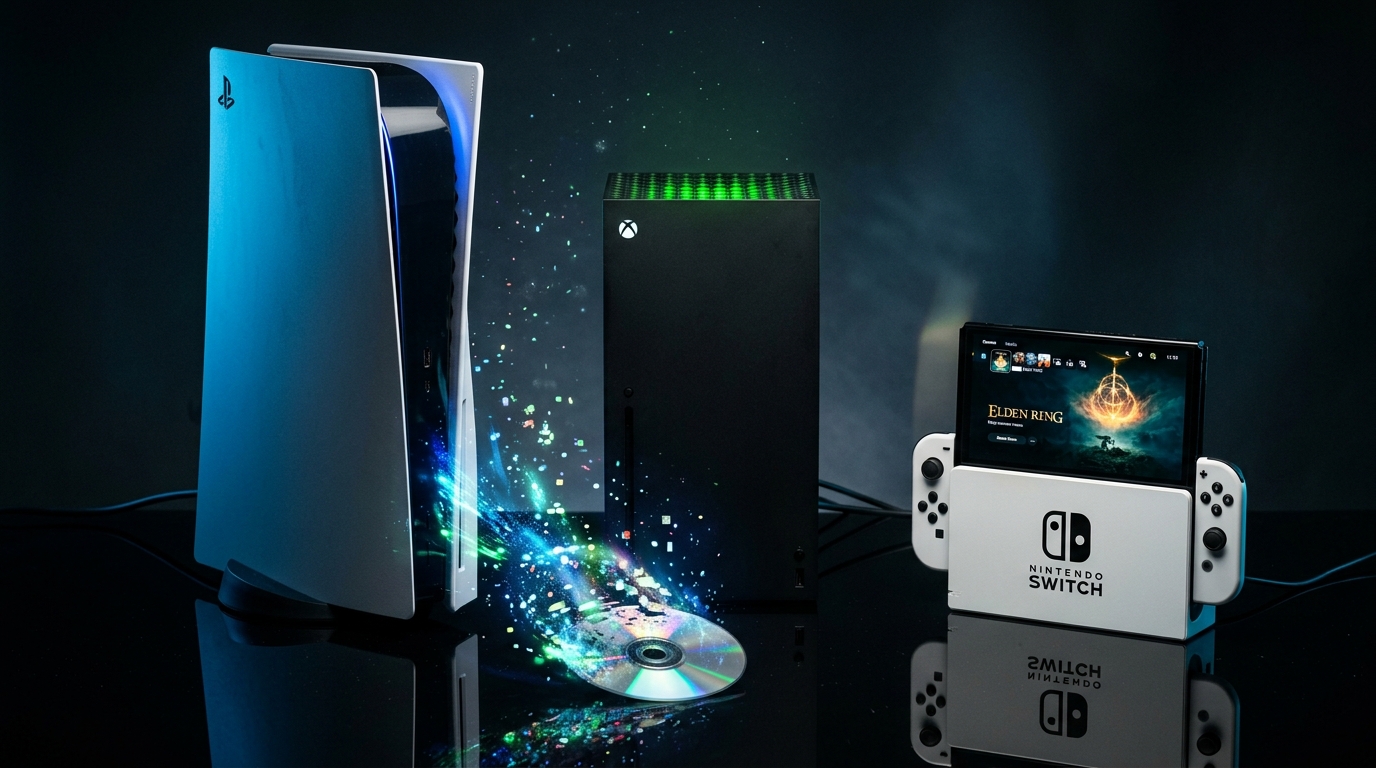
Look at the green team, who essentially treated the disc drive like a useless appendix and sliced it off their flagship hardware. With their software sales sitting at a massive 90% digital download dominance, they stopped pretending to care about physical shelf space long ago. The blue team took a slightly more calculated route by pushing drive-less default consoles while treating the optical drive like an expensive add-on tax for nostalgic collectors. Industry research reveals that U.S. spending on new physical video game software collapsed by 87% from its $11.6 billion peak in 2008 down to a meager $1.5 billion in 2025. That is not just a casual shift in consumer preference, but a deliberate, hardware-driven execution of physical distribution.
- Xbox Ecosystem: Near-total digital dominance with hardware configurations actively abandoning optical drives.
- PlayStation Ecosystem: Pushing drive-less default units and monetizing physical disc compatibility as a premium accessory.
- Nintendo Ecosystem: The lone physical holdout, propelled by cartridge-buying fans holding back the digital tide.
Nintendo remains the weird outlier in this digital wasteland, stubbornly clinging to physical cartridges like a hoarder guarding tiny plastic squares. Switch fans still demand physical media, giving them a resilient physical foothold while rival platforms actively murder their own disc ecosystems. Even Mario cannot single-handedly save retail stores from an unprecedented unit volume bloodbath. In 2009, North American consumers purchased 292 million physical video game units over twelve months, but mid-2026 data shows that number collapsing down to just 37 million units. You do not need a degree in economics to see that physical game sales are officially on life support.
The major platform holders love this digital migration because controlling the storefront means controlling the price, the platform, and the expiration date of your purchases. With digital spending, microtransactions, and subscriptions taking over 90% of the global gaming market’s $188.8 billion pie, physical distribution is practically a charity case. Game stores are shutting down at record rates because keeping plastic boxes on physical shelves no longer makes financial sense for publishers. I miss trading discs with friends, but the big platform owners have made their priority clear: total digital control over consumer ownership. Unless a miracle happens, the disc console is effectively facing complete extinction.
Retail Collapse and the Digital License Trap
I watched the physical game market bleed out in real time, but the latest numbers are a complete bloodbath. According to data from market analysts, U.S. spending on new physical video game software collapsed to a pathetic $1.5 billion in 2025, marking a brutal 87 percent drop from its $11.6 billion peak in 2008. If you think that is just a temporary dip, annual physical unit sales cratered from 292 million copies in 2009 down to a hollow 37 million by mid-2026. Brick-and-mortar game stores are not just struggling right now, they are practically operating as glorified plastic recycling centers. Digital downloads and microtransactions now swallow over 90 percent of all global gaming revenue, completely gutting retail shelves in the process.
- Physical Spend Collapse: U.S. spending plummeted 87 percent from $11.6 billion in 2008 to $1.5 billion in 2025.
- Unit Volume Crater: Annual physical sales crashed from 292 million units in 2009 to just 37 million by mid-2026.
- Digital Dominance: Digital sales, microtransactions, and subscriptions command over 90 percent of all global market revenue.
This massive shift toward digital delivery has walked us right into a cozy little trap where we hand over $70 for the privilege of renting temporary pixels. You do not actually own that shiny new digital release sitting on your dashboard, because you merely bought a temporary license to play it. Publishers can delist titles, pull authentication servers offline, or edit content whenever their legal department gets nervous, leaving you holding an empty digital bag. The moment a publisher decides a game is no longer worth server maintenance fees, your seventy-dollar purchase vanishes into the void without a refund in sight. We traded physical ownership for temporary convenience, and corporate executives are laughing all the way to the bank while holding the ultimate kill switch.
As major hardware makers phase out disc drives entirely in mid-2026, the extinction rate of physical consoles has officially hit the point of no return. Platform holders no longer want to deal with manufacturing plastic discs, shipping cardboard boxes, or sharing profits with physical retailers when they can control the entire ecosystem digitally. Surviving this cloud-tethered future requires us to accept a cold reality where true game preservation is basically dead on mainstream hardware. Once the last disc drive rolls off the assembly line, platform monopolies will dictate game prices, sale discounts, and accessibility without any real competition. Prepare yourself, because when the disc console goes extinct, your library exists solely at the mercy of a remote server and a terms-of-service agreement you never actually read.
Physical Discs Aren’t Dying, They’re Already Dead
The physical video game disc is not just dying on a hill, it has already rolled down the slope and crashed into the valley of irrelevance. Industry data confirms that U.S. spending on physical software cratered to just $1.5 billion in 2025, marking an astounding 87 percent drop from its $11.6 billion peak in 2008. If you want an even grimmer picture, look at unit volume, where sales plummeted from 292 million physical units in 2009 to a miserable 37 million by mid-2026. Digital storefronts, subscription passes, and microtransactions now gobble up more than 90 percent of all global gaming revenue. I know some of us still love holding a plastic case, but the cold, hard math does not care about our nostalgia.
Major platform holders are actively pulling the plug on disc manufacturing altogether as physical retail storefronts continue to shutter across the globe. Execs realized years ago that cutting out shipping costs, plastic production, and retail middlemen nets them much fatter profit margins on raw digital downloads. We are rapidly approaching a reality where buying a console with an optical drive will feel as absurd as buying a modern smartphone with a floppy disk slot. Sure, publishers will keep pushing digital convenience until you realize you are actually just renting a temporary license that can vanish during a corporate dispute. The writing is on the wall, and it is written in pure code.
Ultimately, the disc console extinction rate is no longer a doom and gloom prediction for the distant future because it is happening right in front of our faces today. As collectors watch their physical shelves transform into literal museum exhibits, gamers need to accept that convenience officially won the war over true game ownership. You can mourn the death of midnight release launch parties all you want, but the industry moved on the second digital downloads became fast enough to stream. Keep your old plastic coasters polished if you want, but do not be surprised when your next console turns out to be nothing more than a sleek digital receiver.