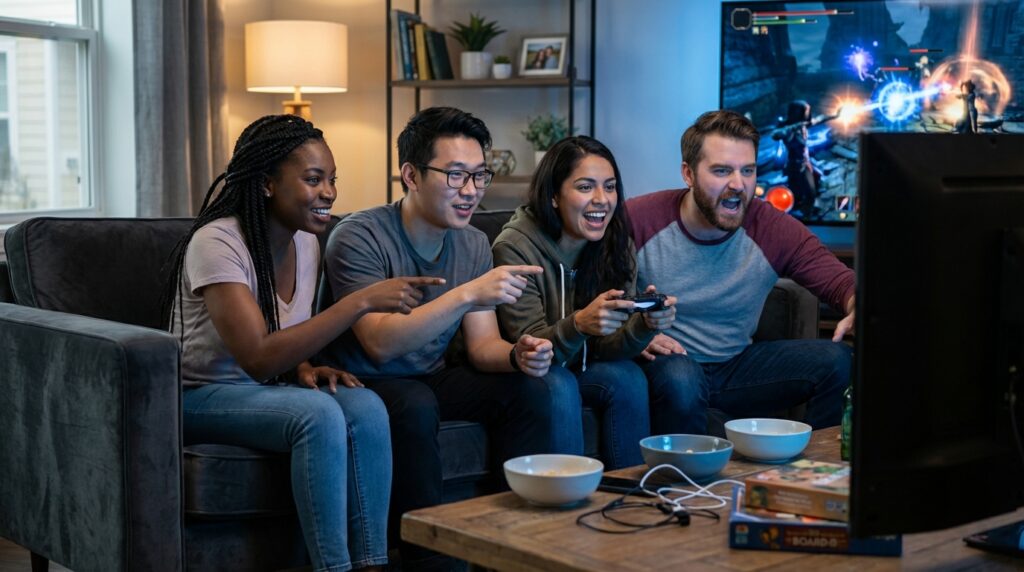
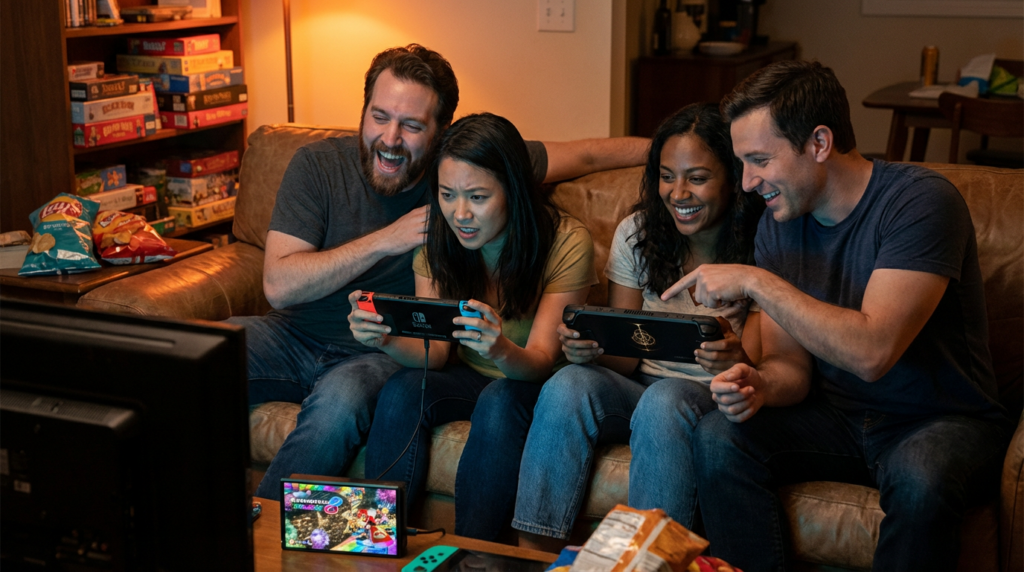
Remember the golden age of gaming when you actually had to be in the same room as your friends to ruin their day? Before we all became shut-ins tethered to a router, local wireless multiplayer was the secret sauce that turned a boring bus ride into a high-stakes tournament. There is something uniquely satisfying about looking a person in the eye while you hit them with a blue shell, all without worrying about a laggy internet connection or a server meltdown.
The industry is finally waking up to the fact that we do not always want to play with a random stranger from halfway across the globe. Recent tech leaps, like the sharing features on the newest hardware, are making it easier than ever to host a session without forcing everyone to buy their own copy of the game. It is a representation of a rare win for the players in an era of corporate greed, proving that sometimes the best way to connect is to just cut the cord and stay close.
Key Takeaways
- Local wireless multiplayer offers a superior, lag-free experience by bypassing corporate servers and unstable internet connections in favor of direct, ad-hoc device communication.
- Modern game-sharing features represent a consumer-friendly shift, allowing a single host to broadcast a session to friends who do not own individual copies of the game.
- The evolution from physical link cables to seamless wireless networking has transformed handhelds into portable arcades that prioritize social, in-person interaction over anonymous online lobbies.
- Physical proximity serves as the ultimate anti-cheat and psychological tool, restoring the authentic ‘couch co-op’ energy and accountability that digital environments lack.
From Game Boy Links To Modern Handheld Ad-Hoc
I still have vivid nightmares about the tangled, purple plastic umbilical cord we called the Link Cable. Back then, if you wanted to trade a monster or settle a playground grudge, you had to physically tether yourself to another human being like some sort of low-tech cyborg. It was an era of constant connection drops caused by a single sneeze and the inevitable frustration of realizing your friend forgot their cable at home. We suffered through those dark ages of physical limitations because the payoff of a shared screen on a handheld was pure magic. Thankfully, the industry finally realized that wires are the natural enemy of portable gaming.
The transition to ad-hoc wireless networking during the dual-screen era felt like alien technology compared to the mess of the nineties. We traded the physical shackles for the ability to beam entire game sessions through the air, even if it meant sitting within spitting distance of each other to keep the signal alive. Modern handhelds have perfected this by making local wireless multiplayer as seamless as breathing. You just fire up a lobby, and the devices shake hands without needing a router or an expensive data plan. It is the ultimate couch co-op experience for people who actually want to leave their house once in a while.
The future of this niche looks even brighter with the evolution of game-sharing features, which proves that local play is not just a relic of the past. Being able to host a session where your friends can jump in without everyone owning a separate copy of the game is the kind of consumer-friendly move that makes me actually like this industry for a change. It brings back that authentic pass the controller energy but scales it up for a group of people sitting in a park or a pub. We have moved from proprietary plastic plugs to a world where your hardware just talks to itself. It is a rare win for gamers who value playing together without being tethered to a corporate server or a tangled wire.
The Next-Gen GameShare Revolution
Remember the glorious days when you could actually play a game with your friends without everyone needing to buy their own copy? It felt like getting away with a heist, and for a while, it seemed like that kind of generosity died out in favor of corporate greed and one-license-per-human policies. Modern hardware is finally tapping into that sweet nostalgia by bringing back local wireless sharing features. It is a massive win for anyone who misses the ad-hoc magic of the early portable era but wants modern performance. You can finally stop worrying about whether your buddy has a fat enough wallet to join your session because the host console does all the heavy lifting.
This setup is excellent because it creates a private, short-range network that does not require you to hunt for a Wi-Fi password or rely on a spotty router. The host console simply broadcasts the session, and nearby players can jump in using their own hardware. It is the kind of common-sense innovation that actually respects the player’s time and social life. You get the stability of a dedicated connection without the lag of a crowded public network. It is direct, it is blunt, and it is exactly how local multiplayer should have functioned for the last decade instead of forcing us into endless digital lobbies.
We have spent years dealing with the industry’s obsession with always-online requirements, so seeing a return to local wireless play is a breath of fresh air. There is something uniquely satisfying about sitting in the same room and playing a high-fidelity game without a single ethernet cable or internet outage getting in the way. It turns a group of handhelds into a localized arcade that works anywhere from a basement to a back seat. Manufacturers are finally admitting that the best way to enjoy a game is with people you actually like, and they are making it affordable again. This feature is not just a gimmick; it is a necessary correction to a market that forgot how much fun a simple local connection can be.
Why Latency-Free Local Play Beats Laggy Online Servers
Back in the day, the gold standard for gaming was not a fiber-optic connection, but a tangled mess of cables and the physical proximity of your best friend’s couch. We have traded the glorious stability of local wireless for the digital lottery of global servers that frequently decide your inputs are merely suggestions. When you are sitting three feet away from your opponent, you are not at the mercy of a routing node in another country or a sudden spike in packet loss. Local play offers a raw, instantaneous response time that modern netcode can only dream of replicating. It is the difference between a crisp headshot and watching your character teleport into a wall because someone in the house decided to stream a movie in 4K.
Beyond the technical superiority of a lag-free connection, local wireless serves as the ultimate, unhackable anti-cheat system. You cannot hide behind an anonymous username or a third-party script when the person you are playing against is close enough to see your screen or give you a nudge. This physical presence adds a layer of accountability and psychological warfare that a headset simply cannot provide. Whether you are utilizing the latest handheld sharing features or dusting off a classic device, the stakes feel higher when the trash talk is delivered in person. It is a reminder that gaming was always meant to be a social experience, not a lonely battle against a spinning loading icon.
The resurgence of ad-hoc networking in modern handhelds proves that the industry is finally remembering why the early portable eras were so special. Features like local game sharing allow a group to jump into a session without every person needing to own a digital license, cutting through the corporate greed of modern multiplayer. You do not need a Wi-Fi password, a subscription service, or a stable router to have a perfect session in a park or on a plane. This technology bypasses all the modern nonsense that gets in the way of actually playing the game. If you want a consistent experience without the headache of server maintenance or laggy lobbies, local wireless remains the undisputed king.
The Low-Latency Joy of Couch Rage
It is time to stop pretending that a lagging Discord call is a substitute for sitting on the same couch and yelling at your friends in person. We have spent way too much time tethered to routers and chasing stable pings when the best connection has always been the direct one between two handhelds. There is a specific kind of magic in the local wireless experience that modern online gaming just cannot replicate, mostly because your friend cannot physically shove you when you land a lucky hit from three states away. Rediscovering this format feels like a return to form for anyone who grew up huddled over a handheld. It is the purest way to play, free from the nonsense of server maintenance and toxic lobby chats.
Modern tech is finally catching up to our nostalgia by making ad-hoc play easier than it has been in decades. Between the seamless direct connections of current handhelds and the clever sharing features on upcoming hardware, there is zero excuse to stay isolated behind a screen. You do not need a centralized Wi-Fi signal or a monthly subscription to host a session in a coffee shop or a park. These devices are literally designed to talk to each other, so it is about time you let them do their jobs. Turning off the internet and relying on local radio waves is not just a retro gimmick; it is the most reliable way to ensure your gaming session actually stays focused on the game.
The industry loves to push us toward always-online ecosystems, but you should be smart enough to see through that corporate noise. Grab your handheld, find a human being you actually like, and rediscover what it feels like to play games without a digital middleman. Whether you are trading monsters or competing in a top local multiplayer racer, the lack of input lag and the presence of real time trash talk makes everything better. We are living in a golden age of portable power, so do not waste it by sitting alone in a dark room. Kill the Wi-Fi, sync up those consoles, and remember why we started playing these things in the first place. If you are looking to expand your collection, check out our retro handheld guide to find the best devices for local play.
Frequently Asked Questions
1. What exactly is local wireless multiplayer?
It is the holy grail of gaming that lets you connect multiple devices directly without using the internet or a router. You get to play with friends in the same room without worrying about a server halfway across the world lagging your game into oblivion.
2. Do I need an internet connection to use local wireless?
No, and that is the entire point. Your devices create their own private network to talk to each other, meaning you can keep playing even if your ISP decides to take a nap or you are stuck on a plane.
3. How does GameShare actually work for players?
It is a rare moment of corporate generosity that lets you host a multiplayer session even if your friends do not own the game. You beam the necessary data to their consoles so you can enjoy a full match without everyone needing to open their wallets.
4. Is local wireless better than the old Link Cables?
Unless you enjoyed being physically tethered to another person like a low-tech hostage, wireless is infinitely superior. We have traded the tangled wires and connection drops for ad-hoc signals that actually let you breathe while you play.
5. What is the maximum range for a local wireless session?
You generally need to stay within the same room or at least within spitting distance to keep the signal stable. While it is better than a physical cable, wandering too far will still result in a disconnected session and a very frustrated group of friends.
6. Why should I care about local play when online gaming exists?
Online gaming is filled with toxic strangers and lag, while local play lets you look your friend in the eye when you ruin their day. There is no substitute for the immediate, lag-free satisfaction of physical proximity and shared screen magic. If you are playing on the go, make sure your battery life is optimized so the session doesn’t end prematurely.