
Asking gamers to shell out for a mid-generation refresh when most people just finally got their hands on the original feels like a cruel joke. The fatigue is real. Marketing buzzwords promise revolutions but usually amount to slightly shinier puddles. The PS5 Pro landed on November 7 with a price tag that made my wallet weep. It demands we decide if we really need those extra pixels. It stands there menacingly, daring us to justify its existence as the ultimate savior of unstable frame rates. It is either the holy grail of high-fidelity gaming or just a very expensive, aesthetically questionable doorstop.
Sony claims this beast packs a GPU with 67% more compute units. That supposedly translates to forty-five percent faster rendering for your eyeballs. They are selling us on the dream of finally ditching that agonizing choice between Fidelity and Performance modes that has plagued this generation. The headline feature is advanced ray tracing that runs twice as fast. This means your reflections will look immaculate while you get shot in the face. It sounds impressive on paper, but raw power means absolutely nothing if developers do not optimize their games to use it. We are looking for a genuine leap in performance rather than a marginal upgrade that requires a magnifying glass to appreciate.
The GPU Overhaul And Rendering Speeds
Look at the hardware specs without falling asleep. Sony claims the PS5 Pro packs a GPU with 67% more Compute Units. That sounds impressive until you realize most people do not know what a Compute Unit actually does. They also promised 45% faster rendering. That is basically corporate speak for ensuring the game will not run like a slideshow when things explode. This is not just marketing fluff for the tech nerds who count pixels in their sleep. It finally kills that annoying ritual of choosing between Fidelity and Performance modes in the settings menu.
We have all suffered through ray tracing on the base console that just made puddles shiny while tanking the frame rate to unplayable levels. With the Pro, that extra horsepower actually lets developers implement advanced lighting without forcing you to play in slow motion. You get to keep those fancy reflections and shadows while maintaining a steady 60 frames per second. It turns out that having a beefier GPU means the console does not struggle to breathe every time a character walks past a mirror. If you care about smooth gameplay more than saving a few bucks, this upgrade is the real deal.
Advanced Ray Tracing Performance Gains

Let us be brutally honest about how ray tracing has actually felt on consoles up until this point. You usually had to choose between looking at a pretty reflection in a puddle or playing a game that moved faster than a tectonic plate. Sony claims the PS5 Pro finally fixes this annoying compromise with a massive GPU upgrade that supposedly doubles ray tracing speeds. It sounds fantastic on paper. However, we have heard these promises before only to end up staring at a blurry 30FPS mess.
The hardware under the hood actually seems to back up the massive marketing hype this time around. With 67% more Compute Units than the base model, the console can chew through lighting calculations without choking. This means we are finally seeing games run at a smooth 60FPS while keeping all those fancy lighting effects turned on. You no longer have to squint at a grainy upscale just to see your character’s face reflected in a glass window. It is refreshing to play a game that looks next-gen without feeling like the console is about to melt through the shelf.
Of course, all this raw power means absolutely nothing if developers are too lazy to optimize their code properly. We are definitely seeing a leap in visual fidelity that makes the original PS5 look a bit dated by comparison. If you are obsessed with counting pixels or staring at shadows, this upgrade is basically mandatory for your sanity. Just remember that shiny puddles will not make a boring game suddenly fun to play.
PSSR AI Upscaling And Image Clarity
Sony finally decided to show up to the AI upscaling party about five years late with PlayStation Spectral Super Resolution. The name sounds like a weapon from a bad sci-fi anime, but the tech itself is actually promising. Instead of forcing the GPU to sweat over every single pixel, PSSR uses machine learning to fill in the gaps and clean up the image. It is essentially their proprietary version of DLSS designed to banish those jagged edges that make your expensive TV look cheap. Ideally, this means we can finally stop choosing between playing a beautiful slideshow or a blurry mess at 60 frames per second.
The big question remains whether this actually fixes visual clarity or just smears digital Vaseline over the screen. Unlike older upscaling tricks that often left artifacts shimmering in the background, PSSR is surprisingly sharp and distinct. It cleans up visual noise without making the game look like an oil painting gone wrong. You can actually read the text on distant signs in updated titles without squinting your eyes. It is not literal magic, but it beats the hell out of the basic checkerboard rendering we settled for on the base model.
The 2TB SSD And Memory Bandwidth Boost
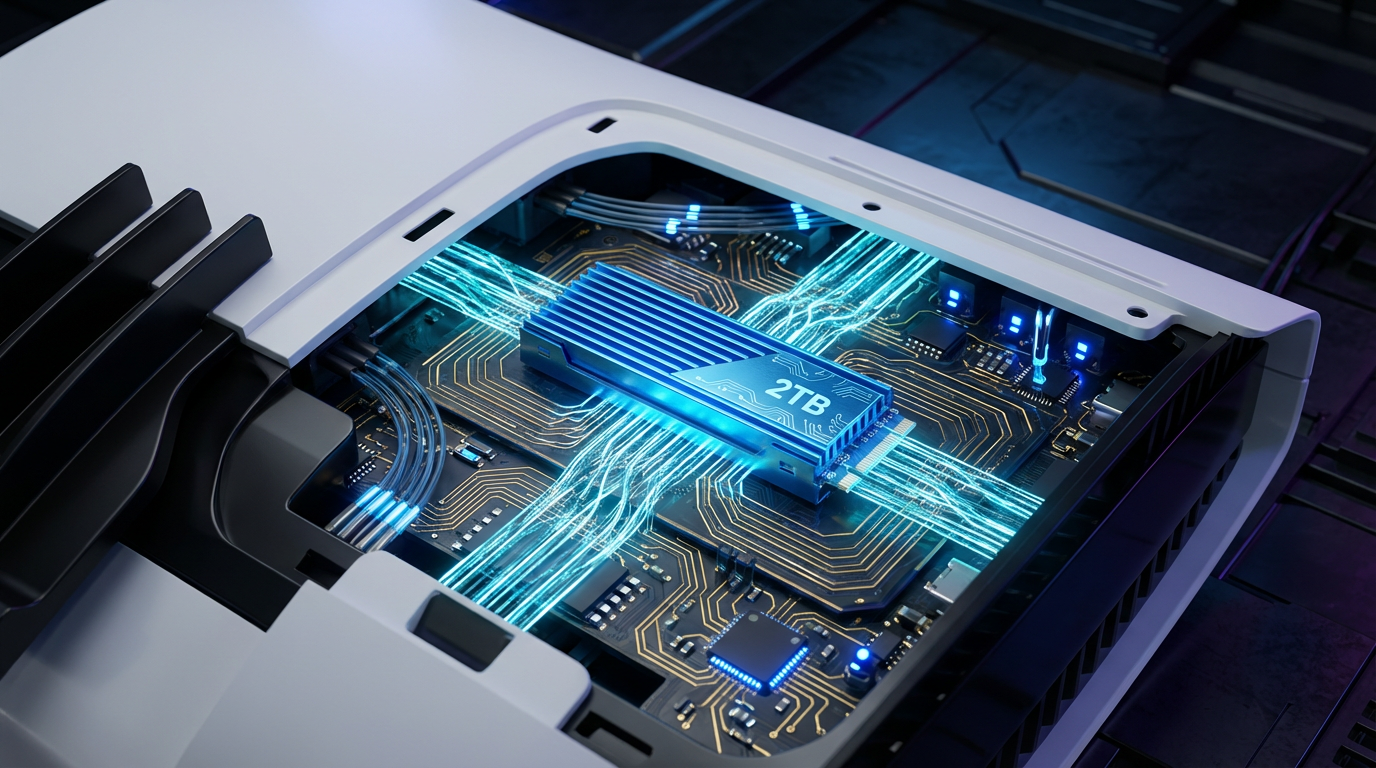
Sony finally realized that shipping a “next-gen” console with a drive the size of a thimble was a terrible idea. The PS5 Pro comes with a 2TB SSD out of the box. That is double the usable space of the launch model and frankly what we should have had years ago. You might actually be able to keep Call of Duty installed alongside a few single-player RPGs without constantly playing storage Tetris. It feels like a genuine luxury to download a new release without immediately being asked to sacrifice Spider-Man 2 to the digital gods. Given how bloated modern game patches are becoming, I give it about six months before we are all deleting things again.
Under the hood, the memory bandwidth has been bumped up by roughly 28 percent. That sounds impressive until you realize most people just want to know if the textures load faster. This extra speed basically helps the GPU chew through data more efficiently so those fancy 4K assets pop in before you walk past them. It creates a smoother experience where the console is not gasping for air while trying to render a crowded city street at high speeds. While it is not the sexiest upgrade on the spec sheet, it keeps the frame rates stable when the on-screen action gets chaotic. Just do not expect it to magically fix the loading times of unoptimized garbage code from lazy developers.
Game Boost And Backward Compatibility
Sony loves to brag about the PS5 Pro’s Game Boost feature stabilizing performance for over 8,500 backward-compatible titles. In reality, this mostly means that games with uncapped frame rates finally hit the targets they were supposed to reach four years ago. If you were hoping this magic box would suddenly turn a muddy PS4 texture into a 4K masterpiece, prepare for a harsh dose of reality. The internal hardware muscle definitely smooths out the stuttering in unoptimized messes, but it will not fix broken game design. It turns out that throwing raw horsepower at a poorly coded game just means you get to see the glitches in higher fidelity.
We are seeing a decent number of existing titles getting the “PS5 Pro Enhanced” sticker slapped on their digital box art. This usually translates to the GPU upgrade forcing dynamic resolutions to stick closer to 4K without turning your frame rate into a slideshow. For the unpatched backlog sitting in your library of shame, the improvements are often subtle enough that you might need a microscope to care. The SSD speeds remain largely the same. While you will not wait long to start playing, the console cannot save you from a boring gameplay loop. You are essentially paying a premium to realize that Bloodborne is still locked at 30 frames per second. That is a tragedy money apparently cannot fix.
Real Power: Finally Ditching The Muddy Graphics
The PS5 Pro is essentially Sony admitting that the launch console was just a warm-up act for the real performance. With a beefy GPU pushing 45% faster rendering, we can finally stop playing the miserable game of choosing between decent frame rates and graphics that do not look like mud. The advanced ray tracing is genuinely impressive provided you are the type of person who stops to admire realistic lighting while getting shot in the face. It is technically the most powerful console on the market, but that power comes with a price tag that makes my wallet weep. If you demand the absolute best performance without the headache of building a PC, this is unfortunately the only game in town.
Sony’s new AI-driven upscaling is the secret sauce that actually makes those fancy 4K promises a reality. It cleans up the image quality significantly. You no longer have to squint at jagged edges on your massive television. However, unless you are obsessed with counting pixels or demand unwavering 60FPS in every single title, the upgrade feels like a luxury rather than a necessity. The original PS5 still plays everything just fine even if it wheezes a bit during intense scenes. Buy this machine if you have money to burn, but do not pretend you actually need it to enjoy the latest releases.