Henry of Skalitz is back, and miraculously, he’s still managed to survive the 15th century despite my best efforts to get him killed by a stray peasant with a pitchfork. Kingdom Come: Deliverance 2 finally dropped on February 4, 2025, and it’s already moved two million copies to people who apparently enjoy being shouted at in Old Czech. The developers didn’t just give us a sequel; they gave us a world twice the size of the original, proving that medieval Bohemia was much larger than the three muddy fields we previously explored.
You’re here because you want to know if this massive expansion into the urban chaos of Kuttenberg is a masterpiece or just a prettier way to starve to death. While the rural beauty of the Trosky region is great for sightseeing, the real meat is in the expanded mechanics that actually respect your time. I’ve spent enough hours in this digital mud to tell you exactly where the game shines and where the armor still has a few rusty spots. This isn’t just a bigger map; it’s a test of whether you can handle the brutal reality of being a blacksmith’s son in a world that wants to execute you for breathing wrong.
Key Takeaways
- Kingdom Come: Deliverance 2 significantly evolves the original’s combat and save systems, offering more responsive swordplay and frequent autosaves while maintaining its signature hardcore realism.
- The sequel features a world twice the size of the original, transitioning from rural fields to the massive, dense urban environment of 15th-century Kuttenberg.
- A staggering two-million-word script delivers a deep narrative experience that balances high-stakes medieval politics with sharp, character-driven humor.
- The game successfully blends high-budget polish with uncompromising simulation mechanics, requiring players to manage survival needs like eating, sleeping, and hygiene to navigate society.
From Peasant To Powerhouse In Kuttenberg
Henry of Skalitz is no longer just a bumbling blacksmith’s boy trying to figure out which end of a sword to hold while getting bullied by rural bandits. Kingdom Come: Deliverance II shoves us into the massive, sprawling urban chaos of Kuttenberg, and the jump in scale is honestly staggering. While the first game felt like a muddy hike through the woods, this sequel feels like a legitimate medieval simulation with actual budgets and ambition. The developers finally realized that we wanted more than just repetitive forest paths, providing a dense city that actually reacts to your presence. The transition to a powerhouse setting hasn’t stripped away the grounded, gritty soul that made the original a cult classic.
The real question for most of us was whether the developers would actually fix the clunky, janky systems that made the first game feel like a chore. Thankfully, the combat feels significantly more responsive without losing that deliberate weight that sets this franchise apart from brainless hack and slash titles. You still have to pay attention to your stamina and positioning, but you will spend less time fighting the controls and more time fighting the actual Bohemian guards. They have polished the rough edges just enough to make the gameplay loop satisfying instead of irritating. It is rare to see a developer refine their vision this well without selling out to the casual crowd or stripping away the complexity.
Walking through Kuttenberg is a masterclass in environmental storytelling that makes most other bloated open worlds look like empty cardboard sets. You can practically smell the open sewers and the roaring meat as you navigate the crowded streets and towering cathedrals. The game still demands that you eat, sleep, and wash the blood off your tunic if you want people to treat you with any shred of respect. It is unapologetically hardcore, refusing to hold your hand while you navigate the political minefield of 15th-century Bohemia. If you enjoyed the first game despite its flaws, this sequel is essentially the polished, high-definition dream we have been waiting for since 2018.
Polishing The Rusty Combat And Save Mechanics
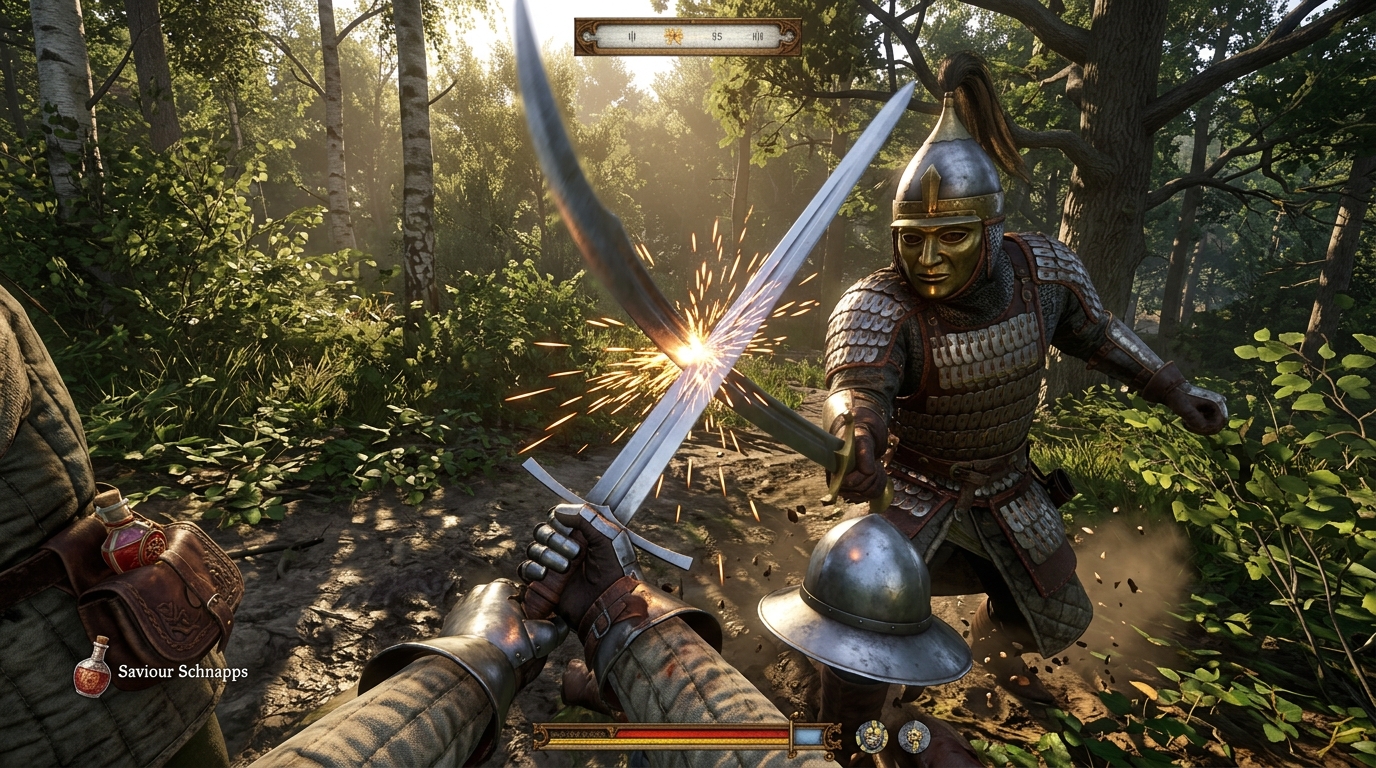
Let’s be honest, the original combat system was less about being a master swordsman and more about flailing around like a drunk toddler with a heavy stick. The developers clearly heard the screams of frustration because the swordplay in Kingdom Come: Deliverance II feels significantly more refined without losing that gritty realism we actually liked. They have smoothed out the clunky transitions and simplified the directional inputs so you are no longer fighting the UI more than the actual bandits. It is still punishingly difficult if you try to button-mash your way through a crowded forest, but at least now when Henry dies, it feels like your fault rather than a mechanical seizure. The addition of crossbows and early firearms adds a much-needed layer of tactical variety that keeps the master strike meta from becoming a repetitive chore.
Then there is the infamous Saviour Schnapps, the drink that forced us to choose between our progress and our digital liver. The sequel keeps the tension of the limited save system but feels a lot less like the developers are actively trolling you for having a life outside of Bohemia. You still need to stock up on the booze for manual saves, but the autosave triggers are far more frequent and logical this time around. It strikes a much better balance between maintaining the high stakes of a hardcore RPG and respecting the fact that some of us might actually need to turn the console off occasionally. You can still lose an hour of progress if you are reckless, but you won’t find yourself repeating the same ten-minute horse ride quite as often.
The overall polish on these systems proves that the developers were paying attention to the right critiques while ignoring the people who wanted the game turned into a generic fantasy slasher. Combat finally has the weight and impact it deserves, making every successful parry feel like a genuine victory rather than a lucky glitch. By keeping the soul of the mechanics intact while sanding off the jagged, frustrating edges, they have turned a janky cult classic into a surprisingly smooth powerhouse. It is still the same uncompromising experience that demands your full attention, but now it actually rewards that effort instead of kicking you in the teeth for trying. This is exactly how you handle a sequel: fix the broken parts, keep the weird parts, and make sure the player actually enjoys the struggle.
Navigating Two Million Words Of Bohemian Drama
The developers clearly didn’t get the memo about brevity being the soul of wit, because the two-million-word script for Kingdom Come: Deliverance II is a staggering two million words long. To put that in perspective, that is roughly four times the length of the entire Lord of the Rings trilogy, or about a dozen average RPGs stapled together. While most developers would use that space to fill a codex with boring lore about fictional deities, Henry and Sir Hans Capon spend a good chunk of it just being the most entertaining disaster duo in 15th-century Bohemia. The banter is sharp and the chemistry is undeniable, making it feel less like a dry history lecture and more like a high-stakes buddy comedy where someone might actually die of dysentery. It is an absurd amount of dialogue to sit through, but thankfully, the writing is punchy enough to keep you from constantly reaching for the skip button.
The real question is whether all that chatter actually serves the gameplay or if it is just a massive wall of text hiding the series’ trademark jank. In the first game, you could barely walk up a flight of stairs without the physics engine having a mid-life crisis, so seeing this much focus on narrative is a bold move. The good news is that the developers seem to have spent some of that massive budget on actually polishing the experience, meaning the dialogue scenes don’t feel like a puppet show performed by wooden mannequins anymore. Kuttenberg is a massive urban sprawl that needs this level of detail to feel alive, even if some of the side quests could have used a more aggressive editor. You will still find yourself trapped in some long-winded conversations about medieval politics, but the charisma of the lead characters usually saves the day.
Ultimately, the sheer volume of the script is a flex that mostly pays off for fans who live for the hardcore simulation aspect of this franchise. If you are the type of player who wants to rush through the story to get to the next loot drop, these two million words will feel like a prison sentence. However, for those of us who appreciate a game that treats its historical setting with genuine passion and a bit of a smirk, the bloat is surprisingly manageable. It is definitely self-indulgent, and yes, the developers probably could have cut a few hundred thousand lines without losing the plot, but the result is a world that feels more realized than almost anything else on the market. Just make sure you have a comfortable chair and a full drink, because Henry is not going to shut up anytime soon.
Polished Medieval Grit Done Right
Kingdom Come: Deliverance 2 is the rare sequel that actually listens to the feedback of its battered and bruised fanbase without losing its soul in the process. The developers managed to polish the original’s legendary jank into something that feels intentional rather than accidental, giving us a world that is twice the size and significantly more stable. While the first game often felt like a medieval simulator held together by digital duct tape and hope, this journey through Kuttenberg feels like a cohesive, high-budget experience. You can still get your head caved in by a peasant with a rusty mace, but at least now the combat system doesn’t feel like you are trying to solve a Rubik’s Cube while wearing oven mitts. It is a massive achievement that proves you can keep the hardcore complexity while ditching the technical headaches that plagued Henry’s first outing.
The final verdict is that this isn’t just a historical reenactment for the elite, but a genuine masterpiece that earns every second of your time. Seeing two million people jump into 15th-century Bohemia within two weeks is proof that players are starving for RPGs that don’t treat them like idiots. The developers fixed the frustrating save systems and smoothed out the clunky movement, yet they kept the brutal, uncompromising spirit that made the first game a cult classic. It is a beautiful, filthy, and incredibly deep adventure that stands as one of the best open-world titles in years. If you were worried that a bigger budget would mean a watered-down experience, you can breathe easy. Keep your sword sharp and your horse fed, because this is the definitive medieval RPG that the industry usually is too afraid to make.
Frequently Asked Questions
1. When did Kingdom Come: Deliverance 2 actually launch?
The game officially dropped on February 4, 2025. It managed to sell two million copies almost immediately, proving people are still gluttons for medieval punishment.
2. Is the map really that much bigger than the first game?
The developers doubled the size of the world this time around. You are trading in those three muddy fields from the original for a massive, sprawling version of medieval Bohemia that actually feels like a country.
3. What is the main setting for Henry’s new adventure?
You will be spending a lot of your time in the urban chaos of Kuttenberg. It is a massive silver mining city that makes the previous game’s villages look like tiny hamlets in comparison.
4. Do I still have to play as a bumbling blacksmith’s son?
Henry is back, but he is finally moving past the phase of getting beaten up by every peasant with a pitchfork. While he is more of a powerhouse now, the world will still happily execute you if you act like an idiot.
5. Is the gameplay still as brutal as the original?
It remains a grounded and gritty simulation where starving to death is a very real possibility. The mechanics are more polished and respect your time better, but it is still the same unapologetic medieval life you either love or hate.
6. Is the sequel better than the first game?
It is a legitimate masterpiece that takes the cult classic soul of the original and adds a massive budget. The transition to a dense city environment makes it feel like a real simulation rather than just a long walk through the woods.