
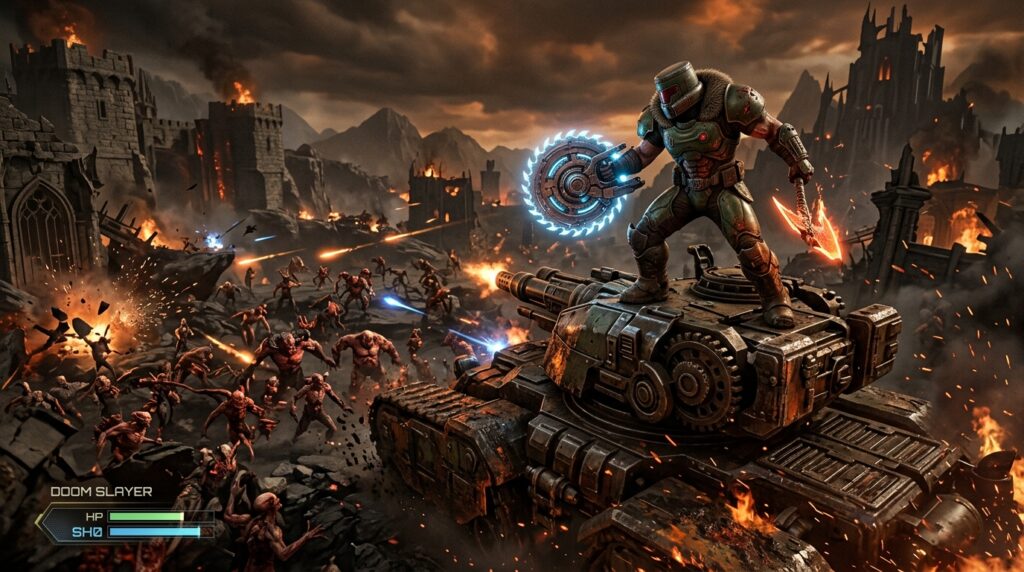
Forget everything you knew about being a caffeinated acrobat in space; DOOM: The Dark Ages gameplay has officially traded the double-jumping gymnastics for the raw power of a medieval tank. Released on May 15, 2025, this prequel pivots from the “floor is lava” meta to a brutal, grounded philosophy that rewards you for actually standing your ground. If you were hoping for more fighter jet physics, you’re out of luck, but if you want to feel like a walking fortress made of spite and iron, the Slayer has finally come home.
The shift from high-speed dashing to the “Stand and Fight” combat style is a bold move that finally stops the franchise from becoming a rhythm game for speedrunners. Central to this carnage is the Shield Saw, a glorious piece of over-engineering that lets you parry Hell Surge attacks or simply grind a demon’s face into a fine paste. It’s a refreshing change of pace that values strategic positioning over mindless twitching, proving that sometimes the best way to handle a demon invasion is to just bash through it with a spinning blade.
Key Takeaways
- DOOM: The Dark Ages moves away from high-speed acrobatics and double-jumping in favor of a grounded, ‘stand and fight’ combat style that emphasizes the power of a medieval tank.
- The new Shield Saw replaces the traditional dash mechanic, allowing players to parry projectiles and execute aggressive shield charges to manage combat positioning.
- Melee combat serves as the primary resource management system, utilizing heavy weapons like the Mace and Gauntlet to pulverize enemies and replenish supplies.
- Massive scale gameplay is introduced through the Atlan mech and mecha-dragon segments, shifting the perspective from claustrophobic corridors to cinematic, titan-sized warfare.
Shield Saw And The Death Of The Dash
If you were hoping to spend another forty hours playing floor-is-lava while spamming the dash button like a caffeinated squirrel, I have some bad news for your muscle memory. DOOM The Dark Ages has officially retired the high-speed acrobatics of the previous era in favor of a combat loop that feels more like driving an Abrams tank through a china shop. The frenetic, jet-set movement that defined the last game has been swapped for a grounded, heavy-metal slugfest where your boots rarely leave the dirt. It is a bold pivot that trades verticality for sheer, unadulterated weight, forcing you to actually look a Hell Knight in the eyes instead of just zooming past its shoulder. This shift might trigger some withdrawal symptoms for the speedrunners, but there is something undeniably satisfying about a Slayer who finally decided that dodging is for people who are afraid of getting hit.
The center of this new universe is the Shield Saw, a mechanical monstrosity that effectively kills the need for a traditional dash by turning defense into a lethal weapon. Instead of zipping out of the way of a fireball, you are now expected to raise that spinning rim of death to parry projectiles or reflect them right back into a demon’s smug face. It changes the entire rhythm of the dance from a frantic ballet to a rhythmic, punishing grind where timing is everything. When you do need to move, the Shield Charge provides a violent burst of momentum that is designed for closing the gap and turning fodder into red paste rather than retreating. It is a Stand and Fight mentality that rewards aggression through positioning rather than just having the fastest fingers in the lobby.
Whether this change revitalizes the formula or signals that the boomer shooter revival is running out of steam depends entirely on how much you enjoy feeling like an immovable object. The Shield Saw is a brilliant piece of gear that adds a layer of tactical depth we haven’t seen in the franchise before, even if it feels like the Slayer put on a few hundred pounds of extra plate armor. It is a refreshing middle finger to the industry trend of making every protagonist feel like they are made of helium and cardboard. While some might miss the frantic air-dashing, the sheer power fantasy of parrying a massive boss and following up with a shield throw is a trade-off I am more than willing to make. This is a heavier, meaner version of Hell, and it turns out that standing your ground is way more fun than running away.
Melee Mastery With Flails And Bone-Crushing Maces
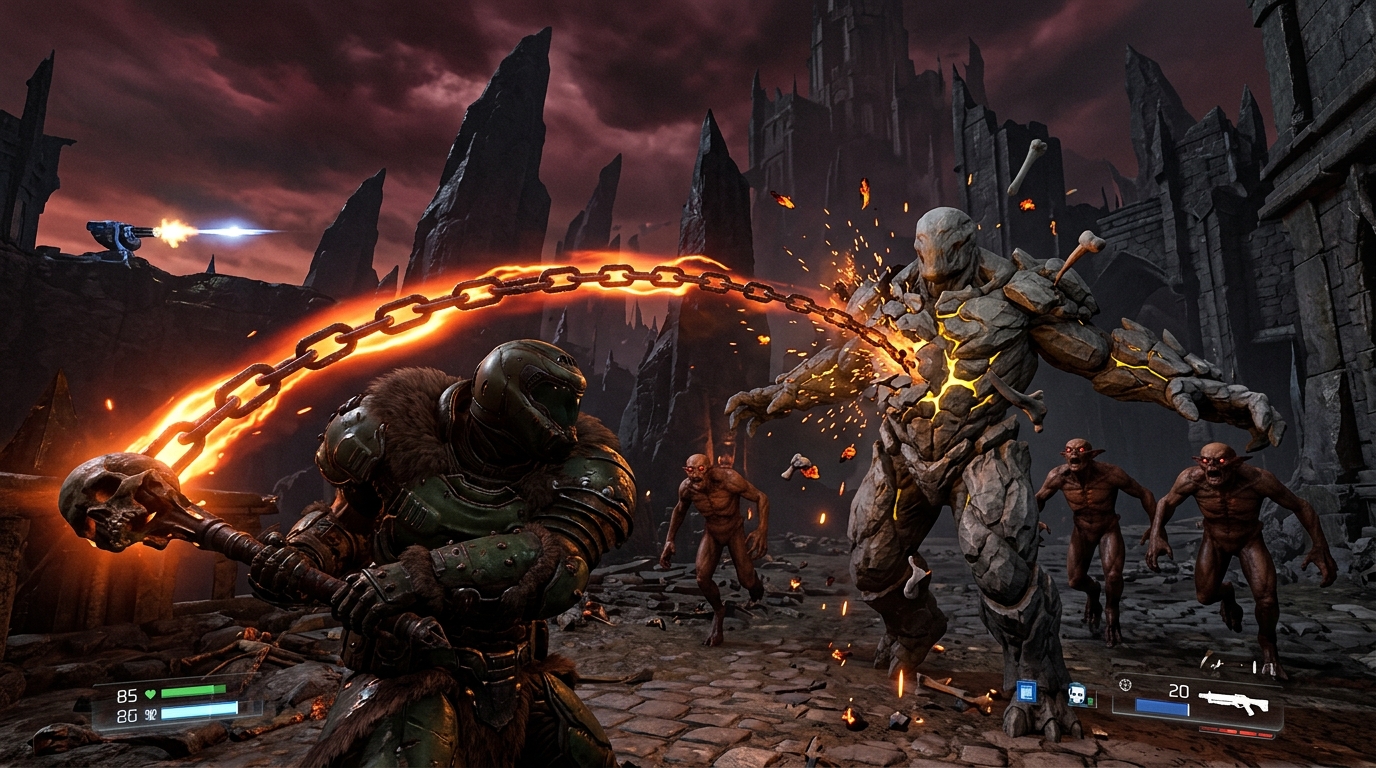
The Slayer has finally traded in his track spikes for a pair of lead-lined boots, and I am absolutely here for the change in pace. Instead of zip-zooming around like a caffeinated flea, the new melee system forces you to actually stand your ground and pulverize anything with a pulse. Swapping between the Gauntlet and the Mace isn’t just about looking cool in a suit of plate armor, it is the heartbeat of your resource management system. The Mace feels like it has the weight of a collapsing star behind every swing, turning demons into a fine red mist while replenishing your essential supplies. If you were worried that the boomer shooter revival was getting stale, this heavy-metal pivot proves there is still plenty of life left in the old school formula.
Managing the flow of combat now requires a brain cell or two since you cannot just dash away from your problems anymore. The Gauntlet serves as your rapid-fire utility tool, perfect for softening up targets or parrying incoming projectiles before you bring the hammer down. I found that the transition from shield-bashing to a Mace overhead smash creates a rhythmic brutality that feels far more rewarding than the frantic projectile spam of previous entries. It is a deliberate, crunchy experience that rewards positioning over twitch reflexes, making every encounter feel like a medieval massacre rather than a high-speed gymnastic routine. This shift toward a grounded iron tank style is exactly the shot of adrenaline the franchise needed to avoid becoming its own parody.
Piloting The Atlan Mech And Dragon Riding
If you thought the Slayer was a walking tank before, wait until you see him pilot the Atlan, a thirty-story mech that makes the traditional corridor-shooter pacing look like a game of laser tag. These massive titans shift the scale from frantic twitch-reflexes to pure, unadulterated power fantasy, forcing you to reconsider how you approach a battlefield. It is a bold move that trades the claustrophobic tension of a hallway for the cinematic weight of crushing demons under a metal heel. While some might worry this slows things down too much, the sheer spectacle of swatting a Kaiju-sized threat out of the sky is exactly the kind of excess this series needed to avoid becoming a parody of its own speed.
Taking to the skies on the back of a mecha-dragon adds another layer of verticality that feels less like a gimmick and more like a necessary evolution of the formula. Organic flight provides a much-needed breather from the heavy, grounded combat of the Shield Saw, offering a different kind of tactical mobility that keeps the loop from feeling stale. You are not just flying for the sake of a cutscene, as these mecha-dragon segments demand you manage your positioning while raining fire on the hordes below. It is a refreshing pivot that proves the medieval masterpiece is not just a coat of paint, but a genuine attempt to revitalize a genre that was starting to hit a wall of diminishing returns.
The contrast between the iron-clad slog of the ground game and the soaring freedom of dragon riding creates a rhythm that keeps you from getting bored. Instead of just being another “boomer shooter” revival that leans too hard on nostalgia, these vehicle segments show a willingness to break the rules of the franchise. It is loud, it is heavy, and it is unapologetically massive in a way that makes the old “jump and dash” meta feel like a distant memory. If the goal was to make the player feel like a god-king of a dying world, then stepping into the cockpit of an Atlan is the loudest way to announce that the Slayer is back and done playing nice.
Trading Caffeinated Squirrels for Iron Tanks
Ultimately, DOOM: The Dark Ages feels like the developers finally realized that the boomer shooter revival was starting to hit a wall of diminishing returns. We have spent the last few years dashing around like caffeinated squirrels in every retro-inspired FPS, and that frantic formula was beginning to feel a bit stale. By trading in the jet-engine mobility for a grounded, iron tank philosophy, this game manages to inject some much-needed weight back into the genre. It is a ballsy move to slow down the Slayer, but the sheer satisfaction of the Shield Saw makes the trade-off feel like a massive win rather than a step backward. This isn’t just a reskin of the previous games, it is a deliberate evolution that proves you can be heavy without being slow.
Whether this grounded approach maintains the series’ momentum depends entirely on your willingness to stop playing floor-is-lava and start playing medieval bouncer. I was skeptical that losing the verticality of previous titles would make the combat feel clunky, but slamming through a crowd of demons with a shield charge is more addictive than any double-jump could ever be. It is a refreshing pivot that avoids the “more of the same” trap that kills so many long-running franchises. The team is essentially betting that we are ready to stand our ground and actually feel the impact of the carnage, and for my money, the gamble has paid off. If you want to feel like an unstoppable force of nature instead of a nimble gymnast, this is the definitive way to experience the Slayer’s rage.
Frequently Asked Questions
1. Is the Slayer still doing parkour in the clouds?
Absolutely not. We have officially retired the caffeinated squirrel routine in favor of a grounded, heavy metal slugfest where your boots stay firmly on the dirt. If you want to play floor is lava, go back to 2020, because this time we are driving a medieval tank through a china shop.
2. What happened to the dash button?
The dash has been unceremoniously dumped in the trash to make room for the Stand and Fight philosophy. Instead of zooming past enemies like a coward, you are forced to actually look a Hell Knight in the eyes while you turn him into a red smear. It is a trade of cheap agility for pure, unadulterated weight.
3. How does the Shield Saw actually work?
The Shield Saw is a glorious piece of over engineering that lets you parry Hell Surge attacks or grind a demon’s face into a fine paste. It is your primary tool for strategic positioning, proving that a spinning blade is much more effective than a double jump. It turns the Slayer into a walking fortress made of spite and iron.
4. Is the gameplay slower than the previous DOOM games?
It is not slower, it is just heavier. We have traded the fighter jet physics for the raw power of a medieval tank, meaning every movement has actual consequence. You are no longer an acrobat in space, you are a localized natural disaster that values crushing force over mindless twitching.
5. Do I still need to worry about verticality and platforming?
The era of high speed gymnastics is over, and the meta has shifted away from the verticality of the previous era. The focus is now on a brutal, grounded combat loop that rewards you for standing your ground and bashing through the horde. It is a refreshing change of pace that stops the franchise from becoming a rhythm game for speedrunners.
6. Who is this new combat style actually for?
This is for anyone who thinks dodging is for people who are afraid of getting hit. If you want to feel like a walking siege engine rather than a space ninja, you have finally come home. It is a bold pivot that prioritizes raw carnage and strategic positioning over spamming the dash button like a nervous wreck. As we look back at news and DLC leaks, it is clear that this grounded direction was the right choice for the series.