Indie game sales share sits somewhere between 38% and 58%, and the number you get depends on what you measure. In Sensor Tower’s October 2026 analysis, indie studios took 43% of breakouts, meaning launches that sold at least 500,000 paid units in their first 30 days, up from 24% in the previous cohort. Among those breakouts, though, AAA games still held 48% of first-month paid units to indies’ 38%.
On Steam, VG Insights put indies at 58% of units sold and 48% of full-game revenue through September 30, 2024. That revenue figure leaves out in-game spending. These sources cover different platforms, periods and definitions, so they add context rather than one settled answer.
Key Takeaways
- Averages mislead on Steam, where Black Myth: Wukong alone earned $1.0 billion of indie revenue through September 30, 2024.
- The indie label now describes how a studio is built, not how little it spent, as Black Myth: Wukong’s reported $70 million budget shows.
- Market share charts cannot judge a game’s worth, so how a game actually plays should decide your purchase.
What Share of Game Sales Do Indies Actually Hold?
It depends on what you count: launches, units or dollars. A breakout share counts only launches that sold at least 500,000 paid units in their first 30 days on PlayStation, Steam or Xbox, using Video Game Insights estimates. A unit share counts every copy sold, and a revenue share counts money. Those three measures tell three different stories, so don’t swap one for another.
VG Insights’ 2024 market report covers Steam only and stops at September 30, 2024. Its 48% revenue figure also leaves out in-game spending, so money earned after launch goes uncounted. The two datasets cover different platforms, different time windows and different definitions. Read side by side, they add context. They don’t give you one settled number.
Is the Indie Market Growing?

Yes, indies are growing on Steam, but how much depends on what you count. In VG Insights’ 2024 Steam report, indies made up 99% of releases. They accounted for 58% of units sold and 48% of full-game revenue through September 30, 2024.
The revenue share has climbed for years. It was 24% in 2018, 31% in 2023, and 48% for 2024 year to date. That revenue figure counts only full-game sales. Money from in-game spending is not in the total, so a game that earns heavily after launch is undercounted.
Are Indie Breakouts Pushing AAA Out?
No, indie breakouts aren’t pushing AAA out. They’re crowding the party, and that’s a different thing.
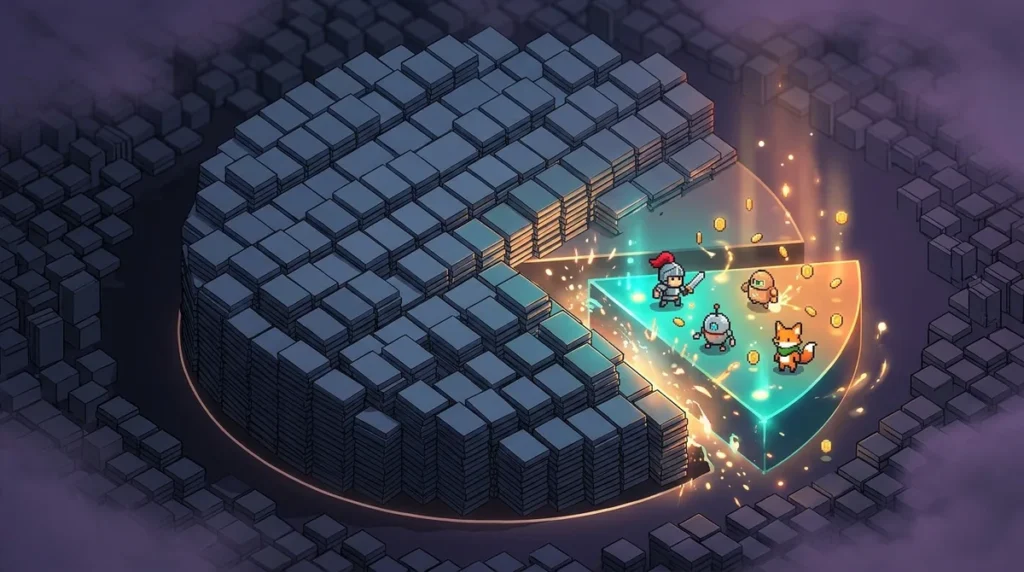
Breakouts rose from 55 to 76 between cohorts, and the newer cohort sold 182.4 million paid units in its first month, up 51%. Indie unit share climbed from 26% to 38%, while AAA slipped from 53% to 48%. Indies grew faster, so their slice got bigger and AAA’s slice got smaller.
That shrinking slice doesn’t mean less food on the plate. AAA first-month sales grew 38% to 87.8 million units. The pie got bigger, and AAA still ate a bigger helping than before.
A shrinking share is not a shrinking market. Big releases still sell in serious volume, and AAA’s first-month growth shows it.
Are Indie Breakouts Really Original?
Partly. Original-IP breakouts rose from 44 to 61 between cohorts, so the market isn’t just recycling sequels. Indies did much of the heavy lifting: of the 35 new-IP breakouts in the newest cohort, indie studios made 27. That’s the strongest evidence yet that small teams are bringing fresh ideas to the top of the charts.
Now the asterisk. Cheap online co-op and party games, which the data groups under “friendslop,” generated 46% of indie first-month sales. Yet they account for only 4 of the 20 additional indie breakouts. That’s a lot of money from a category that wasn’t driving the new hits.
So indie success is real, but it isn’t all experimental design. Some of it is a well-made party game that people play with their friends for months. That’s a legitimate win. It just isn’t the same thing as a revolution in game design.
Why Three Games Dominate Indie Revenue
Concentration is the quiet part of the indie success story. Averages hide the hits, and on Steam in 2024 a few hits did a disproportionate share of the lifting. VG Insights attributed $1.0 billion of indie full-game revenue to Black Myth: Wukong and $0.5 billion to Palworld. Out of $4.0 billion in total indie revenue through September 30, 2024, that’s $1.5 billion from two games.
The firm sorts the top end into a category it calls “Triple I Indies.” It’s a rule of thumb: teams of 50 or more, with first-year sales of at least 1 million units or about $50 million in revenue. VG Insights stresses that team size and performance are only indicative, so treat the label as a rough sorting tool, not a legal definition.
That top tier took 53% of indie Steam revenue in 2024 year to date, up from 23% in 2023. Black Myth: Wukong is a good example of how far “indie” can stretch, since its reported budget of $70 million is in AAA territory. The average indie is not the market.
Triple I Budgets and the Indie Label

Here’s the label problem. A team of 50 or more with strong first-year sales lands in the Triple I bucket, and that bucket can hold budgets in the same league as the biggest AAA releases. Black Myth: Wukong, with its reported $70 million budget, is the proof. “Indie” now describes who owns a studio and how it’s built, not how little it spent.
Budget is only half the story. Burn rate is how fast a studio spends cash each month on salaries, rent and software. A lean team can ride out a slow launch. A team with a heavy burn has to sell fast, because every empty month brings layoffs closer. For that studio, a breakout may be the only realistic way to recoup its costs.
Buy the Game, Not the Market Chart
Indie share numbers give useful context, but they can’t tell you if a game is worth your money. Judge each game on how it plays: the controls, the pacing, and whether you still want to boot it up next week.
Meanwhile, “indie” and “AAA” have become marketing words. One promises scrappy charm, the other promises polish, and both get slapped on whatever needs to sell. We’re opinionated here, so we’ll call it out when that habit is bad.
Buy the Game, Not the Market Chart
Your next step is simple: stop reading market charts and go watch someone play the game. A few minutes of real footage tells you more than any share percentage. Ask whether the controls feel right, whether the pacing drags, and whether you’d still want to boot it up next week.
If you’re torn between Slay the Spire 2 and a big-budget release you’ve been hyped about, pick the one you can picture yourself playing on a random Tuesday night. Then check our reviews before you spend. We’ll tell you what’s worth buying and what’s worth skipping.