AI game development is no longer a shiny tech demo wearing sunglasses. It already handles code assistance, prototyping, testing, localization, analytics, and other jobs humans would rather not do twice. I have seen it speed up production and kill tedious busywork, but I have also seen “AI-powered” slapped onto features that barely qualify as powered. The useful question is not whether AI belongs in games. It is where AI genuinely improves them instead of adding a chatbot to the menu and calling it innovation.
Traditional game AI remains the reliable workhorse, from smarter enemy tactics to adaptive difficulty and procedural worlds, while generative AI pushes into dynamic stories, autonomous NPCs, and instant assets. Those player-facing ideas are exciting, but latency, cost, quality control, safety, and intellectual-property headaches are waiting in the bushes with baseball bats. The winners will use AI to make better games, not cheaper games covered in synthetic wallpaper.
Key Takeaways
- AI delivers the most reliable value behind the scenes through coding assistance, automated testing, localization, analytics, prototyping, and placeholder asset creation. These tools reduce repetitive work and speed iteration while leaving architecture, quality, cultural judgment, and creative direction to humans.
- Generative AI can expand creative possibilities through dynamic stories, autonomous NPCs, procedural worlds, and rapid asset generation, but latency, cost, moderation, privacy, intellectual-property, and quality-control risks limit player-facing use.
- AI productivity gains must not become an excuse to cut staff or expand workloads without restraint. Studios should use efficiency to give teams more time for iteration and quality, not simply to produce more content with fewer people.
- The biggest industry risk is an explosion of cheap, mediocre games that overwhelms players and reduces attention. AI should amplify strong human ideas and judgment—not replace taste, editing, design focus, or the willingness to delete pointless features.
AI Tools Reshape Game Production
AI game development is already doing its best work far from the spotlight. Coding assistants can turn a rough script into a usable prototype, automated testing can hammer menus and edge cases without demanding pizza, and bug triage can sort a mountain of reports before the team loses the will to live. Localization tools also speed up translations, while AI-generated concept art and placeholder assets help developers test ideas before spending weeks polishing the wrong one. None of this replaces designers, artists, engineers, or QA, but it removes enough grunt work to let them focus on making the game good, which remains a sadly radical concept.
The useful tools are the ones that shorten production without lowering the bar. They help teams prototype faster, find crashes earlier, keep documentation readable, and produce temporary assets that do not pretend to be finished art. The flashy stuff is different. It promises infinite worlds, tireless NPCs, or a button that allegedly creates an entire game while quietly producing digital wallpaper with a health bar. That matters as production costs rise, teams shrink, and more releases fight for the same limited player attention.
| Practical production use | Why it helps | What still needs human judgment |
|---|---|---|
| Coding and scripting assistance | Speeds up prototypes, tools, and routine fixes | Architecture, security, performance, and code review |
| Automated testing and bug triage | Finds repeatable failures and organizes reports | Exploratory testing and deciding which problems actually matter |
| Localization and documentation | Reduces repetitive writing and translation workload | Tone, cultural context, terminology, and final editing |
| Asset and concept generation | Creates placeholders and supports early visual experiments | Original art direction, consistency, rights, and final quality |
| Fully generated games or endless AI content | Creates impressive demos and promotional noise | Fun, coherence, polish, and a reason to keep playing |
The best measure of AI in game development is not how loudly it announces itself, but whether the finished game feels sharper, more stable, and less padded with filler. I would rather play a carefully designed game that used AI to catch bugs and speed up iteration than a procedurally inflated universe containing twelve billion quests about collecting emotional turnips. The technology can improve games when it serves human decisions, but it cannot manufacture taste, restraint, or a compelling reason to care. AI is most valuable when players never notice it was used.
Generative AI And Game Jobs
Generative AI is making game production cheaper in some places, faster in others, and more confusing almost everywhere. I am seeing the biggest gains in coding assistance, prototyping, testing, localization, analytics, and repetitive asset work that once ate entire afternoons. That can help a small team build a playable idea instead of spending six months making a menu screen blink correctly. It does not mean an artist, designer, engineer, or QA tester has been replaced by a chatbot wearing a tiny company badge. It means studios can ask the same people to produce more, which sounds great until “more” becomes an excuse to employ fewer people.
Data callout: Productivity gains and labor substitution are not the same thing, but management can turn one into the other with alarming speed. If a team uses generative tools to finish the same game with fewer hours, that is efficiency. If it uses those tools to chase a larger game with the same headcount, that is workload expansion wearing a productivity hat. Outsourcing may shrink or shift as studios bring some asset creation, localization, or testing work in-house, while contractors absorb the work that remains unpredictable or specialized. The result is not a neat future where humans supervise machines from comfortable beanbags. It is a production pipeline with fewer people making more decisions, and therefore fewer chances for a bad idea to be stopped before launch.
The bigger problem is the flood of games this efficiency can create. Lower costs and smaller teams may open the door for inventive projects, but they can also fill storefronts with technically competent digital wallpaper that nobody has time to play. Generative tools can produce a mountain of concepts, dialogue, textures, and prototypes, yet they cannot decide which mountain is worth climbing. I would rather play a focused game made by a small team with a strong point of view than a content landfill assembled because the tools made it cheap. AI may improve game development, but only if studios use it to protect creative judgment instead of trimming the humans responsible for having any.
Runtime AI Meets Player Trust
AI game development is already useful behind the curtain, helping teams prototype code, test systems, localize text, and build rough content faster. That can lower production costs, but it can also give publishers an excuse to shrink teams while flooding storefronts with games nobody has time to play. I like an adaptive difficulty system that quietly rescues a struggling player, and I like procedural worlds that produce genuine surprises instead of another beige field with collectible grass. Player-facing generation is harder, because an NPC that invents dialogue in real time can also invent nonsense, spoilers, harassment, or a sentence that makes a thousand-dollar villain sound like it is disputing a phone bill.
Trust becomes the real design problem once AI starts improvising in front of the player. Generated quests need consistent rules, autonomous companions need useful judgment, and dynamic dialogue needs moderation strong enough to prevent the fantasy tavern from becoming an unfiltered group chat. Latency matters too, because waiting several seconds for an NPC to remember why I entered a dungeon is not immersion. It is a loading screen wearing a hat. Privacy and intellectual-property concerns make the bargain even messier when systems collect player behavior or generate assets from material whose ownership is unclear.
The best games will treat AI as a tool with strict boundaries, not as a substitute for writers, designers, artists, engineers, or quality assurance. A small team may use it to build more ambitious systems, but speed only helps if someone still edits the dialogue, tests the quests, and asks whether the game is worth playing. Otherwise, we get an industrial machine for manufacturing digital wallpaper, complete with infinite side quests and nobody available to remove the bad ones. I want AI to make games stranger, deeper, and more responsive, but I do not want it turning player trust into another production cost to cut.
More Games Less Attention
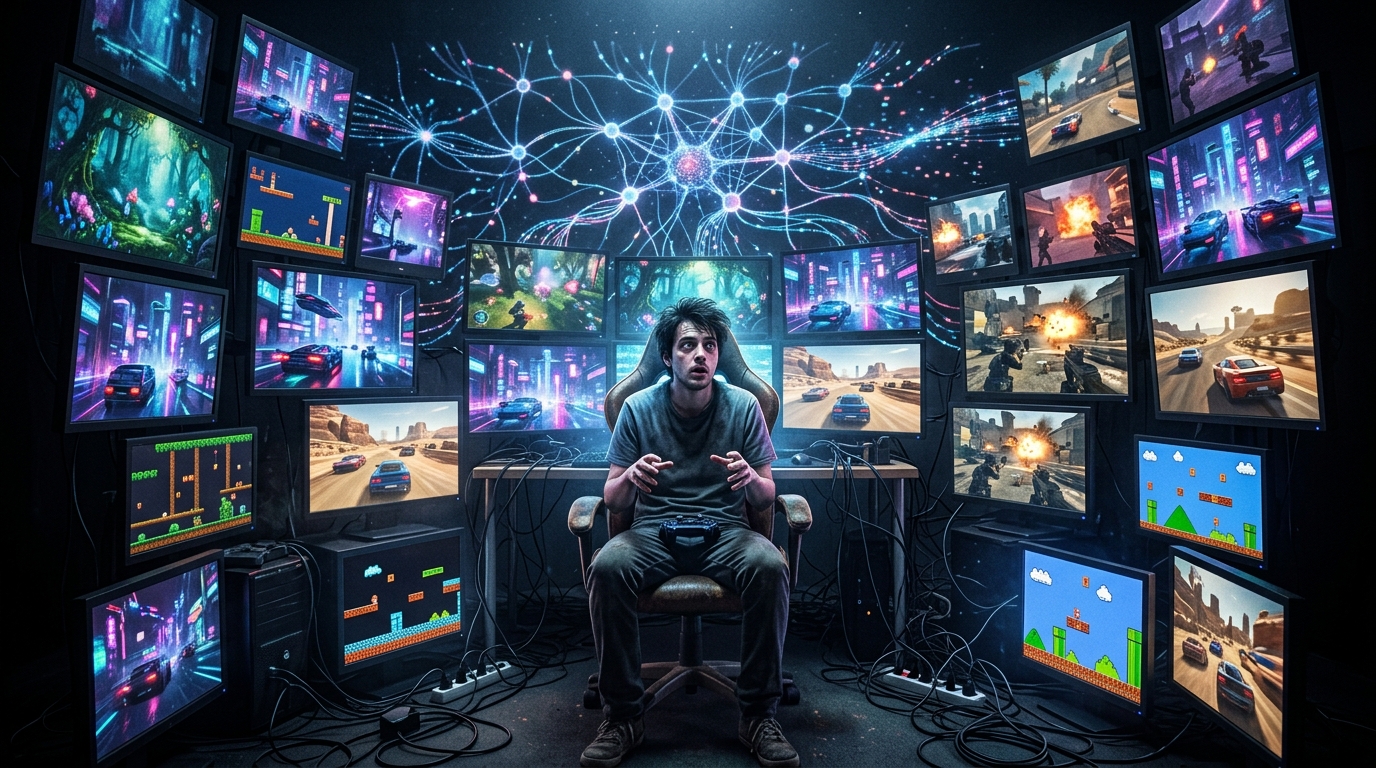
AI game development is making the production pipeline cheaper, faster, and considerably better at generating things nobody asked to play. Coding assistants, automated testing, localization, analytics, and rapid prototyping can help small teams build ambitious ideas without hiring an army of specialists. That is the useful version of AI, the one quietly removing repetitive work instead of proudly announcing a procedurally generated hat. Player-facing systems such as autonomous NPCs, dynamic stories, and generated assets are more promising than polished, but latency, quality control, safety, and intellectual-property problems still make them risky. AI can lower the cost of making games, but it cannot lower the cost of paying attention, because players still have one evening and a backlog shaped like a geological formation.
The real danger is not that AI will make every game terrible, but that it will make mediocre games cheap enough to multiply. When production barriers fall, studios may choose volume over vision, flooding storefronts with familiar maps, interchangeable quests, and enough crafting materials to bury a small country. Generative tools can produce a mountain of concepts, dialogue, textures, and prototypes, yet they cannot decide which mountain is worth climbing. I score the major tradeoffs below, with higher risk meaning more danger for players and higher checklist likelihood meaning a greater chance of another forgettable open-world chore simulator.
| AI development use | Creative upside | Production usefulness | Player risk | Checklist likelihood |
|---|---|---|---|---|
| Code assistance and debugging | 3/5 | 5/5 | 1/5 | 2/5 |
| Automated testing and analytics | 2/5 | 5/5 | 2/5 | 2/5 |
| Procedural worlds and content | 4/5 | 4/5 | 3/5 | 4/5 |
| Generative NPCs and stories | 5/5 | 3/5 | 4/5 | 3/5 |
| Mass-produced assets and quests | 1/5 | 5/5 | 5/5 | 5/5 |
The best outcome is not more games. It is more distinctive games made by teams with enough time to edit, test, and throw away bad ideas. AI can help creators prototype unusual mechanics, support accessibility, expand localization, and spend less energy on technical chores that players never see. It cannot supply taste, restraint, or the terrifyingly important ability to say, “This feature is pointless, remove it.” I would gladly play one clever game shaped by strong human direction over fifty algorithmically assembled worlds full of glowing collectibles. Otherwise, we are not entering a golden age of game development. We are simply giving the backlog a cloning machine.
AI Should Serve Games, Not Replace Ideas
AI game development is neither the death of creativity nor a magic wand for studios that cannot decide what their game is about. I see its best use in the unglamorous work: debugging, localization, testing, prototyping, analytics, and the endless production chores that make developers question their career choices. Used well, these tools give artists, designers, and engineers more time to solve meaningful problems instead of manually sorting another mountain of assets. Used badly, they become an excuse to cut staff, shrink teams, and pretend that quantity is a substitute for a good idea.
The real danger is not that AI will make games soulless overnight, but that it will make it cheaper to produce forgettable ones at industrial scale. More procedural quests, filler dialogue, disposable cosmetics, and open worlds packed with activities nobody asked for will not rescue a weak design. Players already have towering backlogs, limited free time, and enough digital wallpaper to decorate every room in the house. If generative tools mainly help publishers flood storefronts while reducing the people responsible for quality, the result will be more games competing for attention and fewer games worth giving it.
I am cautiously optimistic, but only when AI remains an amplifier rather than the author of a studio’s priorities. A focused team can use it to iterate faster, test more thoroughly, and spend its human energy on tone, judgment, surprise, and the strange little decisions that make a game memorable. A cynical studio can use the same technology to manufacture content faster, cut costs, and serve players a buffet of reheated leftovers. The winners will not be the teams with the most AI, but the ones disciplined enough to know what should be automated, what must stay human, and what deserves to be deleted before launch.