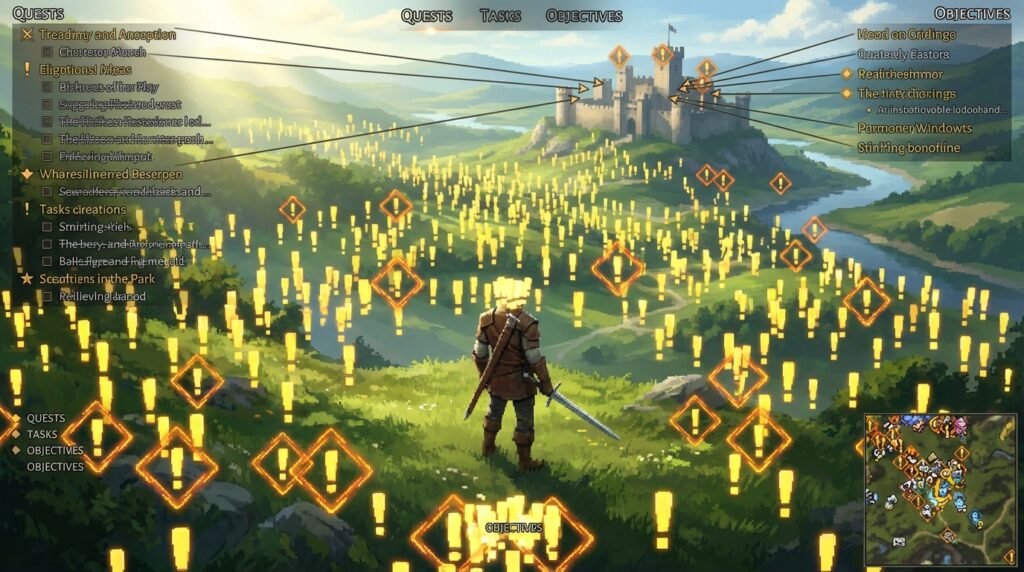
We’ve all been there: you open a massive open-world map only to find it littered with more icons than a cluttered desktop, turning what should be an adventure into a glorified grocery run. Modern developers have become so terrified of us getting lost for five seconds that they’ve traded immersion for bad quest design that treats the player like a toddler. Instead of exploring a living world, we’re just following a neon GPS line while our brains switch to autopilot.
It’s the Checklist Paradox. The more the game holds your hand with glowing markers and intrusive HUD elements, the less you actually care about why you’re there. When you can finish a mission without listening to a single line of dialogue or glancing at your surroundings, the quest is just a chore with better lighting. We don’t need a compass to tell us where the fun is; we need designers who trust us to find it ourselves.
Key Takeaways
- Over-reliance on HUD markers and GPS-style navigation kills immersion by training players to follow icons instead of engaging with the game world.
- Modern quest design frequently uses repetitive fetch quests and escort missions as hollow filler to artificially inflate playtime at the expense of genuine storytelling.
- Poorly scripted NPC logic and mechanical rigidity punish player creativity, turning what should be dynamic adventures into fragile, predictable checklists.
- Developers must prioritize environmental storytelling and descriptive dialogue that trusts the player’s intelligence rather than providing constant, mindless hand-holding.
The Death Of Exploration Via Quest Markers
Modern open-world games have replaced the joy of discovery with the mindless drudgery of following a digital breadcrumb trail. We have reached a point where developers have given up on writing descriptive dialogue or designing intuitive landmarks, opting instead to slap a glowing waypoint on your HUD. You are no longer navigating a living world. You are a glorified delivery driver staring at a mini-map while the actual game happens in your peripheral vision. It is the ultimate GPS-brain phenomenon, where you could be walking through a breathtaking fantasy vista or a literal sewer and you would never know the difference because your eyes are glued to a tiny rotating circle in the corner of the screen.
This over-reliance on markers is a band-aid for lazy quest design and uninspired environmental storytelling. In the past, an NPC might tell you to head east past the jagged rock formation and look for a hidden cave behind a waterfall, which actually required you to use your brain. Now, developers just dump a “Talk to Guard” objective in your log and expect you to sprint toward the floating icon without reading a single word of text. It turns every mission into a literal checklist of chores, stripping away any sense of accomplishment when you finally reach your destination. If I wanted to follow a blue line on a screen for forty hours, I would just turn on my phone and drive around the suburbs.
The worst offenders are the fetch quests and escort missions that treat the player like a toddler who cannot be trusted to cross the street alone. These quests are designed to pad out the runtime, but they lose all impact when the exploration involves zero actual thinking. When a game refuses to give me the tools to find things on my own, it signals that the world itself is just empty filler between waypoints. We need to stop rewarding this mindless hand-holding and start demanding games that trust us to look at the screen instead of the UI. A beautiful world is completely wasted if the developer is too lazy to give me a reason to actually look at it.
Fetch Quests And The Illusion Of Content
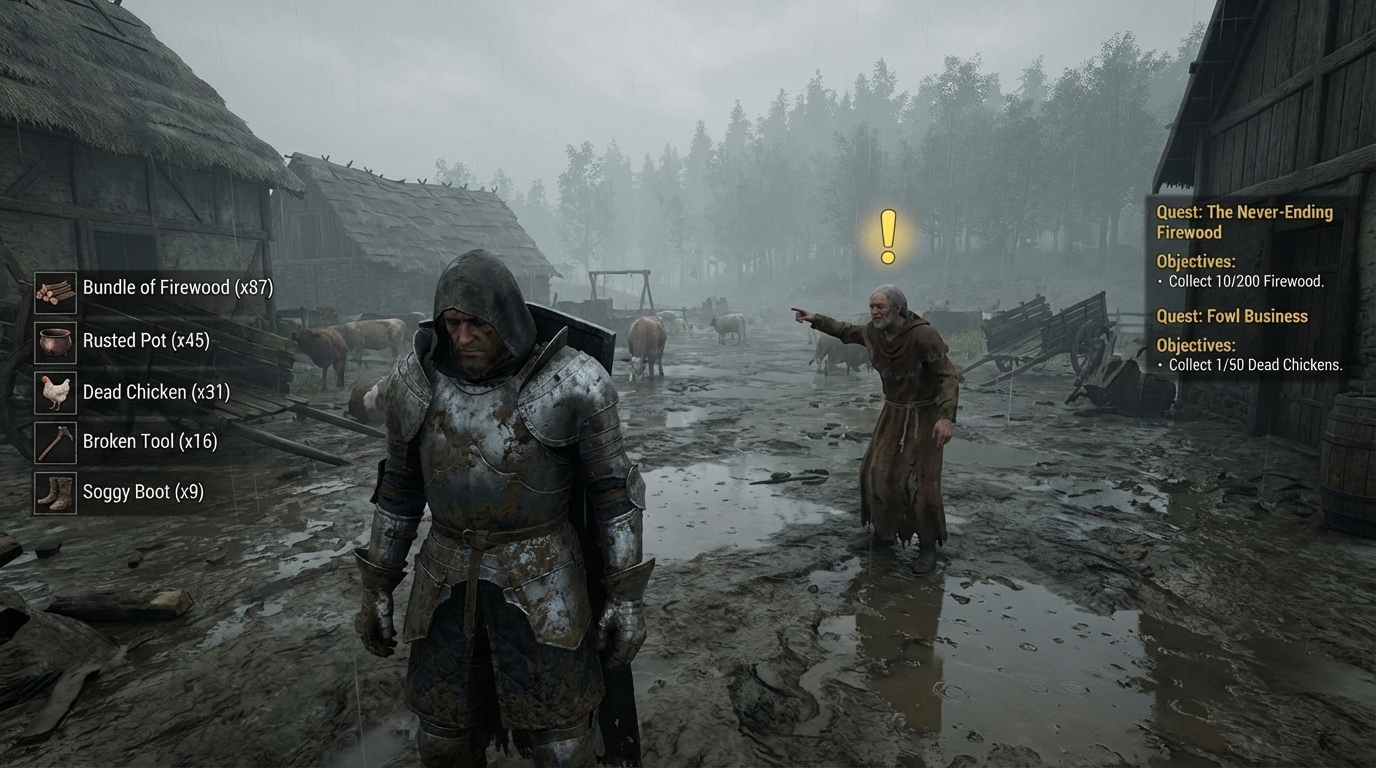
The modern open world has become a digital landfill for “bring me ten wolf pelts” chores that exist only to inflate playtime. Developers seem to think that if they don’t tether you to a checklist of mundane errands, you might actually realize their world is an empty shell. It is a lazy, transparent tactic that treats your free time like a resource to be harvested rather than respected. When I see a quest giver asking for five rare mushrooms that happen to be across the entire map, I don’t feel like a hero. I feel like an unpaid delivery driver. This brand of hollow filler design is an insult to our collective intelligence and a pathetic substitute for actual storytelling.
Escort missions are the equally offensive cousins to the fetch quest, usually featuring an NPC with the survival instincts of a suicidal lemming. These characters move at a speed that is faster than your walk but slower than your run, forcing you into a stutter-stepping dance of pure frustration. It is a special kind of development hell when you have to babysit a brain-dead AI through a gauntlet of enemies just to trigger the next cutscene. Instead of creating a sense of urgency or stakes, these missions turn the gameplay into a tedious chore of pathfinding management. If a game requires me to spend twenty minutes watching a digital person walk into a wall, that game belongs in the trash.
We need to stop pretending that “more content” is synonymous with “better value” when that content is just recycled garbage. True depth comes from quests that require you to actually use your brain, listen to dialogue, and interact with the environment in a meaningful way. Following a glowing dotted line on a mini-map to pick up flowers is not gameplay. It is a compliance test for people who like clicking buttons. We should demand better than these hollow loops that prioritize map density over genuine engagement. If a developer can’t make a quest interesting without a grocery list, they shouldn’t be making an RPG in the first place. Many players find that linear narrative games still rule because they prioritize quality over this kind of aimless quantity.
Escort Missions And Brain-Dead NPC Logic
Escort missions are the ultimate litmus test for a developer’s respect for your time, and most of them are failing miserably. There is a special kind of hell reserved for NPCs who possess a walking speed that doesn’t match any of your character’s movement cycles. You are forced into a stuttering dance of sprinting for two seconds, stopping to wait, and then walking just to stay within a five-foot radius of a character who clearly has nowhere important to be. It is lazy design that replaces genuine challenge with artificial frustration, turning what should be a tense protection detail into a glorified babysitting simulator for a toddler with a death wish.
The situation only gets worse when you realize these NPCs have the survival instincts of a moth in a candle factory. Instead of taking cover or staying behind the heavily armed protagonist, they invariably decide to charge directly into enemy fire with nothing but a decorative dagger and a dream. You end up burning through your best items and health potions just to keep a brain-dead AI from committing suicide-by-bandit before the next checkpoint. It is a complete immersion killer that reminds you you are playing a game built on rigid, outdated scripts rather than a living world that reacts logically to danger.
We need to stop pretending that babysitting a fragile, slow-moving asset is a substitute for actual gameplay depth. Modern titles often use these missions as filler to pad out the runtime, forcing you to backtrack through cleared areas while an NPC regurgitates bits of lore you already know. If a character cannot move at a human pace or understand the basic concept of “not getting shot,” they have no business being the focal point of a quest. It is time for developers to either fix the pathfinding and logic or bury this tired trope in the same graveyard as unskippable tutorials and underwater levels.
Mechanical Rigidity And The Creativity Killer
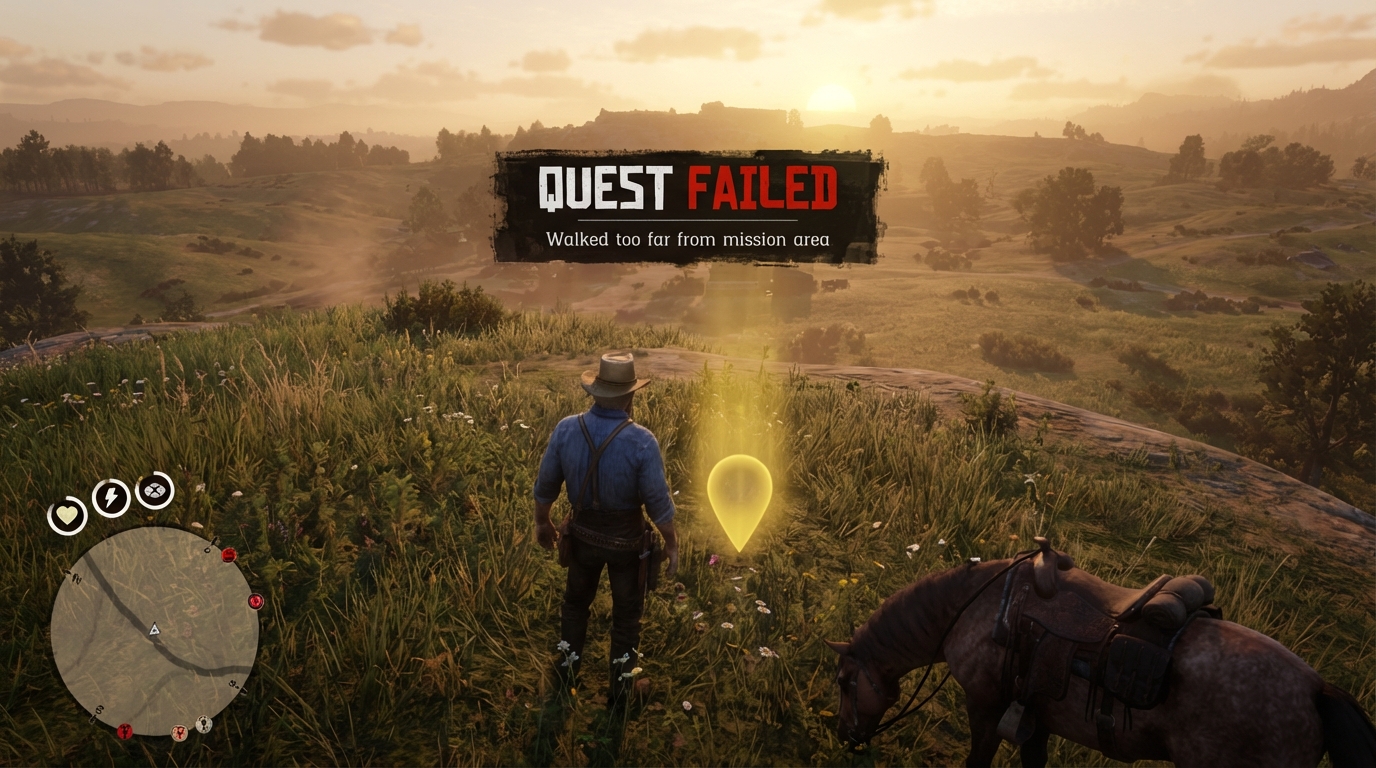
Modern quest design often feels like a hostage situation where the developer is the captor and your brain is the ransom. We have been conditioned to follow glowing trails and mindless markers, but the real insult occurs when you try to use your actual intelligence to solve a problem. You might find a clever shortcut or a logical way to bypass a tedious fetch quest, only to realize the game has stopped functioning because you didn’t trigger a specific invisible tripwire. This mechanical rigidity turns what should be an epic adventure into a fragile sequence of “if-then” statements that break the moment you stop acting like a predictable drone.
Certain high-profile RPGs are prime offenders when it comes to punishing players for simply existing within their worlds. You can spend hours trekking across a map for a basic escort mission, only for the NPC to get stuck on a pebble or vanish into the ether because the scripting couldn’t handle a minor deviation. This isn’t “hardcore” design or a deliberate challenge. It is just lazy development masquerading as friction. When a game soft-locks because you killed a target too early or approached an objective from the “wrong” direction, it kills the very creativity that open-world titles are supposed to foster.
There is nothing more demoralizing than realizing a game is actively fighting against your desire to be clever. We are tired of being treated like toddlers who need a leash, yet we are simultaneously expected to tolerate broken systems that crumble under the slightest bit of player agency. If a quest requires me to deliver a letter, let me find a way to get it there that doesn’t involve babysitting a lobotomized AI through a forest of clipping errors. True immersion comes from a world that reacts to the player, not a world that breaks the second you stop following the manual. This is why immersive sims are the smartest games, as they prioritize player agency over rigid scripting.
Stop Paying to Do Virtual Chores
Ultimately, we have to stop treating these bloated open-world checklists like they are actual gameplay. Developers have spent years training us to be digital delivery drivers, rewarding our mindless obedience with a tiny splash of XP and a pat on the head. When a quest consists of nothing more than walking toward a floating marker to collect five wolf pelts, it is not a mission. It is a chore. We are essentially paying sixty dollars to do data entry in a pretty environment. It is time to stop making excuses for lazy tropes that treat our free time like a resource to be harvested by engagement metrics.
The industry needs a wake-up call that mindless hand-holding and repetitive escort missions are the death of immersion. When a game refuses to let you think for yourself, it stops being an adventure and starts being a guided tour for people who cannot be bothered to read a map. We should be demanding quests that require actual investigation, environmental storytelling, and a shred of critical thinking. If a developer cannot find a way to make a task interesting without a glowing breadcrumb trail, they should probably just cut the content entirely. We deserve worlds that respect our intelligence instead of another thousand icons on a map that mean absolutely nothing. Many critics argue that bloated open worlds are actively ruining the player experience by prioritizing scale over substance.
Frequently Asked Questions
1. What exactly is the Checklist Paradox?
It is the phenomenon where the more icons and glowing markers a game shoves in your face, the less you actually care about the world. You stop playing an adventure and start completing a grocery list, turning the entire experience into a mindless chore with better graphics.
2. Why are quest markers considered lazy design?
Developers use them as a cheap band-aid because they are too tired to write descriptive dialogue or design recognizable landmarks. When a game relies on a GPS line, it means the world itself is too boring or poorly laid out to navigate naturally.
3. Is it really that bad to use a mini-map?
It is when your eyes are glued to a tiny rotating circle instead of the actual game. You could be walking through a majestic dragon’s lair or a literal dumpster fire, and you would never know the difference because you are just a glorified delivery driver following a digital breadcrumb trail.
4. How did older games handle navigation without these markers?
They actually trusted your brain to function by using NPCs who gave real directions. You had to listen for instructions like heading east past a jagged rock, which forced you to actually look at the environment instead of playing HUD-simulator. This is a key part of how the checklist conquered the open world, shifting the focus from organic discovery to mechanical completion.
5. Does hand-holding make games more accessible for casual players?
There is a difference between being accessible and treating players like toddlers in a supermarket. Constant hand-holding kills the sense of discovery, which is the entire point of playing an open-world game in the first place.
6. Can a game have markers and still be well-designed?
Only if the markers are a secondary tool and not a crutch for uninspired world-building. If you can finish a mission without listening to a single word of dialogue or looking at your surroundings, the design has officially failed.