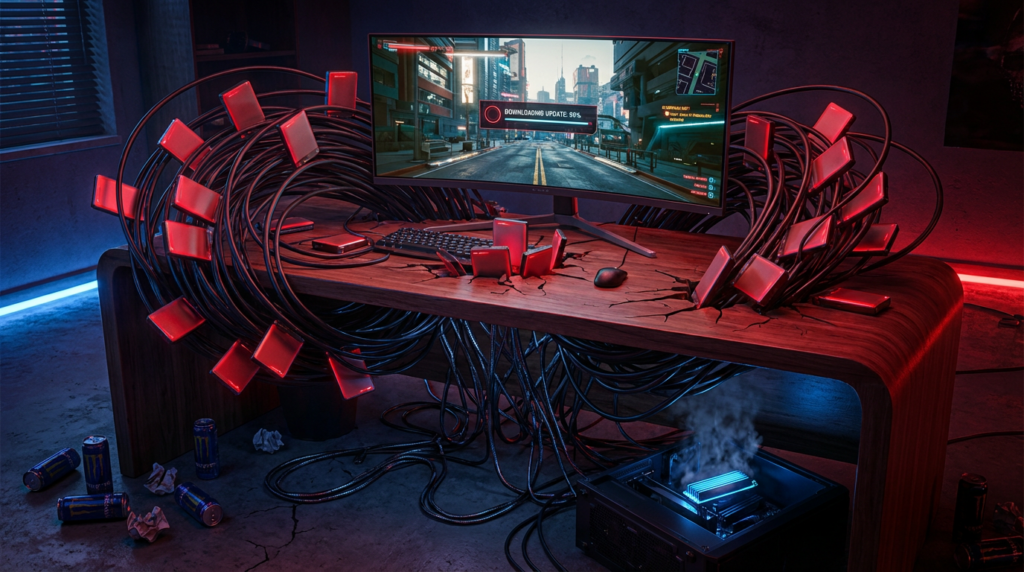
I remember when a 15GB install felt like a massive commitment, but developers now treat your hard drive like an all-you-can-eat buffet and they brought a very large shovel. We have entered the era of modern gaming bloat, where a single title like God of War Ragnarok demands nearly 200GB just to sit on your SSD. It is not just about high-res textures. It is a cocktail of unoptimized files, uncompressed audio, and feature creep that turns your console into a glorified storage locker.
You should not have to uninstall half your library just to see Kratos’s pores in 4K. While the industry tries to convince us that bigger always means better, most of that extra weight is just digital vanity and lazy packaging. We are being sold immersion at the cost of efficiency, leaving us with games that are massive in scale but surprisingly thin on actual substance. If a game needs more space than the entirety of NASA’s archives to tell a twenty-hour story, someone in development forgot how to use a delete key.
Key Takeaways
- Modern game install sizes are a failure of optimization, driven by uncompressed files, mandatory language packs, and 4K textures that many players’ hardware cannot even utilize.
- Massive open-world maps have replaced organic discovery with repetitive ‘digital chores’ and map markers designed to pad playtime rather than provide meaningful engagement.
- Excessive feature creep, such as shallow crafting systems and fractional skill tree buffs, serves as a psychological trick to inflate engagement metrics at the expense of core gameplay quality.
- The gaming industry must prioritize efficiency and craftsmanship over sheer scale, as massive file sizes and bloated content often mask a lack of actual substance and soul.
Huge Textures And Tiny Brains Behind The Install Size
It is time we stop pretending that a 200 gigabyte install size is a badge of honor instead of a massive failure in optimization. Developers are currently obsessed with forcing you to download every single 4K texture and uncompressed audio file regardless of whether you actually have the hardware to use them. You are essentially paying a storage tax for a hyper realistic puddle that you will probably jump over without a second thought. It is the ultimate display of tiny brain energy to bloat a game with files that serve no purpose other than to choke your SSD and slow down your weekend plans.
The sheer laziness of forcing every language pack on earth into a single mandatory download is where I truly lose my patience. I should not have to sacrifice space for three other games just because the studio decided that high quality French and Mandarin voiceovers are non negotiable for my English play session. This is not about being inclusive, it is about developers being too cheap to build a modular installer that respects your time and hardware. They treat your storage like a bottomless pit because they are too busy chasing visual benchmarks to care about basic efficiency.
We are being sold massive worlds that are really just massive folders full of redundant assets and unoptimized junk. When a modern remaster takes up ten times the space of the original game without offering ten times the content, you know the industry has lost the plot. It is a classic case of feature creep where quantity is masquerading as quality to justify a seventy dollar price tag. If a game needs more space than the entire library of a previous console generation, it better be good, not just a collection of very pretty rocks.
Map Markers And The Death Of Meaningful Discovery
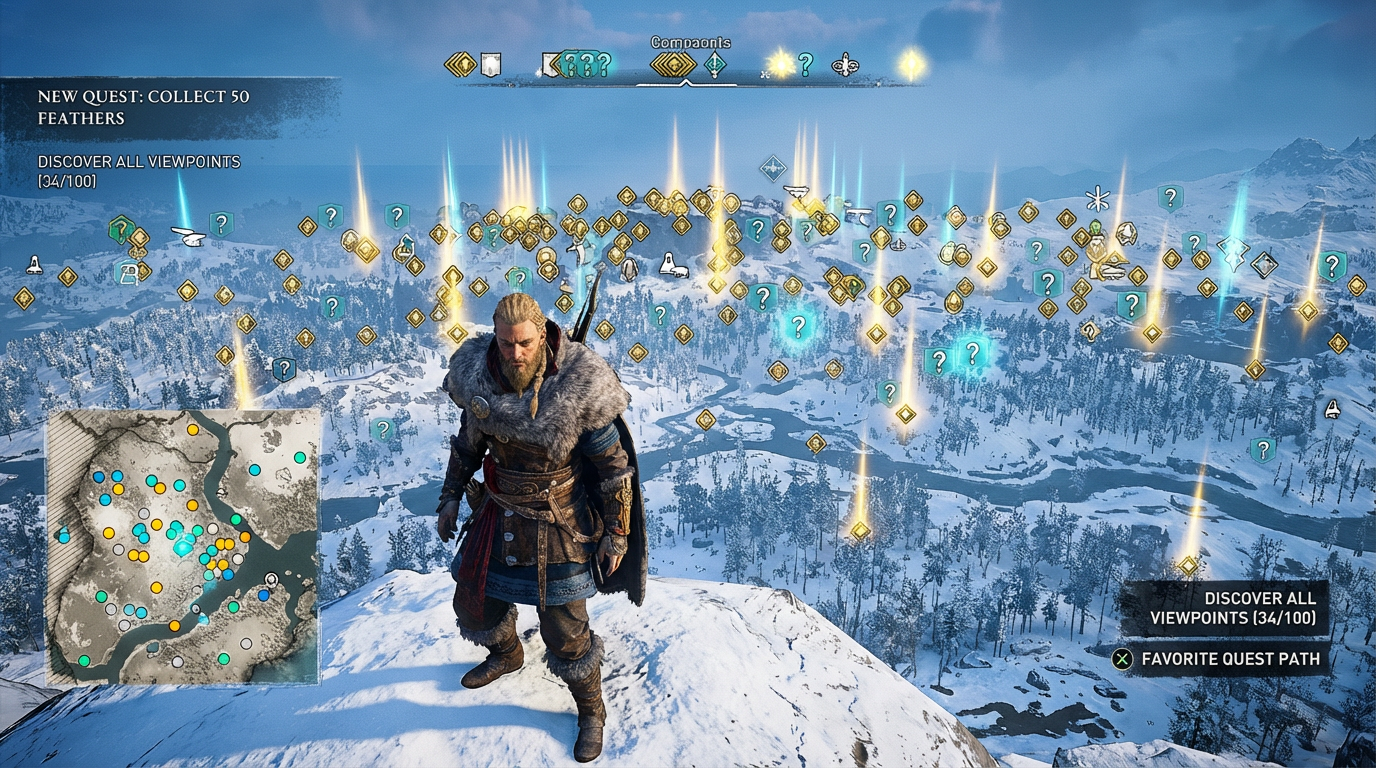
Modern open world design has devolved into a digital chores list that treats your free time like an infinite resource. We used to explore horizons because something looked interesting, but now we just stare at a mini-map saturated with icons until our eyes bleed. These Ubisoft towers and their clones do not offer discovery, they offer a repetitive loop of climbing a structure to reveal a hundred meaningless checkmarks. It is a lazy substitute for organic world-building that forces you to spend forty hours doing digital housework just to see the credits roll. When every square inch of a map is pre-labeled with a glowing waypoint, the actual sense of adventure is the first thing to die.
The sheer physical scale of these games is equally offensive, with install sizes ballooning toward nearly 200GB for assets you will probably never notice. Developers cram these worlds with thousands of high-resolution pebbles and identical collectible trinkets that serve no purpose other than to justify a 100+ hour marketing claim. You are essentially paying for the privilege of hosting a massive, unoptimized data hoard on your SSD that lacks any real soul. It is a bloated arms race where quantity has completely strangled quality, leaving us with massive playgrounds that feel as empty as a vacant shopping mall. If a game requires more storage space than a small operating system, it better offer more than three variations of a fetch quest.
We need to stop pretending that more content automatically equals a better experience for the player. A tight, ten-hour masterpiece like the original Portal is worth more than a hundred hours of chasing feathers or collecting hidden packages in a lifeless desert. This industry obsession with map density is just a distraction from the fact that many of these worlds have nothing interesting to say. I would much rather have a smaller, handcrafted environment where every corner tells a story than a continent-sized map filled with procedural garbage. It is time to start valuing our time and our hard drive space by demanding games that actually respect the art of the journey.
Feature Creep And Mechanics Nobody Actually Asked For
Modern gaming has become a dumping ground for half-baked mechanics that feel more like a chore list than a hobby. Developers seem terrified that if you are not constantly managing an inventory or staring at a skill tree, you might actually realize the core gameplay is paper-thin. We are currently drowning in survival lite elements where every protagonist, regardless of their background, is suddenly a master blacksmith capable of turning scrap metal into a legendary sword. These systems do not add depth, they just add hours of busywork to a map that was already too big to begin with. You spend half your session picking digital flowers or breaking down junk just to engage with the actual game.
The obsession with base-building is perhaps the most egregious offender in the quest to waste your precious limited free time. Unless I am playing a dedicated simulation game, I have zero interest in playing interior decorator for a camp of NPCs who do not contribute anything to the plot. These features are often tacked on as a checkbox for marketing departments to claim the game has hundreds of hours of content when they really mean hundreds of hours of filler. It is a transparent attempt to justify a massive install size that eats up your entire SSD. We are trading quality for sheer mass, and the result is a library of games that feel like second jobs rather than entertainment.
Skill trees have also mutated from meaningful progression into a confusing mess of fractional percentage buffs that nobody actually asked for. Opening a menu to spend a point on a 2 percent increase to crouch speed is not a reward, it is a psychological trick to make you feel like you are accomplishing something. This bloat exists purely to keep you logged in longer, padding out the runtime to satisfy engagement metrics that have nothing to do with fun. If a mechanic does not fundamentally change how I play the game, it should not be taking up space on my hard drive or in my brain. We need to stop rewarding developers for over-stuffing their titles and start demanding games that respect our time and storage capacity.
Stop Burying the Fun in File Size
The industry needs to realize that a 150GB install size is not a badge of honor, it is a failure of discipline. We are being held hostage by unoptimized textures and five dozen languages we will never speak, all while our SSDs scream for mercy. It should not take a weekend-long download and a dedicated hardware upgrade just to see a hyper-realistic horse’s coat. Developers seem to think that more is always better, but they are actually just burying the fun under a mountain of digital clutter. I would much rather have a tight, polished experience than a bloated mess that treats my storage space like a dumping ground.
Stop mistaking a map the size of a small country for actual gameplay depth. I am tired of spending half my limited free time trekking across empty tundras just to reach a repetitive fetch quest that adds nothing to the story. There is a specific kind of exhaustion that sets in when you realize a game is intentionally wasting your time to pad out its completion metrics. I do not need three hundred identical collectibles or a crafting system with forty different types of ore. Just give me a reason to care about the world you built instead of making me feel like I am clocking into a second job.
The next time a triple-A behemoth asks me to clear my entire drive for the privilege of playing it, I am hitting the delete button instead. There is a 20MB indie gem sitting in my queue that offers more soul and creativity than most of these resource-heavy giants combined. If your game cannot justify its footprint with meaningful innovation, it does not deserve a spot on my console. This is especially true when unoptimized AAA ports continue to plague the market, demanding top-tier specs for mediocre performance. I am officially choosing quality over quantity and reclaiming my schedule from the clutches of feature creep. Let the era of the bloated, hundred-hour chore finally come to an end so we can get back to playing things that are actually fun.