

We’ve all been there: you’re staring at a locked door in a video game, and instead of hunting for a glowing blue keycard like a well-trained lab rat, you decide to stack three wooden crates, climb onto a chandelier, and bypass the security grid entirely. That’s the magic of immersive sim essentials, a design philosophy that treats players like intelligent adults rather than mindless button-mashers. It’s about a world that actually reacts when you toss a toaster into a bathtub or hack a turret to do your dirty work, turning the environment into a playground of glorious, unscripted chaos.
But the immersive sim tag isn’t just a badge of honor for cult classics anymore; it’s aggressively bleeding into the real world through high-end industrial XR tech. Whether you’re ghosting through a high-security digital bank or using a VR headset to simulate a complex engineering disaster, the core rules of systemic consistency remain the same. If the world doesn’t follow its own logic, the illusion breaks, and you’re left with a shallow experience that’s worth an immediate uninstall. Success in this genre, and increasingly in modern industry, depends on giving the user the tools to break the rules in all the right ways.
Key Takeaways
- Systemic consistency is the foundation of immersive design, ensuring the environment reacts to universal logic rather than scripted sequences.
- True player agency is achieved by providing a toolbox of interlocking systems that allow users to bypass obstacles through emergent, unscripted solutions.
- Environmental storytelling replaces intrusive cinematics by rewarding observant players who piece together narratives through functional clues and organic world-building.
- The core principles of immersive sims are increasingly vital in industrial XR and engineering simulations, where digital environments must follow real-world logic to remain effective.
Systemic Consistency And The Rules Of Chaos
The true magic of an immersive sim lies in the fact that developers actually trust you to be a bit of a pyromaniac. Instead of scripting every single interaction, top-tier titles build a world governed by systemic consistency where logic actually dictates the outcome. If you see a puddle of water and an exposed electrical wire, you already know exactly what is going to happen to the guard standing in it. It is a refreshing change of pace to play a game where the environment reacts to your common sense rather than forcing you to find a specific keycard hidden in a desk drawer. This elemental logic creates a playground where your brain is the most powerful weapon in your inventory.
I live for those moments where I can intentionally break a mission using nothing but a couple of oil flasks and a well-placed gust of wind. When fire reliably spreads to wooden structures and gravity pulls heavy crates onto unsuspecting heads, the game stops being a series of hallways and starts being a laboratory for chaos. You are not just following a quest marker, you are exploiting the physics of the world to see how much disaster you can cause before the engine gives up. It is the highest form of flattery when a developer builds a system so robust that they do not mind if you bypass their entire level design with a clever bit of systemic tinkering.
This commitment to rigid rules is what separates the masterpieces from the mindless shooters that treat interactivity like an afterthought. There is a specific kind of smug satisfaction that comes from realizing a wooden door can be burned down instead of picked, or that a security bot can be short-circuited by a leaky pipe. These games do not just give you tools, they give you a set of universal laws and then get out of your way. It is smart, deep design that respects player intelligence enough to let us find the “wrong” way to win. When the rules of chaos are this consistent, every accidental explosion feels like a stroke of genius.
Player Agency Beyond The Scripted Path
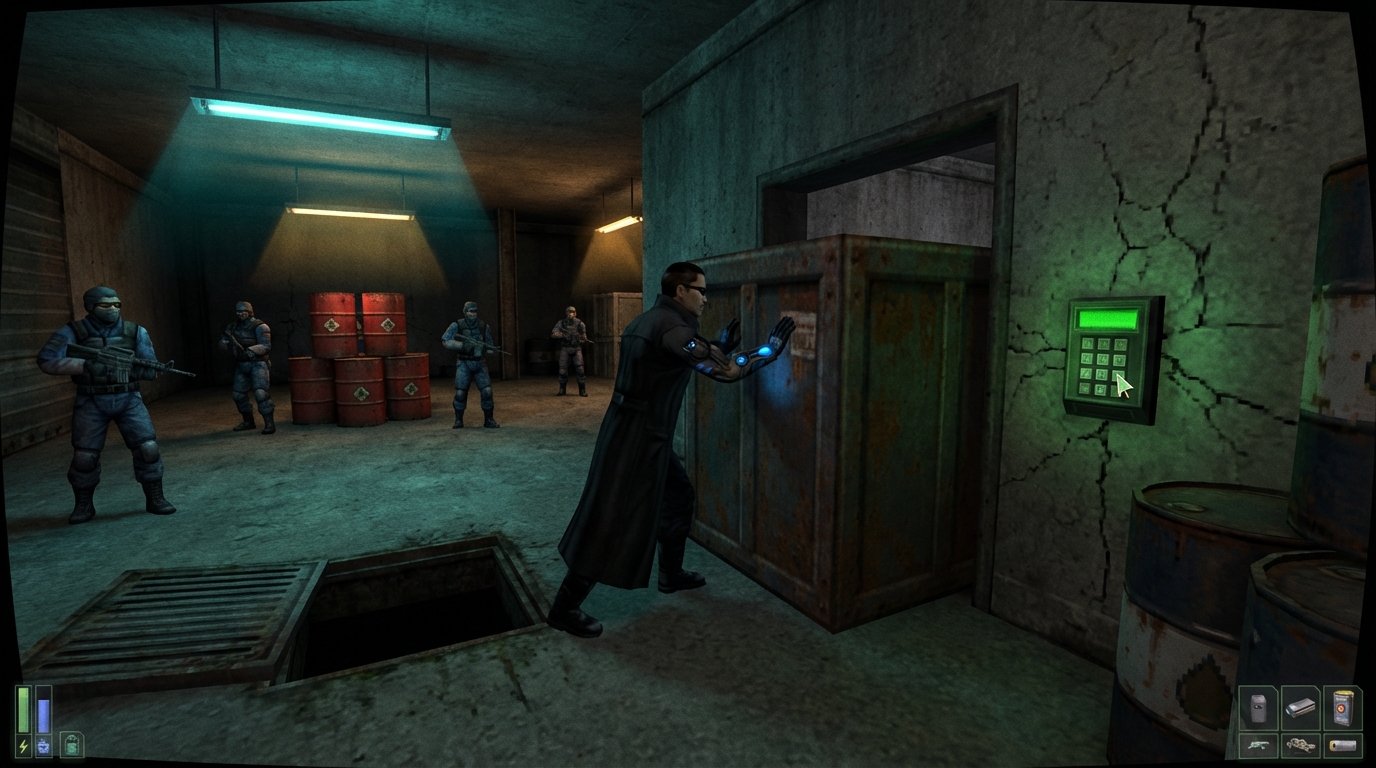
The true magic of an immersive sim lies in the distinct lack of a glowing breadcrumb trail leading you by the nose toward a scripted set piece. Instead of treating you like a toddler in a padded room, the best developers hand you a toolbox full of systemic toys and basically tell you to figure it out yourself. This 0451 philosophy prioritizes consistent rules, like fire always burning wood or electricity traveling through puddles, over rigid mission objectives. When you realize you can bypass a high security door not by finding a keycard, but by stacking crates to reach a vent or shorting out the terminal with a well placed EMP, the game finally stops being a movie and starts being a playground.
I have zero patience for games that pause the action to show me a cinematic of my character doing something cool that I should have been allowed to do myself. In a proper immersive sim, every obstacle is a logic puzzle with a dozen valid solutions rather than a binary pass or fail state dictated by a writer in a booth. If I want to spend three hours turning a guard’s own security turrets against him while I hide in a closet eating digital chocolate bars, the systems should let me. We rave about these games because they respect our intelligence enough to let us break them, proving that emergent gameplay will always be more satisfying than a thousand hours of motion captured cutscenes.
Environmental Storytelling And The Art Of The Note
In the world of immersive sims, developer restraint is often the greatest gift a player can receive. Instead of chaining you to a chair for a twenty minute cinematic lecture on geopolitical tensions, professional design trusts you to be a detective. You learn about the world by rummaging through a stranger’s desk, reading a frantic email about a missed shipment, or noticing the specific way a body was left near a locked safe. This approach respects your intelligence and keeps the momentum firmly in your hands. It turns every room into a puzzle where the solution is the story itself rather than just a keycard.
The true magic happens when the environment stops being a static backdrop and starts feeling like a lived in space. You might find a discarded note from a guard complaining about a faulty vent, only to realize that very vent is your ticket into the high security vault. This isn’t just flavor text, it is a functional piece of game design that rewards your curiosity with actual tactical advantages. When a game uses a blood spatter or a half eaten meal to tell you what happened ten minutes before you arrived, it builds a level of atmosphere that no pre rendered cutscene could ever hope to achieve. Environmental storytelling is the key to making these digital spaces feel authentic.
There is something deeply satisfying about piecing together a corporate conspiracy through nothing but trash and digital footprints. It creates a sense of presence that makes the world feel massive and indifferent to your existence, which is exactly why these games are so addictive. You are not being told a story, you are uncovering one that was already happening long before you hit the start button. This subtle art of breadcrumbing ensures that the narrative feels earned rather than forced. It is the difference between being a tourist in a theme park and an operative in a breathing, reactive world.
The Legacy Of Systemic Design
The magic of the immersive sim isn’t about having a massive map, but about the beautiful chaos that happens when systems actually talk to each other. When I played the genre’s pioneers for the first time, I realized that the developers weren’t just giving me a checklist of objectives, they were handing me a toolbox and a set of consistent physical laws. If a door is locked, I can find the key, hack the terminal, or just blow the hinges off with a well placed explosive because the world understands how fire and force work. This systemic consistency is what makes the best titles feel like living places rather than static movie sets. Modern games often brag about scale, but they usually lack that granular depth where every object in the room feels like a potential solution to a problem.
Modern classics proved that this design philosophy wasn’t just a relic of the nineties by giving us a playground where stealth and supernatural powers collided in hilarious ways. You haven’t truly lived until you have attached a mine to a rat, possessed that rat, and scurried it into a group of unsuspecting guards. This kind of emergent gameplay works because the rules are rigid enough to be exploited, allowing for player agency that feels earned rather than scripted. Unfortunately, many current AAA titles struggle to replicate this because modern stealth mechanics are often too afraid the player might miss a cool explosion if they aren’t forced down a narrow hallway. We see plenty of games with RPG elements nowadays, but very few have the guts to let the player break the mission using their own cleverness.
The legacy of these heavy hitters remains the gold standard because they respect the intelligence of the person holding the controller. In a world of quest markers and intrusive tutorials, the immersive sim asks you to actually look at your surroundings and think. Whether you are stacking cardboard boxes to bypass a high security fence or using a tranquilizer dart on a guard from a ventilation shaft, the satisfaction comes from the “aha” moment of outsmarting the level designer. We need more games that prioritize these deep, interlocking systems over shiny graphics and empty open worlds. Until then, I will keep going back to the classics to remind myself what it feels like when a game actually reacts to my choices.
Stop Playing Games That Hate You
It is time to put down the mindless corridor shooters that treat you like a toddler on a leash and start respecting the genre that actually assumes you have a functioning brain. Immersive sims are not just games, they are complex playgrounds built on logical systems that reward your ingenuity rather than your reflexes. When a game respects your intelligence enough to let us bypass a high security door by stacking crates or hacking a turret, it creates a level of satisfaction that a scripted explosion can never match. You deserve more than a flashing arrow telling you where to stand and which button to mash until the credits roll.
Stop settling for hollow experiences that prioritize shiny graphics over meaningful player agency and systemic consistency. Living in a world where fire actually burns wood and electricity travels through water makes every decision feel heavy and deliberate. You have the power to be a ghost, a chemist, or a chaotic force of nature, provided you are willing to actually think about the tools at your disposal. The industry will keep churning out mindless fluff as long as you keep buying it, so do yourself a favor and demand the depth you actually deserve. Since the immersive sim revival is finally here, go play something that challenges your perspective and rewards your curiosity instead of just wasting your time.
Frequently Asked Questions
1. What actually makes a game an immersive sim?
It is a design philosophy where the world follows consistent logic instead of scripted sequences. If you think you can bypass a lock by blowing up the door or stacking crates to reach a window, the game should actually let you do it.
2. Why is systemic consistency such a big deal?
It ensures the world reacts predictably to your actions. When the rules are consistent, you can plan complex strategies (like electrocuting a puddle) knowing the game engine won’t suddenly decide to ignore its own physics for the sake of a cutscene.
3. Are these games just for hardcore nerds?
Not unless you consider having a functioning brain a niche hobby. These games treat you like an adult by giving you a toolbox and letting you solve problems your own way instead of holding your hand through a hallway.
4. How does this gaming stuff translate to real-world industrial tech?
High-end industrial XR tech and engineering simulations use these same rules to predict disasters or test complex systems. If the digital environment does not follow real-world logic, the simulation is a useless piece of software that belongs in the trash.
5. Is an immersive sim just another name for an RPG?
No, because most RPGs still force you to find the “blue keycard” to progress. An immersive sim is defined by emergent gameplay where the environment is a reactive playground rather than a series of stat checks.
6. What happens when a game fails at these essentials?
The illusion breaks immediately and you are left with a shallow, frustrating experience. If the game’s rules change whenever it is convenient for the plot, it is a lazy design that deserves an immediate uninstall.
7. Can I play an immersive sim without being a stealth expert?
That is the whole point of the genre. You can be a ghost, a hacker, or a complete pyromaniac as long as you use the systems provided to achieve your goals.