We’ve all been there. You click to parry a boss’s overhead swing, but your character stands there like a lobotomized mannequin until three frames after you’re already dead. This is the soul-crushing reality of cloud gaming latency, the motion-to-photon delay that turns a high-octane shooter into a slideshow of your own failures. While streaming sounds like the future, physics is a stubborn jerk that doesn’t care about your subscription tier. If your input has to travel a thousand kilometers just to tell a server you want to jump, you aren’t playing a game. You’re sending a polite suggestion to a computer in another zip code.
The industry wants you to believe that 150ms of lag is basically console quality, which is a blatant lie told by people who haven’t played anything more demanding than Solitaire since 1998. To get a decent experience, you need to fight through network pings, physical distance, and the inherent sluggishness of video encoding. I am dissecting the cold, hard numbers behind the lag and why your fiber connection might still feel like dial-up. Stop pretending that every cloud-ready service is actually worth your time or your sanity.
Key Takeaways
- Physics imposes a non-negotiable floor on cloud gaming latency because the speed of light and network transit times create unavoidable delays that no subscription tier can solve.
- Cloud gaming introduces a ‘mushy visual tax’ caused by the mandatory time required to encode video on the server and decode it on your local device.
- While streaming is viable for turn-based or casual titles, it remains fundamentally unsuitable for competitive, twitch-reflex games where 150ms of lag ruins precision and responsiveness.
- Local hardware will always outperform the cloud because the physical distance between the processor and controller is measured in inches rather than hundreds of miles.
The Brutal Math Of Motion To Photon Latency
To understand why cloud gaming often feels like trying to run a marathon in a deep-sea diving suit, you have to look at the cold, hard physics of the round trip. The moment you click your mouse, that signal has to travel from your desk through a messy web of local routers and ISP hubs before it even reaches the server. Even if you live next door to a data center, you are already burning 15 to 20 milliseconds just on the initial commute. Once the server receives your input, it has to actually process the game logic and render a fresh frame of video. This adds another chunk of time to the tally, and we have not even started the return journey yet.
The real tragedy begins when that high-definition video frame has to be compressed, encoded, and shipped back across the internet to your monitor. This return trip is where the math turns truly brutal, as every 1,000 kilometers of fiber optic cable adds roughly 10 milliseconds of unavoidable delay. By the time your screen finally displays that muzzle flash, you are likely staring at a total latency of 150 milliseconds or more. In a fast-paced shooter, that is the difference between a headshot and staring at a respawn timer. You are essentially playing in the past, reacting to ghosts that have already moved five frames ago.
Marketing teams love to promise a console-quality experience, but they usually forget to mention that physics does not take bribes from subscription services. While a 100 millisecond delay sounds small on paper, it creates a disconnected sensation where your hands and eyes are constantly out of sync. This input lag turns precision platformers into guessing games and makes twitch-reflex fighters feel like they are underwater. Unless you have a direct fiber line plugged into the server’s motherboard, you are going to feel that weight. It is not just a minor annoyance, it is a fundamental break in the link between player and game.
Why Fiber Optics Can Not Defy Physics
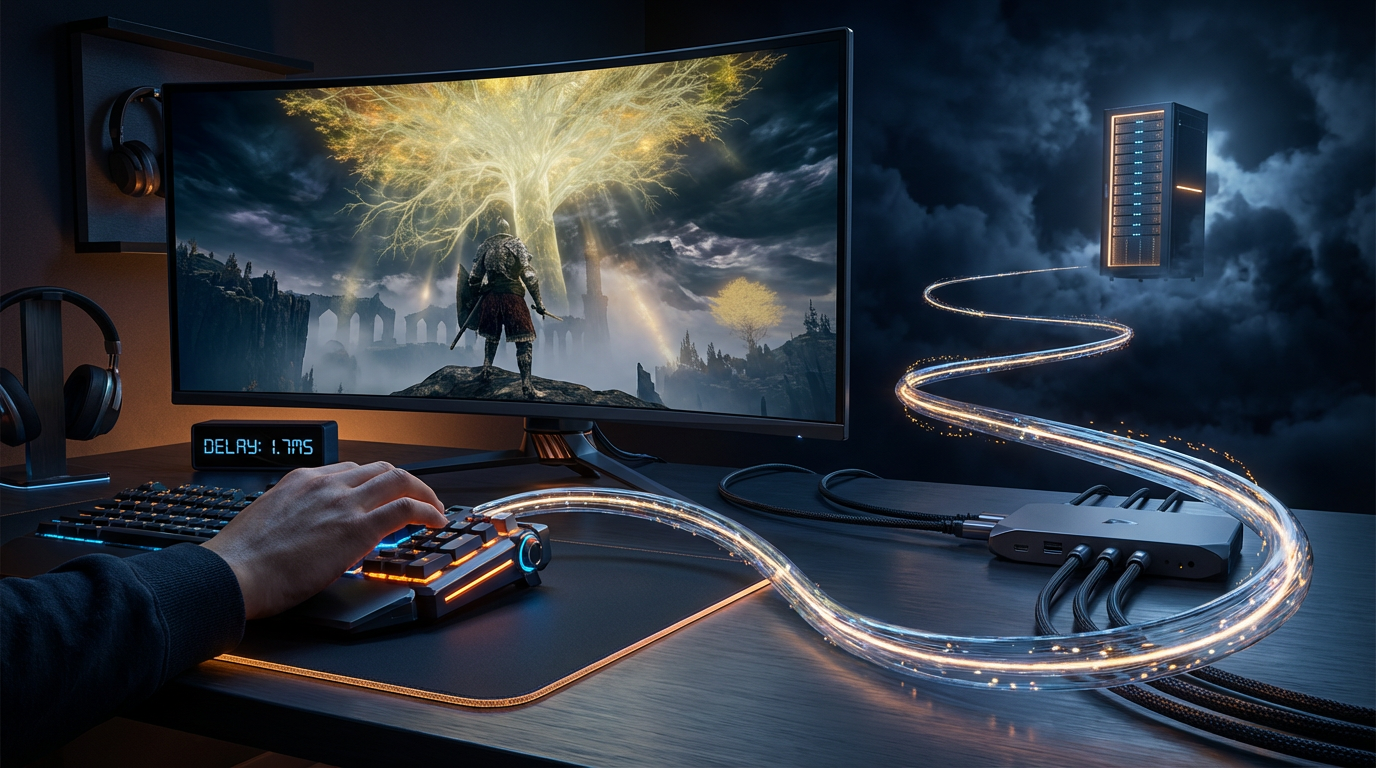
Marketing teams love to toss around edge computing like it is some magical fairy dust that deletes physics, but the reality is much grimmer. Even if you have a top tier fiber connection, your data still has to travel through a physical maze of switches, routers, and glass cables to reach a server. Light in a fiber optic cable moves about thirty percent slower than it does in a vacuum, meaning every hundred miles of distance adds a measurable tax to your reaction time. You cannot patch the speed of light, and you certainly cannot optimize your way out of the fundamental laws of the universe. If you are playing a frame-perfect fighter or a competitive shooter, those few extra milliseconds of travel time are the difference between a killstreak and a broken controller.
The industry hides behind buzzwords to distract you from the fact that the cloud is just someone else’s computer located three states away. When you press a button, that signal has to make several hops through various network nodes, and each stop adds a tiny bit of processing delay. Even if the server renders the frame in a blink, it still has to encode that image into a video stream and ship it back to your house. This back-and-forth transit creates a persistent floor for latency that no amount of clever software can fully eliminate. While a 150ms round trip might feel fine for a turn-based strategy game, it feels like wading through knee-high molasses in a high-speed twitch gamer’s world.
Don’t let a slick presentation convince you that a data center in a different zip code is just as good as a console under your television. Local hardware will always win because the distance between your controller and your processor is measured in inches, not hundreds of miles. Cloud providers are essentially asking you to accept a permanent handicap in exchange for the convenience of not owning a box. They can build all the server farms they want, but until they figure out how to teleport data instantaneously, the lag is here to stay. Stop pretending that close enough is the same thing as instant, especially when your rank is on the line.
Encoding Bottlenecks And The Mushy Visual Tax
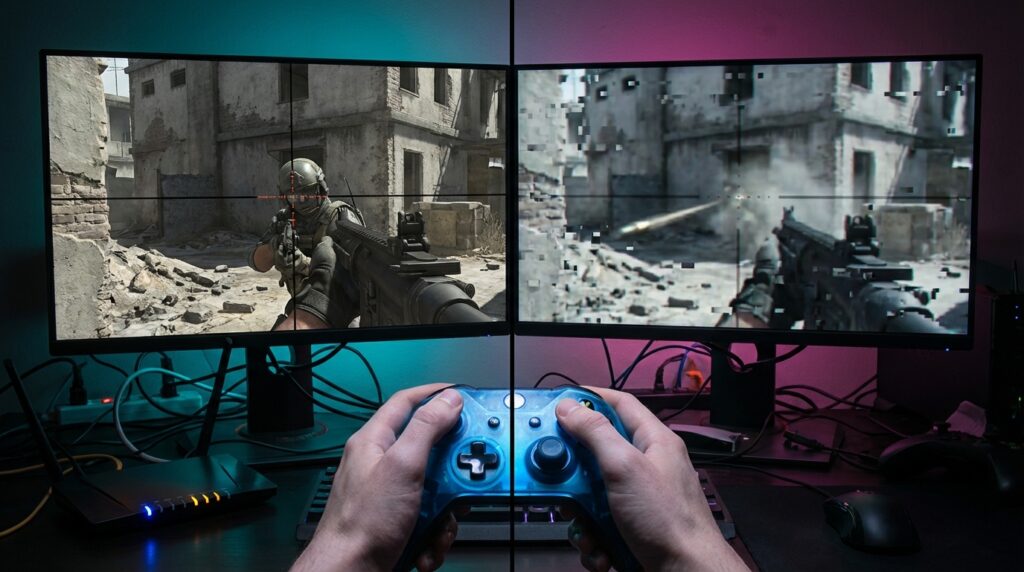
The moment you press the fire button, your input has to begin a grueling marathon before anything actually happens on your monitor. While the server is busy rendering your headshot, it has to compress that raw data into a video stream using codecs like H.264 or HEVC to keep your bandwidth from exploding. This encoding process adds a mandatory tax on your reaction time, turning what should be a crisp snap-aim into a sluggish suggestion. By the time the server finishes packing those pixels, your opponent has already moved, and you are left shooting at a ghost of the past. It is a fundamental physics problem that no amount of marketing jargon about hyper-scale infrastructure can actually solve.
Once that compressed data packet finally reaches your house, your local hardware has to scramble to unpack the mess. This client-side decoding adds another layer of mushy visual tax to the experience, creating a heavy, underwater sensation that makes high-speed shooters feel like you are playing through a vat of syrup. Even if you have a top-tier fiber connection, the milliseconds lost during this digital gift-wrapping process are enough to ruin your K/D ratio in a competitive environment. You might see a beautiful image, but the disconnect between your hand and the screen makes the game feel unresponsive and greasy. It is the visual equivalent of trying to perform surgery while wearing oven mitts and looking through a telescope.
This cumulative delay is what I like to call the mushy visual tax, and it is the primary reason cloud gaming still feels like a compromise. For a casual RPG or a turn-based strategy game, these extra frames of latency are a minor annoyance you can eventually ignore. However, the second you hop into a twitch-reflex game where every frame is sacred, the tech falls apart faster than a budget controller. Subscription services want you to believe that the hardware in the cloud is just as good as the box under your TV, but they conveniently forget to mention the processing overhead. Until we figure out how to transmit and decode data at the speed of thought, streaming will remain the participation trophy of serious gaming performance.
The Millisecond Between Victory and Garbage
Cloud gaming is currently stuck in a frustrating middle ground where it is technically impressive but practically flawed for anyone with a pulse. If you are playing a turn based strategy game or a cozy farm simulator, the minor input delay feels like a distant thought rather than a dealbreaker. However, the second you hop into a high stakes shooter where every millisecond determines whether you win or eat dirt, the illusion of a local experience completely evaporates. You can have the fastest fiber optic connection on the planet, but physics does not care about your subscription tier when data has to travel hundreds of miles. It is less of a revolution and more of a compromise for people who value convenience over actually hitting their targets.
The industry wants you to believe that 150 milliseconds of latency is an acceptable sacrifice for the luxury of not owning a console. In reality, that delay turns twitch reflex games into a muddy, unresponsive mess that feels like you are playing through a vat of syrup. While server tech is getting better, the physical reality of network congestion and distance means cloud gaming remains fundamentally unsuitable for the competitive crowd. Unless you enjoy the sensation of your character reacting to your commands on a three second delay, stick to local hardware for anything that requires precision. Even if you have a $3,000 PC, it is a viable secondary option for travel or casual play, but calling it the future of serious gaming is just marketing fluff designed to sell you a recurring bill.
Frequently Asked Questions
1. What exactly is motion to photon latency?
It is the total time it takes for your physical button press to travel to a server, get processed, and show up as an action on your screen. In the cloud, this is a grueling relay race where every millisecond of delay makes your character feel like they are underwater. If this number is too high, you are basically playing a game via carrier pigeon.
2. Is my high speed fiber connection enough to stop the lag?
Bandwidth is just the size of the pipe, but latency is how fast the water actually moves. You can have a billion gigabit connection and still suffer if you live a thousand miles from the server. Physics does not care about your expensive internet plan if the round trip takes longer than a human reflex.
3. Why does cloud gaming feel worse than playing on a console?
A console sits three feet away and talks to your TV instantly, while the cloud has to encode, compress, and ship video frames over the open internet. This adds layers of digital sludge that even the best hardware cannot fully erase. You are trading responsiveness for the convenience of not owning a black box under your TV.
4. Is 150ms of latency actually playable?
Only if you are playing a turn based card game or something that requires the reflexes of a tectonic plate. For shooters or fighting games, 150ms is an absolute dumpster fire that will result in you dying before you even see the enemy. Anyone telling you otherwise is likely trying to sell you a subscription you do not need.
5. Why is the video quality sometimes blurry?
The server has to squeeze a high definition image into a tiny data packet to send it to you, which takes precious time. This compression process is why fast movement often looks like a blurry mess of Lego bricks. It is a constant battle between image quality and the speed of your inputs. If you want to see how fast games should actually feel, check out our guide to boomer shooters where speed and precision are everything.
6. Can I do anything to make my cloud gaming experience less terrible?
Stop using Wi-Fi immediately and plug in an ethernet cable to cut out local interference. You should also pick the data center closest to your actual house, not just the one with the coolest name. If it still feels like trash, it is probably because the service itself is not ready for prime time. If you want the best performance, checking out a shiny new GPU on local hardware is still the only way to play without compromise.