
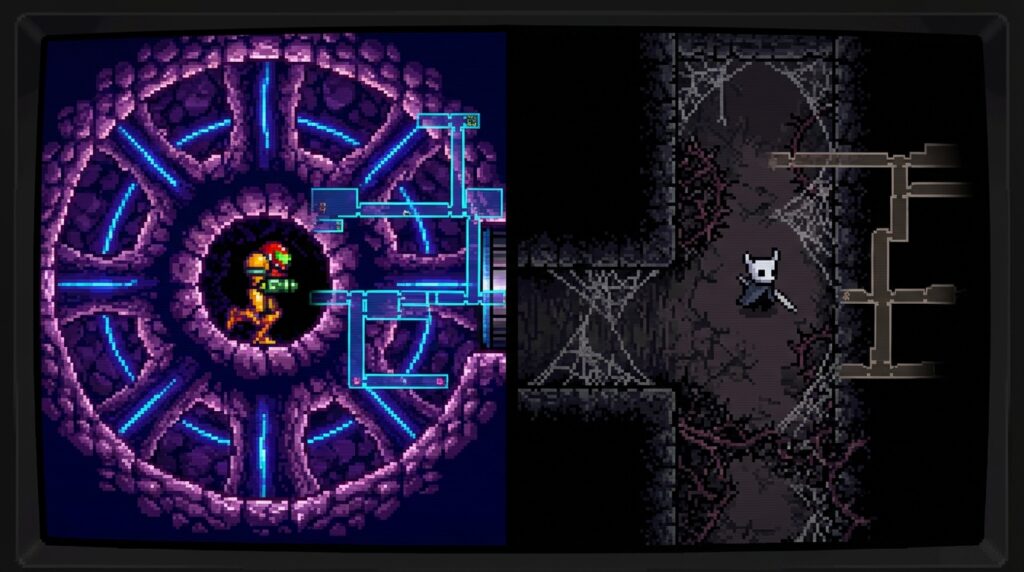
There is nothing quite as satisfying as staring at a complex web of corridors and realizing that the dead end you saw two hours ago is actually the front door to a secret boss. Modern metroidvania map design has moved past the era of mindless hallways, evolving into a living, breathing organism where every ledge and locked door serves a psychological purpose. If a developer does their job right, you aren’t just playing a game; you’re performing a mental autopsy on a world that refuses to give up its secrets without a fight.
The magic happens when ability-gating stops feeling like a chore and starts feeling like a superpower. We’ve all dealt with lazy backtracking that feels like a commute to a job you hate, but the best maps recontextualize old ground until it feels brand new. When a simple double-jump turns a previously impossible cliff into a shortcut, the map stops being a static image and becomes a puzzle that rewards you for actually paying attention.
Key Takeaways
- Meaningful ability-gating must feel like a character evolution that turns the environment into a playground, rather than an arbitrary roadblock like a keycard that merely pads playtime.
- Effective map design utilizes ‘recontextualization’ to transform backtracking into a victory lap, where new skills turn previous obstacles into rewarding shortcuts or hidden pathways.
- The ‘shortcut epiphany’—discovering a loop back to a central hub—is a superior design tool to fast travel, as it maintains world immersion and rewards the player’s spatial memory.
- Wayfinding should rely on organic environmental cues like unique lighting and architecture rather than intrusive UI elements, keeping the player engaged with the world’s physical layout.
Ability Gating Versus Arbitrary Roadblocks
The difference between a brilliant Metroidvania and a tedious slog usually comes down to whether the developer respects your intelligence or just wants to waste your Saturday. True ability-gating is a beautiful thing because it turns the world into a puzzle where your growing power set is the solution. When you finally get that double jump or air dash, the map transforms from a series of walls into a playground of new opportunities. It feels earned because you didn’t just find a key, you evolved as a player to overcome a physical limitation. This kind of design makes backtracking feel like a victory lap rather than a mandatory commute through areas you already cleared.
On the flip side, we have the arbitrary roadblock, which is basically the developer’s way of saying they ran out of ideas. There is nothing more soul-crushing than finding a door that only opens with a Blue Orb or a specific keycard that serves no purpose other than to stop your progress. This isn’t gameplay, it is just a grocery list disguised as an adventure. It shatters the illusion of a cohesive world and reminds you that you are just a rat in a maze waiting for the scientist to click a button. These literal locks are the hallmarks of lazy design that prioritize padding the game’s length over actual mechanical depth.
When a game relies on these cheap tricks, the interconnectedness of the map starts to feel like a series of disconnected hallways. Instead of looking at a ledge and thinking about which skill might get you up there, you just sigh and wait for the game to hand you the specific item it decided you needed. Great map design should feel like a conversation between the player and the environment, not a security guard demanding to see your credentials. If I wanted to wander around looking for lost keys, I would just try to leave my house in the morning. We play these games to feel powerful, not to act as an unpaid locksmith for a world that refuses to let us explore.
The Psychology Of Rewarding Backtracking
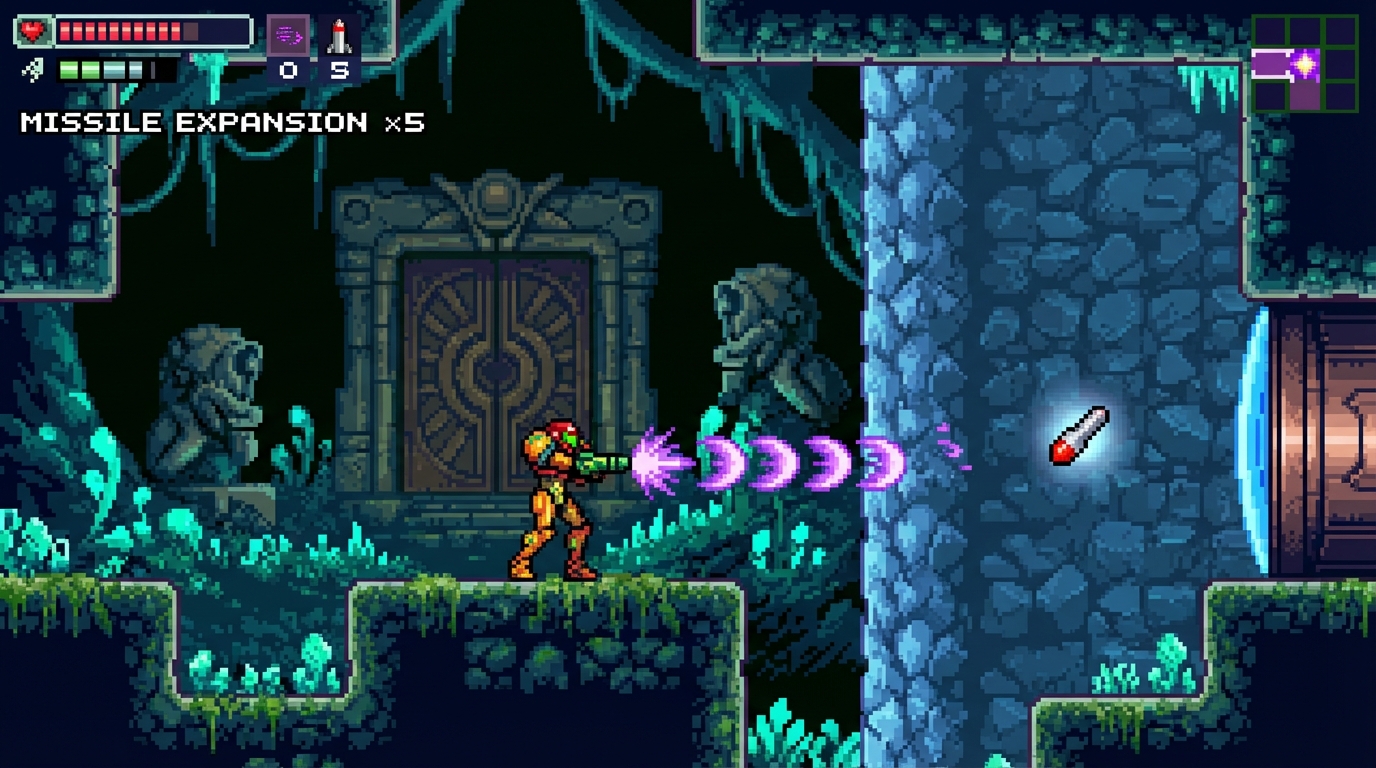
Backtracking shouldn’t feel like you are being punished for forgetting your keys, but lazy developers often treat it that way. We have all suffered through those corridor simulators where you are forced to jog through the same lifeless hallway five times just to flip a switch. It is a cheap tactic used to artificially pad the runtime of a game without actually adding any substance. When a map is designed poorly, returning to an old area feels like an administrative chore rather than an adventure. If I am staring at my phone while holding the joystick forward, the game has officially failed to respect my time.
Modern masterpieces understand that the secret to a great map is recontextualization. Instead of just making you walk back through the same room, these games use new abilities to turn old obstacles into minor inconveniences or hidden gateways. That high ledge you couldn’t reach three hours ago isn’t just a wall anymore, it is a glowing invitation to a secret boss or a permanent health upgrade. This creates a psychological eureka moment that makes the player feel clever for remembering a specific location. You aren’t just retreading old ground, you are conquering it with your new kit.
The best world designs treat the map like a single, living organism where every vein and artery serves a purpose. Short-cutting through a zone you once struggled with provides a tangible sense of growth that a simple level-up screen can never replicate. When a developer nails this interconnectedness, the world feels dense and intentional rather than a series of disconnected boxes tied together by boring transit. It is the difference between a commute and an exploration, and it is exactly why some games stay installed while others get deleted after the first hour. Smart design ensures that every trip back to the starting zone feels like a victory lap rather than a funeral march.
Navigational Flow And The Shortcut Epiphany
There is nothing quite as soul-crushing as realizing a developer expects you to manually trudge through five screens of respawning trash mobs just to turn in a quest. Lazy map design treats backtracking like a mandatory sentence in gaming purgatory, forcing you to stare at the same tilesets until your eyes bleed. We have all played those titles where the world feels like a series of disconnected hallways held together by boredom and bad intentions. When a game lacks a cohesive flow, the map stops being an invitation to explore and starts feeling like a chore list from a particularly unimaginative boss. You can practically smell the desperation when a developer pads out the runtime by making you walk the long way around for the tenth time.
The true magic of a well-constructed Metroidvania happens during that glorious moment when you unlock a door from the wrong side and realize you are back at the starting hub. This shortcut epiphany is the ultimate reward for your curiosity, instantly shrinking a massive world into a manageable, interconnected organism. It is the architectural equivalent of a get out of jail free card, sparing you from a twenty-minute trek through a poison swamp you never wanted to see again. Good design ensures that every new ability does not just let you jump higher, but fundamentally recontextualizes the ground you have already covered. These loops turn the map into a puzzle that rewards your memory rather than just testing your patience.
Modern classics understand that fast travel is often just a bandage for a map that is fundamentally tedious to navigate. If I am constantly staring at a loading screen because your world is a nightmare to traverse, you have failed the most basic tenet of the genre. A masterfully designed environment makes the act of movement itself a joy, turning the journey into something as satisfying as the destination. We should be celebrating the clever vents and hidden elevators that make the world feel alive and reactive to our progress. When a shortcut clicks into place, it is a high-fiving acknowledgement from the developer that they actually value your time.
Wayfinding Tools And The Fast Travel Trap

Fast travel is the ultimate double edged sword in Metroidvania design because it often serves as a lazy apology for a world that is a chore to navigate. When a developer realizes their map is a sprawling, disconnected mess of boring hallways, they slap down a bunch of teleportation portals and call it a day. This band-aid approach completely kills the magic of a cohesive world and turns the experience into a series of loading screens rather than a continuous journey. You aren’t exploring a living organism anymore, you are just clicking icons on a menu because the actual act of walking through the environment is soul crushing. A truly great map should make you want to walk through it, not look for the nearest exit strategy the moment you finish a boss fight.
The best wayfinding tools don’t involve a glowing GPS line or a cluttered mini map that does all the thinking for you. Instead, smart designers use psychological cues like environmental cues, distinct architectural silhouettes, and clever environmental storytelling to guide your subconscious. When I see a giant glowing tower in the distance or a specific type of moss that only grows near water, I know exactly where I am without pausing the game every thirty seconds. This type of intuitive design turns the map into a puzzle you solve with your eyes rather than a chore you manage with a cursor. Relying on organic landmarks keeps the immersion intact and rewards players for actually paying attention to the gorgeous world the art team spent years building.
Backtracking should feel like a victory lap where your new abilities turn old threats into minor inconveniences. If I have to trek across the entire world just to use a double jump on one specific ledge, the path back better be filled with new secrets or shortcuts that make the trip worthwhile. Lazy design forces you to walk the exact same empty corridor four times, whereas brilliant design recontextualizes that space with every new power up you earn. We should be celebrating maps that feel like a giant, interconnected clockwork mechanism where every gear serves a purpose. If your fast travel system exists only because your world is too tedious to walk through twice, you haven’t built a world, you have built a commute.
The Map: A Living Organism or a Hallway Simulator?
Ultimately, the map isn’t just a guide to the world, it is the actual heart of the experience that determines whether you are playing a masterpiece or a glorified errand simulator. You can have the tightest combat and the most beautiful pixel art in the industry, but if your layout feels like a sequence of disconnected hallways, your game is dead on arrival. A truly great Metroidvania treats its map as a single, living organism where every corridor serves a specific psychological purpose. We have all played those titles where the world feels like a chore to navigate, proving that if the geography is boring, the entire game fails. The map is the true protagonist because it is the only character that forces you to think, adapt, and eventually master its secrets.
Lazy developers love to hide their lack of inspiration behind backtracking bloat and hallways that lead to absolutely nowhere. There is a massive difference between returning to an old area to unlock a meaningful shortcut and being forced to trek across the entire world because the designer forgot to include a fast travel point. When a game respects your time, every new ability recontextualizes the ground you have already covered, turning an old obstacle into a fresh opportunity. Much like how the immersive sim revival has proven that player agency is paramount, we should stop rewarding games that treat interconnectedness as a buzzword for making us run in circles without a purpose. If a map does not make you feel like a genius for discovering a hidden path, it is just a digital labyrinth designed to waste your hard drive space.
Frequently Asked Questions
1. What is the secret to making a map feel like a living organism?
A great map uses every ledge and locked door to mess with your head until you finally unlock the secret. It stops being a static drawing and becomes a mental autopsy where you piece together how the world actually functions. If the developer is doing their job, you should feel like the world is actively fighting to keep its secrets from you.
2. Why does backtracking feel like a chore in some games but not others?
Lazy backtracking feels like a morning commute to a job you hate because the world never changes. The best maps recontextualize old areas so that a new power makes a previously impossible cliff feel like a simple shortcut. It turns a boring walk into a victory lap that rewards you for actually paying attention to your surroundings.
3. What is the difference between ability gating and a boring roadblock?
Ability gating is a beautiful puzzle where your growing power set is the literal solution to the environment. Roadblocks are just lazy design choices like Blue Orbs or keycards that exist because the developer ran out of ideas. One makes you feel like you are evolving, while the other just wastes your Saturday with mindless fetch quests.
4. How should a new ability change the way I look at the map?
A new ability like a double jump or air dash should transform a series of walls into a playground of new opportunities. It should make you realize that the dead end you saw two hours ago was actually a front door in disguise. If a power doesn’t make you rethink every screen you have already visited, it is probably a boring mechanic.
5. Is it better for a map to be complex or straightforward?
Complexity is king because nothing beats the satisfaction of realizing a massive web of corridors is actually interconnected. A straightforward map is just a hallway with a paint job, which is an insult to your intelligence. You want a world that respects you enough to let you get lost before you finally master its layout.
6. Why is evolving as a player better than just finding a key?
Finding a key is a binary task that any toddler can handle, but mastering a new physical limitation feels earned. When you use a new skill to bypass an obstacle, you are proving you have grown alongside the character. It turns the map into a physical manifestation of your progress rather than a grocery list of items to find.