There is no betrayal quite like sinking 80 hours into a game only to be slapped in the face by a nonsensical plot twist or a lazy fade-to-black. We have all been there. You stare blankly at the screen while the credits roll, realizing you just witnessed one of the worst video game endings in history. It turns a potential masterpiece into a shiny coaster and proves that some writers clearly clocked out right before the final boss fight.
Take Cyberpunk 2077. Your grand reward for conquering Night City is essentially choosing which flavor of inevitable death you prefer. It is a special kind of cruelty when a game strips away your agency in the final hour just to seem edgy or profound. If I wanted a lecture on the bleak futility of existence, I would have saved my cash and just turned on the news.
Key Takeaways
- Disregarding player agency through arbitrary choices or illogical plot devices, such as Mass Effect 3’s color-coded finale or Fallout 3’s forced sacrifice, betrays the core promise of role-playing games.
- Narrative conclusions that offer only varying degrees of tragedy and hopelessness, like Cyberpunk 2077, often prioritize artistic themes over rewarding the player’s struggle with a satisfying resolution.
- Game endings that invalidate the player’s effort—whether through mandatory replays or rendering previous choices meaningless—demonstrate a profound lack of respect for the user’s time.
- A nonsensical or lazy finale does not just ruin the game’s final moments; it retroactively devalues the entire experience and breaks the trust between developer and player.
Mass Effect 3 and the RGB Cupcake Disaster
After pouring hundreds of hours into a galactic opera where every decision supposedly rippled across the cosmos, we expected a finale that reflected our specific journey. Instead of a nuanced conclusion tailored to whether you cured the genophage or romanced a bird-man, BioWare handed us a multiple-choice quiz proctored by a glowing space toddler. You reach the climax of the most ambitious narrative in gaming history only to find out your previous choices amount to absolutely nothing. It feels like agonizing over a dinner menu for three years just to be force-fed the same stale cupcake with three different colors of frosting. The sheer audacity to boil down complex political maneuvering into a literal “pick your favorite color” minigame is insulting to anyone with a pulse.
The logic here is baffling. The game essentially asks you to choose which color filter you want to apply to the exact same explosion cinematic. You can pick the Red ending to destroy the Reapers, the Blue ending to control them, or the Green ending if you want to force creepy transhumanism on the entire galaxy without asking. Regardless of which tube you walk towards, the Normandy crashes, the relays blow up, and you are left wondering why you bothered saving the Rachni Queen back in the first game. It turns the complexities of war and diplomacy into a simplistic decision that completely ignores the nuance of the universe you fought to save. This isn’t closure. It is a lazy narrative slap in the face disguised as high-concept sci-fi philosophy.
Cyberpunk 2077s Menu of Absolute Misery
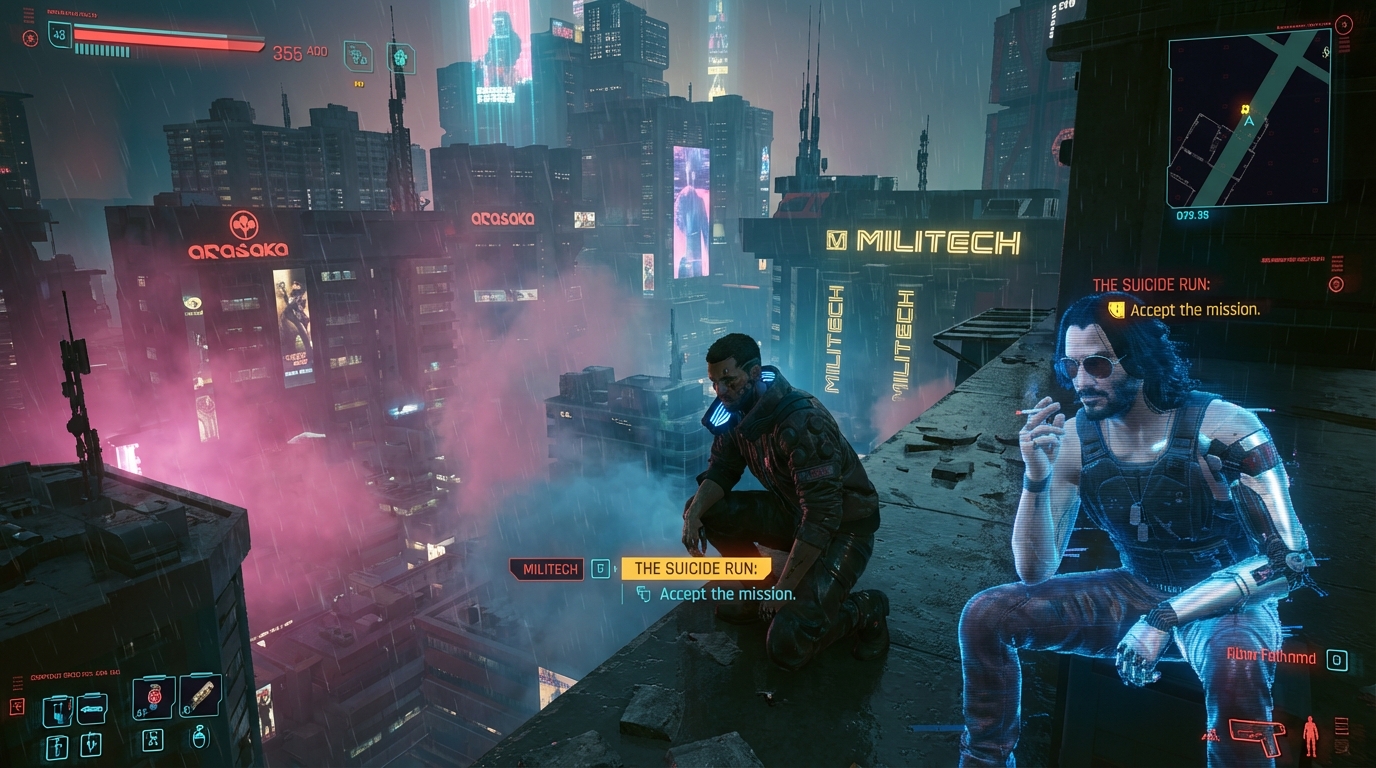
Night City doesn’t just chew you up and spit you out. It makes sure you thank it for the privilege before you expire. You spend dozens of hours grinding gigs and modding your cyberware only to reach a finale where the absolute best-case scenario involves dying of terminal brain rot in the desert. Sure, you can ride off into the sunset with Panam in “The Star” ending, but let us be real about the fact that V still has an expiration date shorter than a carton of milk. The alternative “Sun” ending isn’t much better since it rewards your status as a living legend with a suicide mission to a space casino. It feels like the writers looked at the concept of a happy ending and decided to shoot it in the face just to make a point about dystopia.
If you decide to actually trust the corporate overlords at Arasaka, the game punishes you with the digital equivalent of purgatory. You literally sign away your soul to become an engram in a secure database, proving that even in death you cannot escape the fine print of a user license agreement. Then comes the Phantom Liberty DLC, which somehow manages to offer a “cure” that feels infinitely worse than the disease. You survive the Relic only to return as a powerless nobody who gets mugged by low-level thugs and ghosted by all your so-called friends. It is a special kind of narrative cruelty to strip the most dangerous merc in Night City of their chrome and leave them to fade into obscurity as just another face in the crowd.
The Ghosts n Goblins Replay Insult
If I had to list games that actively hate their player base, the original Ghosts ‘n Goblins would sit comfortably at the top of the pile. Arthur moves like a tank in mud, the enemies spawn infinitely, and two hits send you back to a checkpoint in your underwear. Reaching the final boss feels less like a gaming achievement and more like surviving a medieval torture device designed to eat quarters. You sweat, you bleed, and you finally defeat the demon king Astaroth after hours of pure misery. Most normal games would reward this Herculean effort with a parade or at least a nice credit roll to validate your suffering.
Instead of a trophy, Capcom decides to spit directly in your face with the most disrespectful text screen in history. I stared in disbelief as the game had the audacity to tell me that the room was an illusion and a trap devised by Satan. To make matters worse, it unceremoniously dumps you back to the very first level of the graveyard to do it all over again. This isn’t a New Game Plus mode with fun bonuses. It is a mandatory sentence to repeat the exact same agonizing loop on a harder difficulty. You literally cannot see the real ending unless you beat the hardest game ever made twice in a row without turning off the console.
Fallout 3s Original Suicide Pact Nonsense
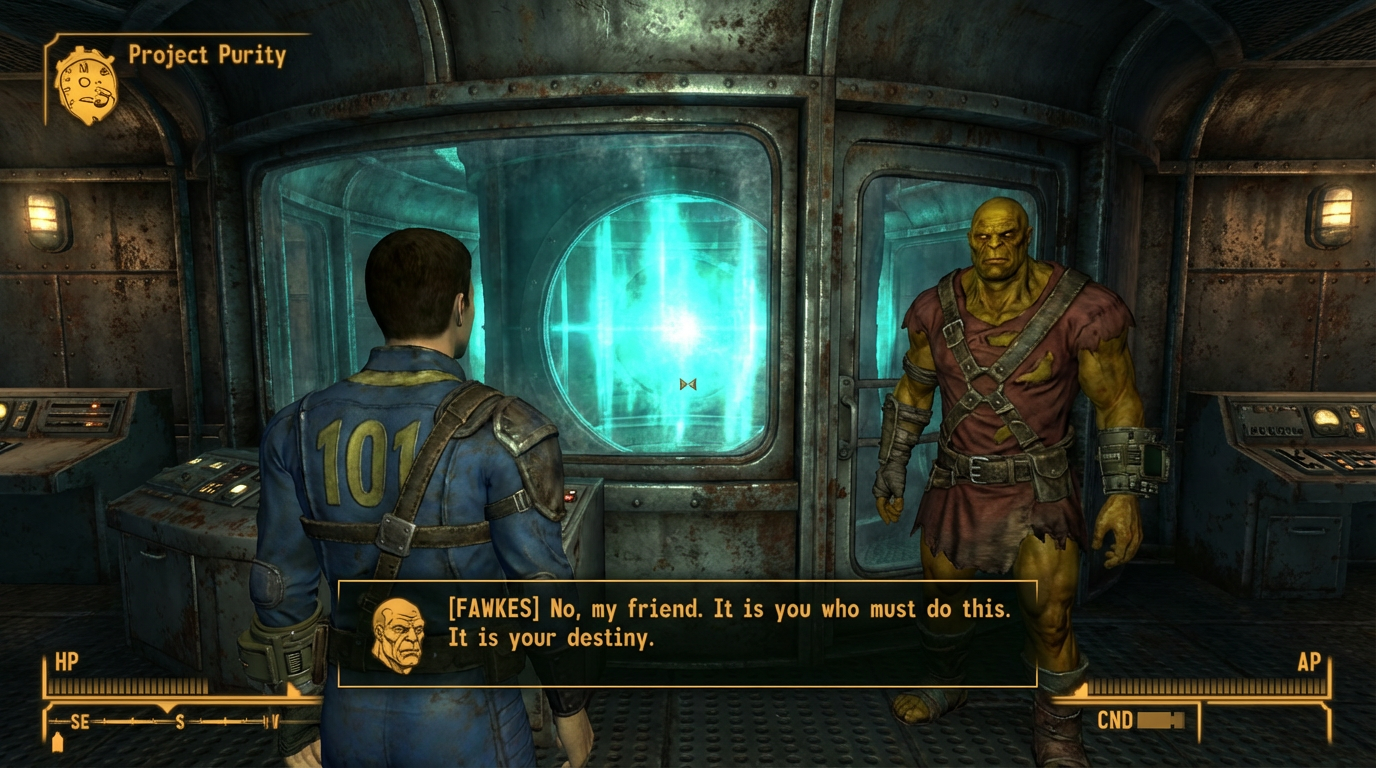
Bethesda has a knack for building incredible worlds and then fumbling the narrative ball at the one-yard line. You spend dozens of hours trudging through the Capital Wasteland fighting Enclave soldiers and super mutants, all to reach the climactic moment at Project Purity. The game demands a noble sacrifice where someone must enter a highly radioactive chamber to punch in a code, guaranteeing a heroic but very permanent death. It tries to force a tear-jerking moment about destiny and sacrifice down your throat, insisting that your journey has to end with your body melting into a puddle of goo. The writers clearly wanted a profound philosophical conclusion, but they forgot to account for basic logic or player agency in their rush to be deep.
The real kick in the teeth happens if you were smart enough to bring Fawkes, a literal super mutant who eats radiation for breakfast, along for the ride. Any rational person would look at their giant, radiation-immune buddy and ask him to push the button, but the original game flat-out refused to let you do the smart thing. Instead of helping, Fawkes hits you with some pseudo-intellectual garbage about how this is a destiny you must face alone. He essentially refuses to save your life because the script said so. It is arguably the laziest writing in RPG history when a companion watches you die for narrative weight despite being perfectly capable of surviving the task. This wasn’t a tragic ending. It was a plot hole so massive you could drive a Vertibird through it.
Endings That Insult Your Time And Intelligence
Nothing kills the buzz of a hundred-hour RPG faster than a finale that feels like the writers just gave up and went to the pub. You spend weeks grinding levels and bonding with NPCs only to watch your choices dissolve into a singular, meaningless cutscene. It is the digital equivalent of eating a gourmet meal and finding a dead fly at the bottom of your espresso. We put up with bugs and fetch quests because we trust the destination will be worth the journey, but these games prove that trust is often misplaced. A terrible ending doesn’t just ruin the final hour. It retroactively poisons the entire experience and makes you question why you didn’t just play Tetris instead.
Look at Cyberpunk 2077, a game where the absolute best-case scenario involves dying slightly later than usual while your friends leave town. It is hard to feel like a winner when the game ranks its conclusions from morbid to soul-crushing without offering a single path to genuine happiness. Developers seem obsessed with artistic tragedy at the expense of player satisfaction, forgetting that sometimes we just want to win without a philosophical lecture. Even if you become a Night City legend, the narrative forces you into a corner where agency is an illusion and depression is the only reward. If I wanted to feel hopeless and insignificant, I would just check my bank account balance instead of playing a sci-fi power fantasy.
Now it is your turn to vent about the narrative disasters that made you want to snap your controller in half. Drop a comment below detailing which game betrayed you the hardest, whether it was a cliffhanger that never got resolved or a plot twist that made zero sense. We want to hear about the finales that scarred you for life and made you swear off pre-orders forever. Turn this comments section into a therapy group for gamers who have been personally victimized by lazy writing teams. Don’t hold back. If the developers didn’t respect your time, you certainly don’t need to respect their artistic vision.