The PC gaming price surge has turned a sensible upgrade into a financial boss fight. Graphics cards, RAM, SSDs, and complete gaming PCs are getting hammered by AI-driven demand for memory and storage, while supply remains stubbornly tight. Forecasts point to PC prices rising roughly 17% to 18% in 2026, which is a spectacular way to make “just one more upgrade” sound like a threat.
I’m breaking down what is actually getting more expensive, why the shortage is hitting gamers so hard, and whether buying now is smart or simply volunteering to be overcharged. The short version: some upgrades are worth grabbing, some can wait, and a few price tags deserve to be launched directly into the sun.
Key Takeaways
- AI-driven demand for DRAM, NAND flash, and graphics memory is squeezing consumer supply, with PC prices projected to rise roughly 17%–18% in 2026 while shipments decline about 10%–11%.
- The price surge hits graphics cards, RAM, SSDs, and prebuilt gaming PCs hardest, so the same budget now buys less performance, less storage, and fewer upgrade options.
- Prioritize the graphics card and a reliable power supply, target 32GB of RAM, and delay nonessential SSD upgrades; reuse compatible components and consider previous-generation or carefully specified prebuilt systems.
- Buy now only if your current PC is failing or cannot run the games you need; otherwise, wait, upgrade selectively, and avoid paying inflated prices for a full rebuild or flagship hardware.
The 2026 Memory Shock
The 2026 PC gaming price surge is being powered by a very unglamorous tug-of-war over memory. AI servers and data centers are buying up DRAM for system memory, NAND flash for storage, and graphics memory for accelerators, leaving consumer PC builders to fight over whatever survives the shopping cart. That squeeze is hitting RAM, SSDs, graphics cards, and prebuilt gaming PCs hardest because all of them depend on memory-heavy parts. In practical terms, a $1,500 gaming build that once delivered a comfortable midrange GPU, 32GB of RAM, and a 2TB SSD could now land closer to $1,755 or $1,770 before any premium for especially scarce components. Apparently, the future of computing requires making games more expensive so a server can autocomplete a spreadsheet.
“The ugly math of 2026: PC prices are projected to rise roughly 17% to 18%, shipments could fall 10% to 11%, and industry revenue may still grow because each shrinking number of PCs costs more.”
That is the key distinction behind the headlines: inflated revenue does not mean more people are buying PCs. Forecasts point to average PC prices climbing about 17% to 18% while global shipments decline around 10% to 11%, creating a market that earns more by selling fewer machines at higher prices. For players, that means the same upgrade budget buys less performance, whether we are talking about a new graphics card, a larger SSD, or enough RAM to stop modern games from treating 16GB as a personal insult. I would rather see the industry sell fewer machines because people are waiting for sensible prices, not because every memory chip has been drafted into an AI data center. Until supply catches up, building a gaming PC means paying tomorrow’s price for yesterday’s parts.
Before And After Builds
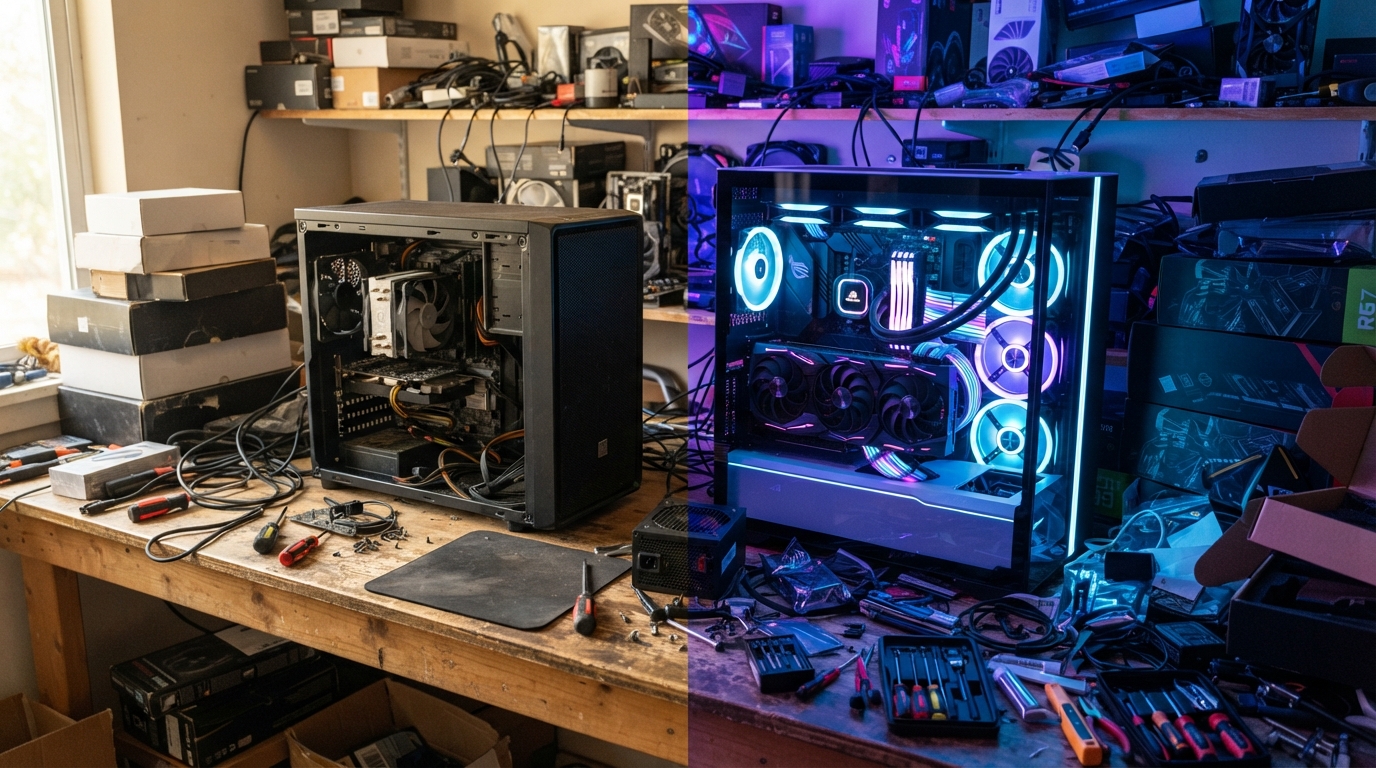
Before the PC gaming price surge, $1,000 could buy a genuinely capable 1440p machine instead of a carefully negotiated compromise. Today, memory, storage, and graphics hardware consume more of the budget, with overall PC prices forecast to rise roughly 17% to 18% in 2026. The result is not merely paying more for the same box, but paying more for less headroom. Here is the unpleasant arithmetic, presented in table form so your wallet can suffer efficiently.
| Budget | Before the surge | After the surge | What gets worse |
|---|---|---|---|
| $1,000 | Upper-midrange GPU, 32GB RAM, 1TB SSD, comfortable 1440p gaming, spare power and storage capacity for upgrades. | Mainstream GPU, 16GB to 32GB RAM, 1TB SSD, mostly 1080p with selective 1440p settings, tighter power and case budgets. | 1440p becomes a compromise, RAM may need upgrading sooner, and the SSD can fill up after installing roughly four enormous games and one badly behaved launcher. |
| $1,500 | Strong 1440p or entry-level 4K GPU, 32GB RAM, 1TB to 2TB SSD, solid cooling, and room for another drive. | Upper-midrange 1440p GPU, 32GB RAM, usually 1TB SSD, acceptable 1440p performance, but less room for premium cooling or future upgrades. | The graphics tier drops, storage gets stingier, and the build may require choosing between a better GPU, more SSD space, or a power supply that is not designed by wishful thinking. |
| $2,000 | High-end GPU, 32GB to 64GB RAM, 2TB SSD, high-refresh 1440p or dependable 4K gaming, with generous upgrade flexibility. | High-end 1440p or compromised 4K GPU, 32GB RAM, 1TB to 2TB SSD, and fewer premium components around it. | The budget still buys a powerful PC, but less of it reaches the graphics card, while storage, memory expansion, and cooling become the parts quietly sacrificed in the corner. |
The biggest insult is that the downgrade is easy to miss if you only compare total system prices. A current $1,000 build can look respectable on a product page while hiding 16GB of RAM, a small SSD, a weaker power supply, or a GPU aimed at 1080p rather than the 1440p experience that used to be the obvious target. At $1,500, I would prioritize the graphics card and a decent power supply, then accept a 1TB SSD and add storage later when prices stop behaving like they have discovered rent. Even the $2,000 tier is no longer a blank cheque, so leave room for RAM, storage, and cooling upgrades instead of spending every dollar on a flashy component that turns the rest of the build into a hostage situation.
AI Versus Gamers
The PC gaming price surge is hitting memory-heavy parts first because graphics cards, RAM, and SSDs all depend on components now being hoovered up by AI data centers. Industry forecasts put average PC price increases around 17% to 18% in 2026, which means the same midrange gaming budget buys noticeably less performance than it did before. A graphics card that once anchored a sensible build can now swallow the money meant for extra RAM and storage, while prebuilt gaming PCs pass those inflated component costs straight to the buyer. Apparently, even assembling a computer has become a luxury hobby with worse furniture.
Supplier allocation makes the squeeze nastier by steering limited DRAM, NAND flash, and graphics memory toward the largest and most profitable orders. Semiconductor factories cannot instantly switch production when demand spikes, so constrained capacity turns a shortage into a bidding contest, and gamers are not exactly winning that auction. AI servers consume memory at a ridiculous scale, using huge pools of high-speed memory and storage across entire racks, while a player is just trying to install three modern games without deleting everything else. At roughly 100 to 150GB per game, that modest gaming goal can demand 300 to 450GB before updates, launchers, and the operating system start demanding their own rent.
For shoppers, the practical difference is brutal: a pre-surge budget that covered a capable graphics card, 32GB of RAM, and a roomy SSD may now force a downgrade in one or more of those categories. Cutting RAM can create stutters, choosing a weaker graphics card hurts frame rates, and saving on storage means playing musical chairs with game installs. Prebuilt systems feel the damage twice because manufacturers face higher component costs and less room to absorb them, so the final price rises even when the design has not improved. AI may be curing diseases or doing something impressive in a server rack, but right now it is also making gamers pay extra to keep three games installed.
Surviving The PC Price Surge

The smartest way to survive the PC price surge is to avoid rebuilding the entire machine out of panic. I would reuse an existing case and power supply when they are compatible, reliable, and powerful enough for the replacement parts, because a box and a PSU do not magically become faster with age. For RAM, 16GB remains acceptable for a budget gaming system, while 32GB is the sensible target for most new builds. 64GB is usually expensive overkill unless you have a very specific workload. SSD prices are painful, but an upgrade can wait if your current drive still has usable space because extra loading-screen storage will not improve frame rates. Put that money toward the components that actually affect gameplay, rather than buying a larger digital cupboard for games you may never launch.
Graphics cards deserve the most scrutiny, since current models are absorbing the worst of the memory crunch and can wreck an otherwise reasonable budget. I would seriously consider a previous-generation GPU, especially if it delivers the resolution and frame rate I want without turning the build into a financial hostage situation. Prebuilts also deserve a fair comparison because bulk purchasing can sometimes beat a DIY build when RAM, SSDs, and graphics hardware are all inflated. Suspiciously weak power supplies and vague component listings should trigger an immediate exit. Building yourself still wins when you already own reusable parts or can shop patiently, but there is no prize for assembling the most expensive pile of shortages. Compare the complete cost, warranty, upgrade path, and exact parts, not just the headline price printed in giant cheerful numbers.
My buy-now-or-wait decision comes down to urgency, current hardware, and how much price pain I am willing to tolerate. With PC prices forecast to rise roughly 17% to 18% in 2026, waiting is not guaranteed to produce a bargain, but it can make sense if the upgrade is mostly cosmetic or driven by upgrade fever. I would buy now when a failing system blocks the games I want to play, and wait when my current machine still performs comfortably at my target settings. The table below keeps the decision practical instead of letting a shiny product page make it for me.
| Upgrade situation | What I would do | Why |
|---|---|---|
| Urgent failure or current PC cannot run the games I play | Buy now, focusing on value and proven parts | Playing today is worth more than gambling on an uncertain drop |
| Current PC runs games well, but I want higher settings or more storage | Wait and upgrade selectively | Reuse the case and PSU, delay the SSD, and avoid paying surge prices for small gains |
| Very price-sensitive buyer with an older but functional system | Wait, shop used or previous-generation hardware, and monitor prebuilts | Patience creates more chances to find a sensible deal |
| Need a full system immediately | Compare a carefully specified prebuilt with a DIY parts list | The cheaper route depends on the actual GPU, RAM, SSD, PSU, warranty, and upgrade options |
AI Is Gutting Your Gaming Budget
The PC gaming price surge is not just a graphics-card problem wearing a fancy heatsink. AI and data-center demand are squeezing DRAM and NAND supplies, pushing up the cost of graphics memory, system RAM, SSDs, and even complete gaming PCs, with average PC prices forecast to rise roughly 17% to 18% in 2026. Before the increase, a $1,500 build could reasonably target a capable midrange graphics card, 32GB of RAM, and a 1TB SSD. Now, that same budget may mean choosing between weaker graphics, less memory, or storage that disappears faster than free hard-drive space after installing one modern game. The result is a broad memory-driven affordability crisis, not a single overpriced component throwing a tantrum.
I would upgrade now only if my current system is failing, cannot meet the requirements of the games I actually play, or a targeted replacement solves a specific problem without forcing a full rebuild. If my machine still handles my library at acceptable settings, waiting is the smarter move because paying inflated prices for every major component is how a sensible upgrade turns into financial self-harm with RGB lighting. Flagship buyers can still spend freely, but demanding the absolute best hardware in 2026 offers poor value unless the performance is genuinely necessary. For everyone else, buying flagship hardware during this surge is the gaming equivalent of buying bottled water during a drought, possible, but a spectacularly expensive way to prove you were thirsty.