For a decade, the only way to get a virtual hit of adrenaline was to dust off a crusty console and pray your old discs still worked. We survived a brutal drought where the industry seemingly forgot that four wheels and a plank of wood make for a perfect video game. Thankfully, we are officially in the middle of a massive skating game revival that is finally kicking the genre out of its coma and back onto the pavement.
Between the long-awaited return of a certain simulation giant and the nostalgia-fueled resurrection of the arcade legends, developers have stopped ignoring the millions of us who just want to kickflip off a roof. It is not just about the heavy hitters anymore, either; a wave of indie sims is filling the void for anyone who prefers technical realism over gravity-defying arcade physics. Whether you are looking for a live-service sandbox or a pixel-perfect remake, there is finally a reason to pick up a controller again without feeling like you are stuck in 2005.
Key Takeaways
- The skating genre has entered a massive revival, successfully bridging the gap between nostalgic arcade physics and highly technical indie simulations.
- Players must now choose between the high-flying, gravity-defying logic of arcade remakes and the punishing, physics-based realism of modern indie titles.
- Major publishers are transitioning to a live-service sandbox model, which offers evolving multiplayer environments but carries the risk of microtransaction-heavy structures.
- The genre’s survival is currently driven by indie developers who prioritize deep control mechanics and the technical flow of skating over flashy celebrity cameos.
The Resurrection Of Tony Hawk And Skate
The gaming industry finally woke up and realized that staring at a board for ten years was not nearly as fun as actually riding one. For a long time, we were stuck in a drought where the only way to get a skating fix was to dust off a crusty console from 2005. That changed when the classic remakes hit the scene, proving that the arcade perfection of the nineties still hits like a shot of pure adrenaline. These games did not just capitalize on nostalgia, they reminded us that landing a million point combo while listening to punk rock is a fundamental human right. It turns out that when you stop trying to reinvent the wheel and just give people tight controls and iconic levels, they will show up in droves.
While the arcade side handles the high flying spectacle, major publishers have finally decided to answer the prayers of the simulation crowd with a massive reboot. Moving into a new city as a live-service sandbox title is a bold move that could have been a disaster, but the early feedback suggests they actually remembered what made the physics feel so good. We are seeing a shift where the core fans are no longer a niche group begging for a sequel on social media. With new mechanics like board wear and tear and a massive multiplayer sandbox, the developers are leaning into the community driven chaos that defined the original trilogy. It is a relief to see a major studio stop ignoring a goldmine and actually build something that respects the legacy of the flip trick.
This resurgence is not just about the big names, as the gap between retro charm and modern physics is narrower than it has ever been. We are living in a golden era where you can choose between the gravity defying logic of an arcade legend or the punishing realism of a physics based sim. The current state of things feels like a celebration of the sport rather than a cynical cash grab, which is a rare win in the modern gaming market. Whether you are grinding a rail in a perfectly recreated warehouse or exploring sprawling streets with friends, the variety is staggering. It took a decade of silence, but the skating genre has finally found its footing and is currently sticking the landing with style.
Realism Versus Arcade Physics The Great Divide
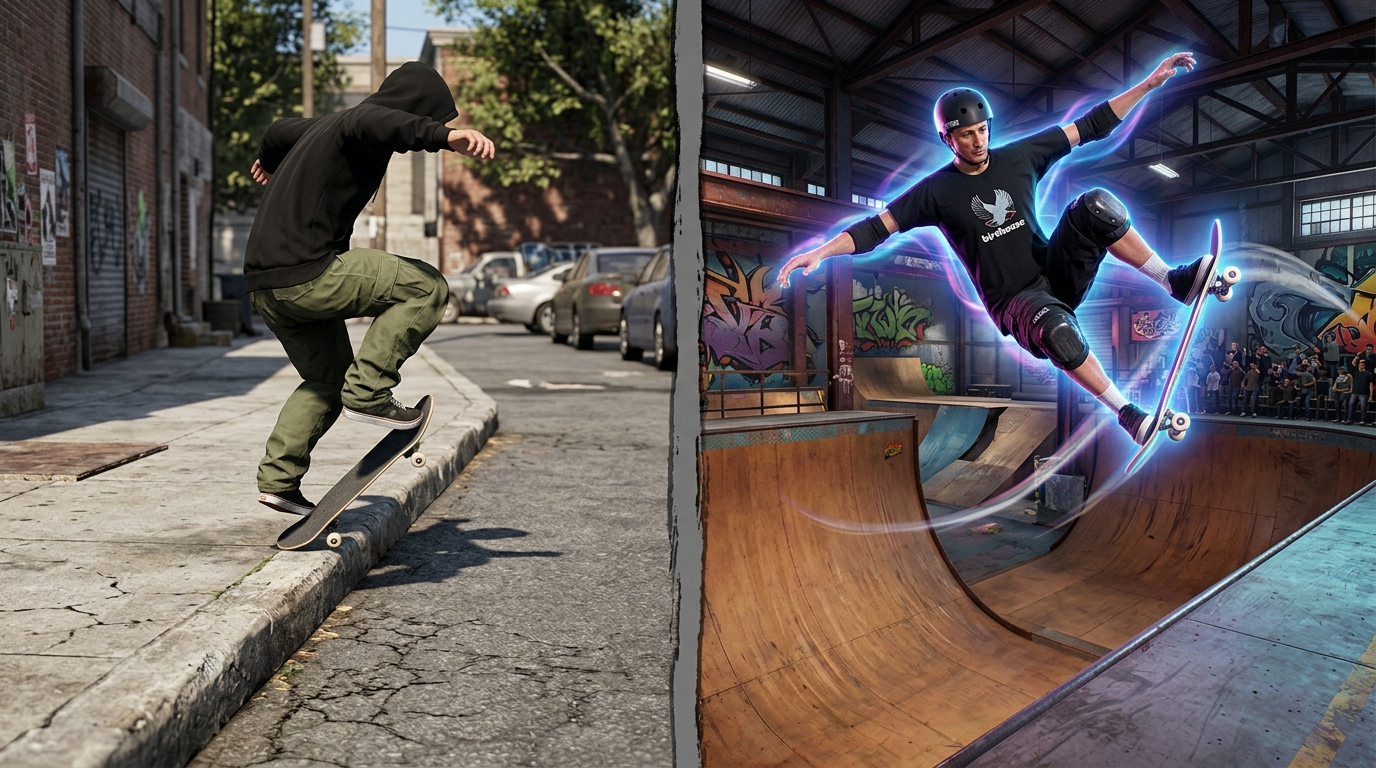
The skating genre is currently split down the middle between those who want a digital workout and those who just want to fly. On one side of the concrete, you have the flick-it realism of modern indie sims, which treat a simple kickflip like a complex physics equation. These games are digital simulations where your feet are mapped to the analog sticks, requiring actual practice just to land a basic trick without eating pavement. It is a rewarding grind for the hardcore crowd, but sometimes I just want to land a 900 without feeling like I need a PhD in gravitational constants.
The other side of the divide is where the nostalgia hits hardest, channeling the high-flying nonsense of the early 2000s. We are seeing a massive resurgence in arcade physics thanks to recent remakes and upcoming sequels, which aim to recapture that gravity-defying magic. These games do not care about your realistic center of gravity or the friction of the asphalt. They are built on the glorious lie that you can grind a power line for three blocks and then ollie off a rooftop into a perfect manual.
Finding the sweet spot between these two extremes is the holy grail of the modern skating revival. While the indie scene has mastered the art of the simulation, the big budget reboots are trying to bridge the gap by offering accessible fun with modernized mechanics. Whether you prefer the punishing precision of a board sim or the dopamine hit of a thousand-point combo, the genre is finally healthy again. It is a great time to be a digital skater, provided you can decide if you want to respect the laws of physics or break them entirely for a high score.
Indie Contenders And The Future Of Digital Boarding
The indie scene is currently doing the heavy lifting to bridge the gap between our collective nostalgia and the technical demands of modern hardware. While the big publishers spent a decade acting like skateboards did not exist, smaller studios stepped up to deliver the physics-based purity that players actually crave. These titles have moved away from the button-mashing arcade chaos of the nineties, opting instead for control schemes that make landing a simple kickflip feel like a genuine achievement. It is a refreshing change of pace to see developers focusing on the flow of the ride rather than just cramming in celebrity cameos or licensed soundtracks to mask shallow gameplay. We are finally seeing a market where the soul of the sport is being preserved by people who actually seem to spend time at a local park.
The future of digital boarding looks a bit more complicated as we pivot toward the live-service model with upcoming major releases. While the promise of a massive, evolving sandbox is enticing, the free-to-play structure always carries the looming threat of a microtransaction faceplant. I want to be optimistic about seasonal updates and fresh gear, but there is a thin line between a thriving community and a game that feels like a digital storefront on wheels. If the developers can keep the board wear and tear mechanics grounded in reality without charging us real money for virtual grip tape, we might actually see a sustainable revival. This genre deserves a comeback that respects the player’s time and wallet as much as it respects the culture it represents.
The Golden Age of Grinding is Back
If you have been clinging to your dusty copy of old school classics like a security blanket, it is finally time to let go and clear some space on your drive. The revival of the skating genre is not just a nostalgia trip, it is a full blown restoration of what made extreme sports games the kings of the early 2000s. Whether you are looking for the arcade perfection found in recent remakes or the chaotic social sandbox of the newest simulation titles, there is finally a reason to pick up a controller again. These titles bridge the gap between the pixelated memories of our youth and the physics-heavy demands of modern hardware without losing the soul of the sport.
The sheer variety available right now means you can choose between a punishing simulation or a gravity-defying score attack based on your mood. Major titles have evolved into massive live-service playgrounds where the board wear and tear actually matters, while indie gems are filling the gaps with experimental mechanics that the big studios are too scared to touch. It has been a long, dry decade of mediocre mobile ports and broken promises, but the genre has officially stuck the landing. You do not need to be a real-life pro to appreciate that the industry is finally rewarding our patience with games that actually respect the culture.
Ultimately, the skating genre is back where it belongs because developers stopped trying to reinvent the wheel and started remembering why we loved it in the first place. You should prioritize the arcade remakes if you want that classic, dopamine-heavy combo hunting, but keep the new simulation titles installed for when you want to just vibe in a massive multiplayer city. Both approaches are valid, and both prove that the demand for digital four-wheeled mayhem never actually went away. It is a great time to be a fan, so stop reading this, download your favorite of the bunch, and go find a virtual 12-stair to hurl yourself down.
Frequently Asked Questions
1. Why did it take a decade for skating games to make a comeback?
The industry suffered a collective brain fart where they convinced themselves nobody wanted to kickflip off a roof anymore. They spent years chasing trends while our old consoles gathered dust, finally realizing that the demand for four wheels and a plank of wood never actually went away.
2. Is the new arcade remake actually worth my time?
It is a shot of pure adrenaline that proves arcade perfection does not age. They stopped trying to reinvent the wheel and just gave us tight controls and iconic levels, which is exactly what you need when you want to land a million point combo.
3. What is the deal with the new skating games being a live service?
Major publishers are moving into the live service model, which usually makes gamers break out in hives. However, if they manage to keep the physics soul of the original franchises intact while updating the world, it might actually be the sandbox we have been begging for.
4. Should I choose arcade classics or the new indie skating sims?
It depends on whether you want to defy gravity or respect it. Arcade titles are for the high flying spectacle of the nineties, while the new wave of indie sims is built for technical realism and people who care about the nuance of a perfect flick.
5. Are these new games just lazy nostalgia cash grabs?
While the industry loves a quick buck, the recent remakes actually respect the source material. These games did not just capitalize on your childhood memories, they updated the mechanics so you do not feel like you are stuck in 2005 with clunky controls.
6. Do I need a controller to play these new skating titles on PC?
Trying to play a skating sim with a keyboard is a fast track to carpal tunnel and misery. If you want to actually enjoy the technical realism of the revival, do yourself a favor and plug in a controller before you embarrass yourself.