
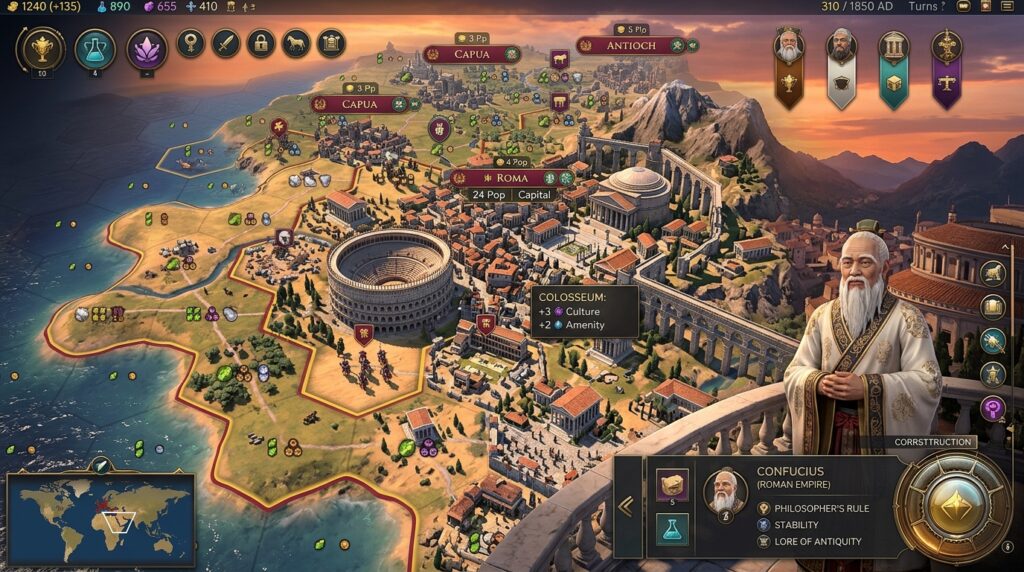
Sid Meier is finally letting us play god without the historical handcuffs, and the new Civilization 7 leader mechanics are the biggest middle finger to tradition we’ve seen yet. For decades, we’ve been stuck with the same rigid pairings, but the developers finally realized that maybe players want to see what happens when you put a tech-obsessed founding father in charge of an ancient legion. It’s a modular overhaul that turns the game into a strategic sandbox rather than a predictable history lecture.
The core of this shake-up is simple: your leader is now your permanent avatar while your civilization evolves underneath them like a revolving door of cultural identities. You can stick to the Historical Pairings if you’re a boring traditionalist who needs a gold star for accuracy, but the real fun lies in the chaotic synergy of mix-and-matching. If you’ve ever wanted to lead a group of Maya warriors as Augustus Caesar just to see the world burn, your time has finally come.
Key Takeaways
- Civilization 7 decouples leaders from specific nations, allowing players to retain one permanent leader while their civilization evolves into different cultural identities at the start of every new Age.
- The new RPG-style progression system introduces six distinct attribute categories and talent trees, enabling players to customize their leader’s strengths with earned Experience and Legacy Points.
- Strategic flexibility is prioritized over historical accuracy through a mix-and-match system that allows for unconventional leader and civilization pairings to optimize gameplay meta.
- Historical Synergy Bonuses provide traditionalists with gameplay incentives for choosing accurate pairings, balancing chaotic sandbox experimentation with rewarded thematic play.
Breaking The Sacred Bond Of Leaders And Civs
For years, the Civilization franchise has operated on a logic that felt as sturdy as a Great Wall. Your leader was your identity, and your civilization was your destiny. In Civ 7, the developers decided to take a sledgehammer to that foundation by decoupling leaders from their specific nations. You now pick a leader who stays with you from the first stone tool to the final rocket launch, but your actual civilization swaps out at the start of every new Age. It is a massive departure that feels like a mad scientist experiment, allowing you to run Rome in the Antiquity Age and then pivot into a completely different culture once the Exploration Age kicks in. While the purists are currently screaming into their history books, I have to admit there is a certain chaotic brilliance to the flexibility this offers.
This mix and match system means the strategic meta is about to become a beautiful disaster of experimentation. You are no longer locked into a single gameplay loop for six hundred turns just because you picked a specific historical figure at the start. If you want to play as Benjamin Franklin but decide that his scientific bonuses would be better served by leading the Mongol hordes across the steppes, the game actually lets you do it. The developers have included historical paths for those who crave accuracy, but they are clearly inviting us to break the timeline for the sake of power gaming. It is a bold move that prioritizes mechanical depth over the rigid historical roleplay we have grown used to since the nineties.
Whether this overhaul is a stroke of genius or a total flavor fail depends entirely on how much you value consistency over creativity. On one hand, seeing Augustus Caesar leading a modern tech giant feels like a fever dream induced by too much late night gaming. On the other hand, the traditional system often led to certain civilizations feeling useless if they did not win in their specific era. By letting the civilization evolve while the leader remains a constant anchor, the game forces you to constantly adapt your strategy to the current world state. It is a risky play that ignores the sacred bond of the past, but it might just be the shot of adrenaline the series needed to keep from becoming a dusty museum piece.
RPG Style Skill Trees And Attribute Progression
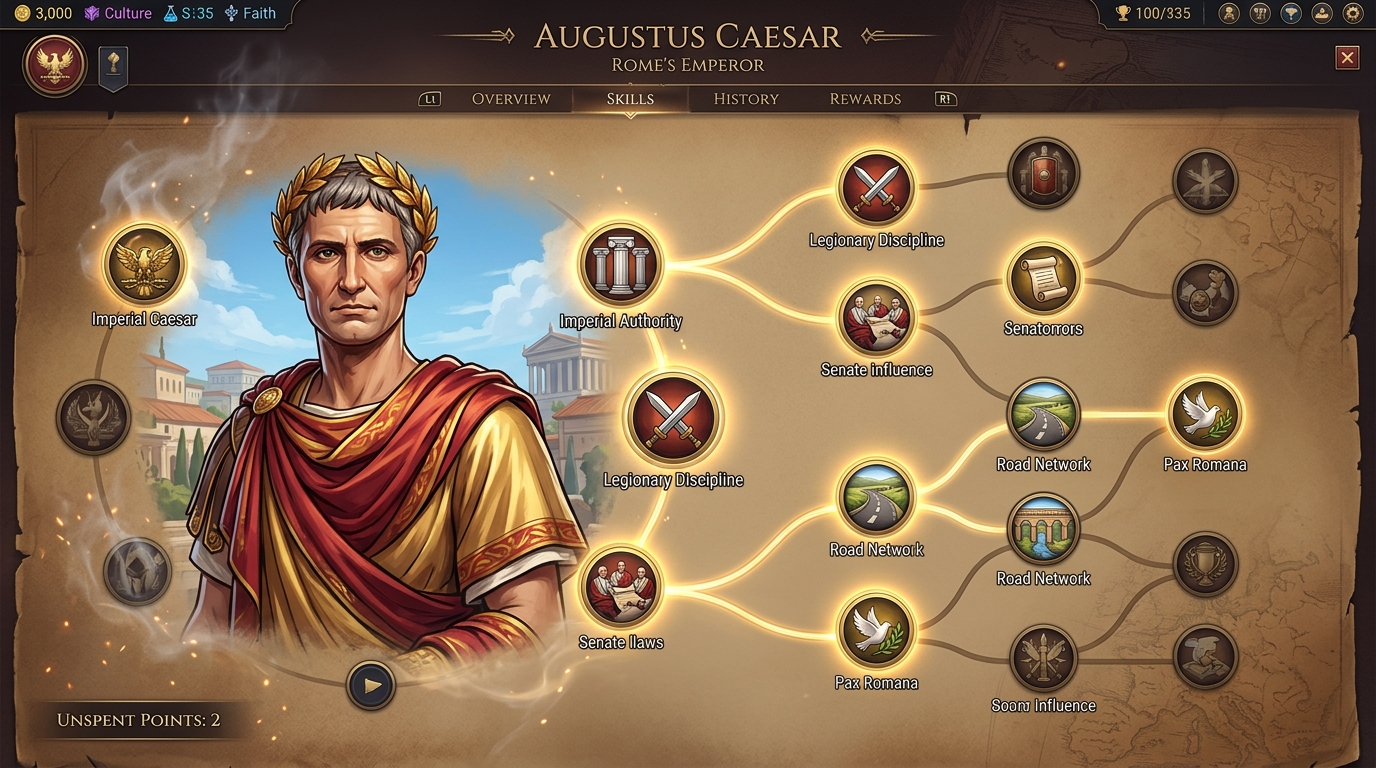
Civilization 7 is finally leaning into the fact that we all treat our leaders like RPG protagonists anyway, so they might as well give us the talent trees to prove it. Instead of being locked into a rigid set of static bonuses from turn one, you now navigate six distinct attribute categories including Militaristic, Economic, Cultural, Scientific, Diplomatic, and Expansionist. This shift means your version of Augustus Caesar could be a silver-tongued diplomat in one game and a warmongering menace in the next. It is a refreshing departure from the old one size fits all approach that usually forced players into a single optimal build. By earning Experience and Legacy Points through gameplay, you get to hand-pick upgrades that actually suit your current situation rather than what a history book says you should do.
The real magic happens when you start funneling those hard-earned Legacy Points into the progression system to turn your leader into a specialized powerhouse. As you transition between the Antiquity, Exploration, and Modern Ages, these points act as the currency for your long-term survival and dominance. You are essentially crafting a persistent avatar that retains its core strengths even as the world around it swaps from chariots to biplanes. It creates a much deeper layer of strategy because you have to decide if you want to be a jack of all trades or go all-in on a Scientific blitz. This level of customization is exactly what the franchise needed to stop every match from feeling like a scripted reenactment of a pointless skill bloat exhibit.
This new system also fixes the long-standing issue where certain leaders felt completely useless if their specific niche was not meta-relevant. Now, if you find yourself stuck on a tiny island with no room to expand, you can pivot your attributes toward Diplomacy or Science to stay in the running. It adds a level of agency that makes your decisions feel impactful across the entire span of human history. You are no longer just a passive observer of your leader’s pre-determined traits, but a manager fine-tuning a machine for maximum efficiency. It is a smart, modular evolution that rewards players for actually thinking ahead instead of just clicking the same three buttons every time they start a new save.
Historical Synergy Bonuses Versus Wild Sandbox Pairings
The new mix and match system in Civilization 7 is a bold departure from the rigid historical accuracy of the past, offering a fascinating tug of war between logical strategy and pure sandbox chaos. At its core, the game introduces Historical Synergy Bonuses which act as a gentle nudge for players who actually want their world history to make a lick of sense. If you pair Augustus with Rome, the game rewards your commitment to the timeline with specific gameplay bonuses and unique attribute paths that feel like a warm hug from a history textbook. It is a smart way to ensure that the traditionalists among us can still play a focused, thematic game without feeling like they are leaving power on the table. This system acknowledges that while the game has changed, the soul of these legendary leaders still belongs to their original homes.
On the flip side, the developers have finally embraced the absurdity of the genre by letting us create the most unhinged political scenarios imaginable. There is something undeniably hilarious about watching Benjamin Franklin trade his bifocals for a recurve bow as he leads a horde of Mongol horse archers across the steppe. This decoupling of leaders and civilizations turns the meta on its head, forcing strategy veterans to stop relying on muscle memory and start thinking about modular synergies. You are no longer just playing a civ, but rather building a custom engine where a leader’s permanent traits can bolster the shifting strengths of different cultures across the ages. It is a chaotic, experimental playground that proves the franchise is finally willing to stop taking itself so seriously.
This shift represents a massive gamble on player agency, prioritizing deep mechanical experimentation over the static identities we have grown used to since the nineties. By offering tangible rewards for historical choices while leaving the door wide to insanity, the game avoids the trap of being a dry simulation. You can chase the optimal synergy bonuses by following the intended path, or you can spend your weekend seeing if a Roman emperor can successfully pivot into a seafaring Polynesian empire. It is a refreshing change of pace that treats the player like an adult who can decide exactly how much realism they want in their digital board game. Whether you are a lore purist or a mad scientist of strategy, this overhauled system ensures that no two matches will ever feel like the same old grind.
Divorcing Leaders From Civs Is Brilliant Chaos
The developers are essentially performing open-heart surgery on the franchise, and whether the patient survives depends entirely on how much you value historical purity over mechanical depth. De-coupling leaders from civilizations is a massive gamble that finally kills the stale tradition of being locked into a single strategy for three hundred turns. While some purists will likely have a meltdown seeing Benjamin Franklin commanding Roman Legionaries, this modularity addresses the biggest issue in 4X gaming: the late-game slog. By letting us pivot our civilization’s identity at the start of each Age, the developers are actually forcing us to stay awake and adapt rather than just clicking next turn until a victory screen pops up.
This new system breathes some much-needed life into the genre by prioritizing strategic flexibility over static history lessons. It is a bold move that acknowledges that the way we played in the nineties does not necessarily work for a modern audience looking for complex, evolving puzzles. The studio is definitely playing a dangerous game with the franchise identity, but honestly, the old identity was starting to feel like a dusty museum exhibit. If this mix-and-match chaos leads to more meaningful choices and fewer predictable outcomes, then I am all for burning the traditional rulebook. Civilization 7 gameplay features are clearly not interested in being a safe sequel, and for a series this old, that kind of audacity is exactly what we need to keep the one more turn addiction alive.
Frequently Asked Questions
1. Can I still play the game like a normal person who respects history?
Yes, you can stick to Historical Pairings if you really need that gold star for accuracy. It is the safe, boring route for traditionalists who think mixing Augustus Caesar with the Maya is a crime against humanity.
2. How long does my chosen leader actually stay in power?
Your leader is your permanent avatar from the first stone tool until the final rocket launch. While your civilization swaps out like a revolving door of cultural identities at the start of every Age, your leader remains the one constant in your empire.
3. Does this mean I am stuck with one civilization for the entire game?
Not even close, because your civilization evolves underneath your leader at the start of every new Age. You can run Rome in the Antiquity Age and then pivot into a completely different culture once the Exploration Age kicks in, which is a massive departure from the old rigid system.
4. What is the point of decoupling leaders from their specific nations?
The developers finally took a sledgehammer to the foundation of the game to turn it into a strategic sandbox. It allows for a chaotic synergy of mix and matching that lets you experiment with wild combinations that were previously impossible.
5. Is the strategic meta going to be more predictable now?
The meta is about to become a beautiful disaster of experimentation. Since you are no longer chained to a specific history lecture, the game rewards players who find the most broken, overpowered combinations of leaders and evolving cultures.
6. Why did the developers change a system that has worked for decades?
They realized that players want to play god without the historical handcuffs. It is a modular overhaul designed to prioritize fun and strategic flexibility over the same tired, predictable pairings we have been playing since the nineties.