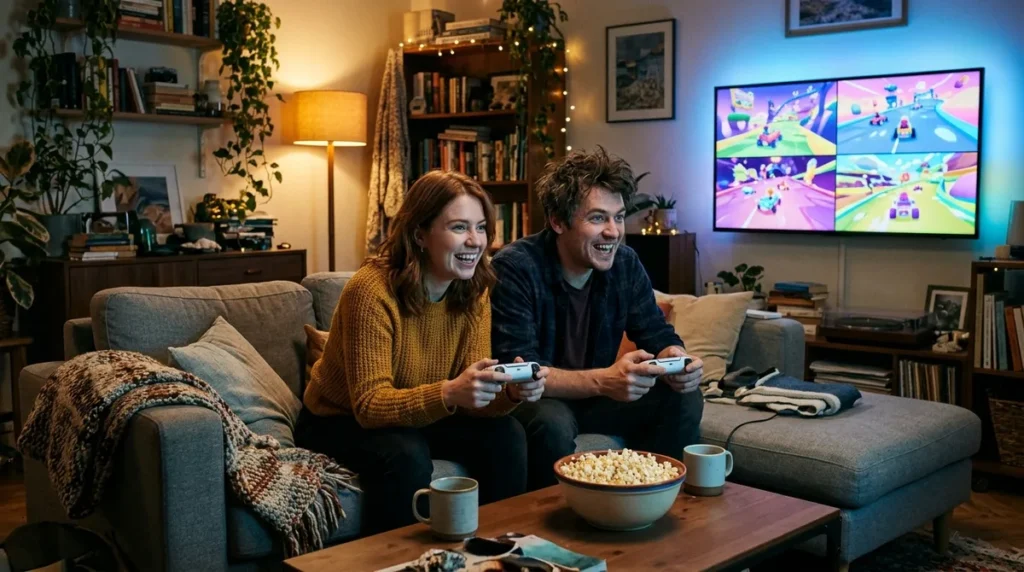
The best games for couples fall into three camps: cooperative picks that reward teamwork, competitive two-player strategy games that reward a little smugness, and accessible games that work no matter how each of you sees or plays. For teamwork, Sky Team is hard to beat. It’s built for exactly two players, takes about 20 minutes, and its publisher identifies it as the 2024 Spiel des Jahres winner, the board game world’s most famous prize. It lists at $39.99 CAD, a fair price for a game you can finish before the pizza gets cold.
Video game co-op costs more. Friend’s Pass lets a second player join It Takes Two online without owning the full game, but someone in the pair has to own it for anything past the first chapter. The game itself runs around $39.99. Want rivalry instead? Jaipur sells for $26.99 and plays in about 30 minutes, while Patchwork, also about 30 minutes, hands the win to whoever scores highest. Pick one, pour the drinks, and let the trash talk begin.
Key Takeaways
- Codenames: Duet is the go-to cooperative pick for two players, averaging 15 minutes or less per game, so couples can lose together and still fit in a rematch.
- Couples who want to play It Takes Two should read the Friend’s Pass conditions on the publisher’s page first, because one player must own the full game before the second player can get past the first chapter.
- Jaipur at $26.99 and Patchwork, both about 30 minutes long, are the strongest two-player choices for couples who want rivalry, and Patchwork’s highest score wins outright.
- UNO Braille, released in 2019 with the National Federation of the Blind, prints Braille on all 112 cards so blind and sighted partners can play the same game without one narrating every card.
What Are the Best Games for Couples to Play Together?
The best games for couples are the ones that match how the two of you like to relate. A game can ask you to work toward a shared goal, compete for a winner, or fit both players’ needs through accessibility features. Which group wins depends on your temperament. If one of you goes quiet when losing and the other gloats for sport, skip the rivalry. This is a guide from the GameRuckus editors, not a ranking drawn from one couple’s test night.
For teamwork, Codenames: Duet is built for two players and is cooperative rather than competitive. Its average game takes 15 minutes or less, so you can lose together and still squeeze in a rematch. One partner gives one-word clues, the other guesses, and you both lose if you hit the assassin card. Nobody gets to be the hero, which is either healthy or a great way to start an argument.
For rivalry with a little dignity, Patchwork is an age-8-plus game for two players, first released in 2014. You both race to grab the best fabric patches for your quilt, and your partner is always one move from taking the piece you wanted. It’s the rare game where you can be cutthroat and still feel smug about your tidy quilt.
Accessibility is where good design quietly shows up. Mattel’s UNO Braille deck, released in 2019 with the National Federation of the Blind, has Braille on all 112 cards and on the packaging. A sighted partner and a blind partner can play the same game without one of them narrating every card.
Color-only design is still the industry’s favorite lazy habit. Microsoft’s game-accessibility guidance says not to rely solely on color to distinguish game objects, and to use shapes or patterns as well.
Video games change the math. Split Fiction and It Takes Two are co-op adventures that can eat a whole weekend, and that’s the point. A 20-minute board game asks for a quick hit of teamwork, while a long adventure asks you to share a controller through an entire story. Ask yourselves which one you’ll actually finish. It Takes Two arrives on Nintendo Switch 2 on October 15, 2026, with a free upgrade for existing Switch players.
If you’d rather skip winners entirely, We’re Not Really Strangers’ Couples Edition costs $20 and includes 150 conversation cards. You can spend 10 to 15 minutes drawing a few, or keep going longer, which makes it a low-pressure option for a night when neither of you wants to lose at anything.
Which Co-op Games Actually Bring Couples Closer?

The co-op games that bring couples closer are the ones where winning and losing both belong to the pair, so nobody gets to pin a bad move on the other person. Shared goals create the good moments. When you’re both trying to land a plane or get a clue across the table, the win belongs to you as a team, which is a surprisingly warm feeling for two people who usually argue about who left the dishwasher running.
The picks that do this well share a few traits. Each one gives both players a job that matters, and none of them let one partner carry the whole thing for long.
- Sky Team: a two-player puzzle that rewards a shared plan over a sharp individual.
- Codenames: Duet: the clue-giver and the guesser are equally on the hook for every round.
- It Takes Two: a co-op adventure that stretches one shared story across a long weekend.
- Split Fiction: another two-player adventure built around both characters moving through the same story.
The video game picks deserve a warning. A long co-op adventure gives you hours of good teamwork, but it also gives you hours for resentment to build. One partner ends up as the designated jumper, the other becomes the person who keeps dying at the same ledge, and somewhere around the third boss fight both of you start keeping score in your heads.
So here’s the quiet part, said out loud: co-op only works if both players accept responsibility for failure. The moment one of you says “well, you were the one who ran ahead,” the game stops being teamwork and turns into a courtroom. Nobody wins a courtroom at 11 p.m.
Good co-op partners have a simple habit. After a failure, the first thing out of their mouth is “we,” not “you.” It sounds corny. It also works, which is more than you can say for most of the sulking that happens on the couch after a wipe.
If you can’t manage that, be honest about it before you start. A game you bail on halfway through isn’t a teamwork success. It’s an expensive reminder of who the real problem is.
Does Your Partner Need Their Own Copy to Play?
Not necessarily, and the catch is in the fine print. EA’s Friend’s Pass lets a second player join It Takes Two online without owning the full game, but one player still has to own it before the second player can get past the first chapter. Think of the pass as a free ticket into the opening chapter, with the rest of the story locked behind a purchase somebody has to make.
The rules decide who pays, so read them before anyone clicks buy. It Takes Two and Split Fiction both offer a free Friend’s Pass under specified conditions. Both offer the pass, but each sets its own rules, and having a free pass in common doesn’t mean they work the same way. Check the conditions on the publisher’s page for each game before you assume either one covers you.
Split Fiction deserves the same scrutiny. It’s the other two-player adventure in this lineup, and couples who pick it should confirm what the pass covers before splitting anything.
Now the money. Typical pricing for It Takes Two sits around $39.99, so a single copy is a real purchase for a couple on a budget. If one partner buys it and the other joins through the free pass, the cost is effectively one copy shared by two people. That only saves money if the conditions actually let the non-owner in, which is why the checking step matters.
Splitting the bill is also where resentment starts. If one of you pays $39.99 and the other gets a free ticket, expect a joke about it by chapter two. Settle the details before checkout: who buys, who joins for free, and whether the owner gets to pick the next game. Money arguments are dull, but they’re cheaper than a couch standoff.
Which Two-Player Games Turn Date Night Into a Rivalry?

Competitive two-player games turn date night into a rivalry because they put a score on the table and make one of you the winner. Once there’s a number, every move becomes a small argument, and counting points does more for the mood than any candle.
Jaipur is the cleanest example. It’s listed at $26.99 and plays in about 30 minutes, so you can squeeze in a rematch before anyone gets bored. Its trading rounds reward the player who reads the other person’s moves, which is a polite way of saying you’ll spend the night staring at each other’s hands.
Patchwork works on the same principle. Its official rules say the player with the highest score wins, full stop. There’s no committee and no tiebreak drama, just a scoreboard that doesn’t care whose turn it was to load the dishwasher.
Friendly rivalry works for couples who enjoy banter because the scoreboard acts as referee. The game decides who won, so nobody has to say it out loud. You get to gloat, your partner gets to demand a rematch, and both of you get to pretend the trash talk was harmless.
Here’s the caution. A competitive game can sour a relationship if one partner hates losing. If your partner goes quiet after the third loss, the game has stopped being fun and started feeling like a verdict on their character. Agree on a rematch rule before the first card is dealt: the loser gets one immediate rematch, and the winner picks the snack, not the next game.
Some couples treat board games like divorce proceedings. They bring rulebooks like legal briefs, cite old scores from three weeks ago, and argue over a trade in round two with the energy of a custody hearing. Keep it light. Nobody needs a judge to settle a card game.
Are There Games Both Partners Can Enjoy Regardless of Ability?
Yes, plenty of games let partners with different abilities play on equal footing. The trick is that the design can’t assume everyone sees, hears, and reacts the same way. Good accessibility is less about charity and more about not making half the table squint.
Start with the worst habit. Color-only design is still the industry’s favorite shortcut: a red icon means danger, a green one means safe, and if you can’t tell the difference, you’re guessing. Microsoft’s game-accessibility guidance pushes developers to pair color with shapes or patterns, so a warning triangle looks different from a stop sign whether or not you can see the hue. Roast the laziness, not the people stuck with it.
UNO Braille takes the same idea offline. Mattel built the deck with the National Federation of the Blind in 2019, and the Braille sits on the cards themselves, so a blind player and a sighted partner can share one game without anyone reading every card aloud.
Accessibility also helps the partner who doesn’t need it. Clearer information means fewer arguments about what you just saw. If a card, icon, or game state is easy to read at a glance, nobody has to ask “wait, was that the blue one?” for the fourth time.
When you’re shopping, look for a few practical features. Large, high-contrast text helps tired eyes at 11 p.m. Subtitles let one partner follow the story while the other is still reading the dialogue. Remappable controls matter if one of you has a sore thumb, and a hold-or-tap option matters if one of you can’t mash buttons for ten minutes straight.
Before you buy, check the settings menu. If the options are buried or missing, the game has already told you who it expects to win.
Is a Conversation Card Game Worth It for Couples?
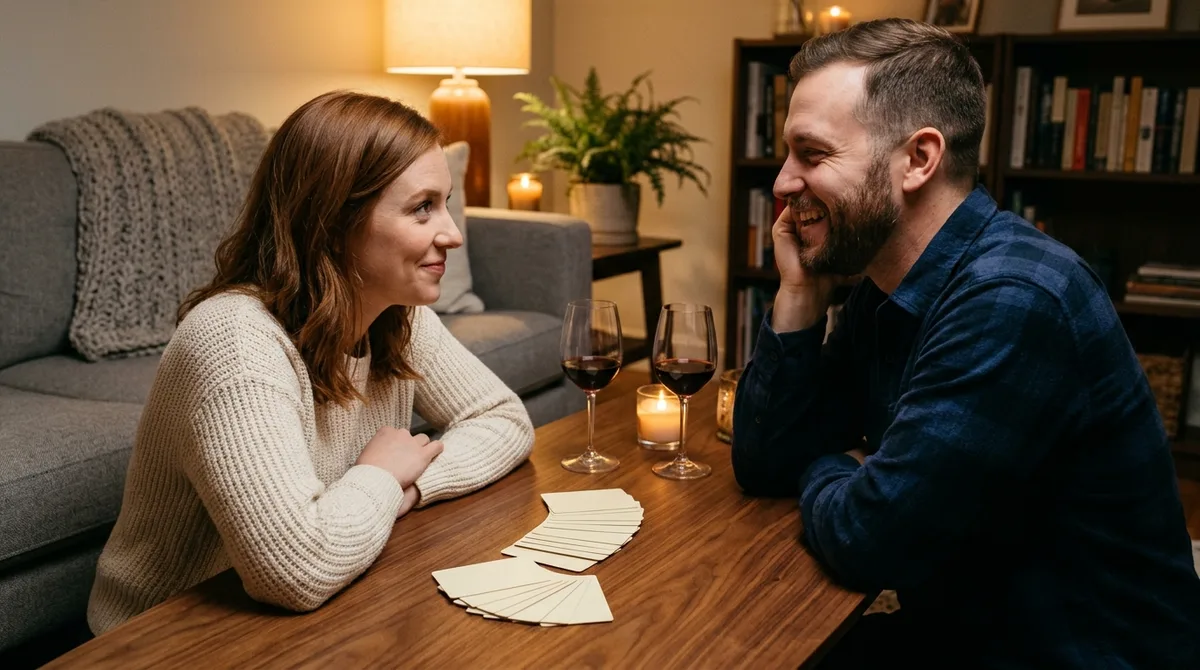
Yes, a conversation card game is worth it for couples who have run out of things to talk about. It’s a poor pick for anyone who wants rules, a board, and a winner. We’re Not Really Strangers Couples Edition costs $20 and comes with 150 conversation cards, which makes it cheaper than Jaipur’s $26.99 listing. There’s no setup and no scoreboard.
You decide how long to play. Spend 10 to 15 minutes drawing a few cards, or keep going until one of you wants to stop. Each card asks a personal question, and both of you answer it.
Answering personal questions on command is awkward in a special way. Nothing makes you feel like a hostage negotiator like being asked your deepest fear over takeout while your partner waits with a straight face.
This works well for couples who go quiet over dinner or keep rehashing the same three topics. The cards force conversations you might otherwise skip, and they do it without anyone having to start a serious talk on purpose.
It works badly for couples who want to compete. There’s no score to chase and no turn order to exploit, so “winning” just means getting through the deck without dodging. If one of you enjoys beating the other, you’ll get bored fast.
The cost question is simple. A deck that’s played once or twice is an expensive coaster, so buy it only if you’ll pull it out repeatedly. Unlike a co-op adventure, the cards won’t entertain you on their own. You have to supply the honesty, and if the questions start feeling like a job interview, put the deck back on the shelf.
Which Game Should You Try First Tonight?
Pick the game that fits your mood and the time you have tonight, then play it. If you have about 15 minutes and want to work as a team, Codenames: Duet is the quickest fit. Sky Team suits a 20-minute cooperative puzzle, and Jaipur or Patchwork works when you have about half an hour and want some friendly banter. When energy is low, skip the scoreboard entirely and reach for the conversation cards.
If you want to try two or three games in one night, run them in this order:
1. Start with the shortest game that matches your mood, such as Codenames: Duet for a quick round of teamwork. 2. Play one full game and stop before anyone’s patience runs out. 3. Switch to a rivalry game like Patchwork if you both still want to compete, and agree on the rematch rule before the first tile goes down. 4. If the night has gone quiet and tired, finish with a few cards from the conversation deck instead of another round of scoring. 5. If a video game is on the list, check the Friend’s Pass conditions on the publisher’s page before anyone buys anything.
Pick one game tonight, lose with as much grace as you can manage, and report back on who cheated first. Somebody always does.
Picking Your First Game Tonight
Start with the clock. If you have 15 minutes and a mild grudge, open Codenames: Duet and play one round. Losing together still counts as a result, so nobody gets to blame the other person for hitting the assassin card.
Got half an hour and a healthy appetite for smugness? Set up Jaipur or Patchwork and agree on the rematch rule before the first card hits the table. Write it on a sticky note if you have to. Memory gets creative by round three, and somebody will suddenly remember winning a game they lost.
Thinking about a whole weekend with a shared controller? Don’t buy It Takes Two yet. Open the Friend’s Pass page on your own, read the conditions, and confirm which of you has to own the game before anyone opens a checkout screen. A few minutes of reading beats a fight over who paid.
If neither of you has the energy to score anything, pull out the conversation deck instead. Draw a few cards, answer honestly, and call it a night. Nobody has to win, which is the one competition you can both afford to lose.