
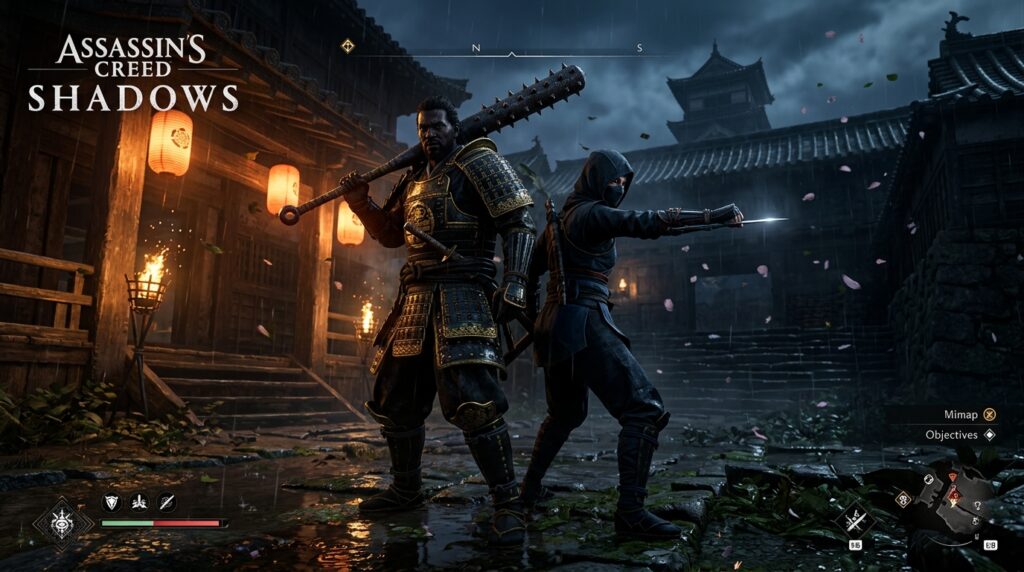
Ubisoft finally stopped flirting with the concept and dropped us into 16th-century Japan, but the real hook is how the Assassins Creed Shadows gameplay forces you to choose between being a silent shadow or a human wrecking ball. This isn’t your typical “do everything” protagonist setup. Instead, we get a dual-protagonist system that feels like two different games stitched together. Whether you’re scaling walls as the shinobi Naoe or turning skeletons into dust as the samurai Yasuke, the late Sengoku period has never looked quite this brutal.
The genius, or the gamble, lies in how these two playstyles refuse to overlap, making your choice of character more than just a cosmetic swap. Naoe brings back the classic stealth we’ve been begging for, complete with a grappling hook and a kusarigama that makes crowd control look like an art form. Meanwhile, Yasuke is a walking tank who treats parkour like a suggestion and subtlety like a foreign language, relying on a Kanabo to break guards and settle debates. Toss in a dynamic seasonal system that actually changes how you navigate the world, and you’ve got a game that finally respects your time enough to offer some genuine variety.
Key Takeaways
- The dual-protagonist system enforces two distinct playstyles by separating Naoe’s traditional stealth and parkour from Yasuke’s heavy, guard-breaking combat.
- A dynamic seasonal system fundamentally alters gameplay by removing stealth cover in winter and freezing water to create new navigation paths for heavier characters.
- Environmental factors like rain and storms provide tactical trade-offs, muffling footstep noise for stealth while simultaneously reducing the player’s visibility.
- The 140-square-kilometer map of feudal Japan uses specialized level design to accommodate both Naoe’s vertical agility and Yasuke’s grounded, power-based movement.
Naoe Versus Yasuke Two Distinct Playstyles
The dual-protagonist system in Shadows is less about giving you options and more about forcing you to decide how much you actually enjoy the classic Assassin’s Creed loop. If you pick Naoe, you are getting the traditional shinobi experience complete with a grappling hook, hidden blades, and the ability to crawl through tall grass like a caffeinated garden snake. She is built for the purists who still believe that being seen is a personal failure, offering enough agility to make the parkour feel like more than just holding down a single button. It is a refreshing return to form that actually rewards patience instead of just letting you counter-kill your way through an entire army.
Yasuke, on the other hand, is a walking tank who treats stealth like a suggestion he chose to ignore. Since he lacks Eagle Vision and the ability to scale walls like a mountain goat, his gameplay revolves entirely around turning enemies into paste with a massive Kanabo. The new posture system means you cannot just mash the attack button and hope for the best, as you actually have to break a guard before delivering a lethal blow. It is a brutal, heavy style of combat that feels more like a dedicated action game than a stealth title, which is great for those days when you just want to kick down the front door.
This split approach is a clever way to mask the fact that we are still essentially clearing icons off a map, but at least the tools feel distinct this time around. You are constantly forced to weigh whether a mission is worth the headache of a slow stealth crawl or if it is better to just send in the samurai to wreck the furniture. By separating these playstyles so strictly, the game avoids the jack of all trades problem where one character becomes a master of nothing. It is a blunt evolution of the formula that finally acknowledges that some players want to be a ghost while others just want to be a riot.
Seasonal Changes Impacting Stealth And Navigation
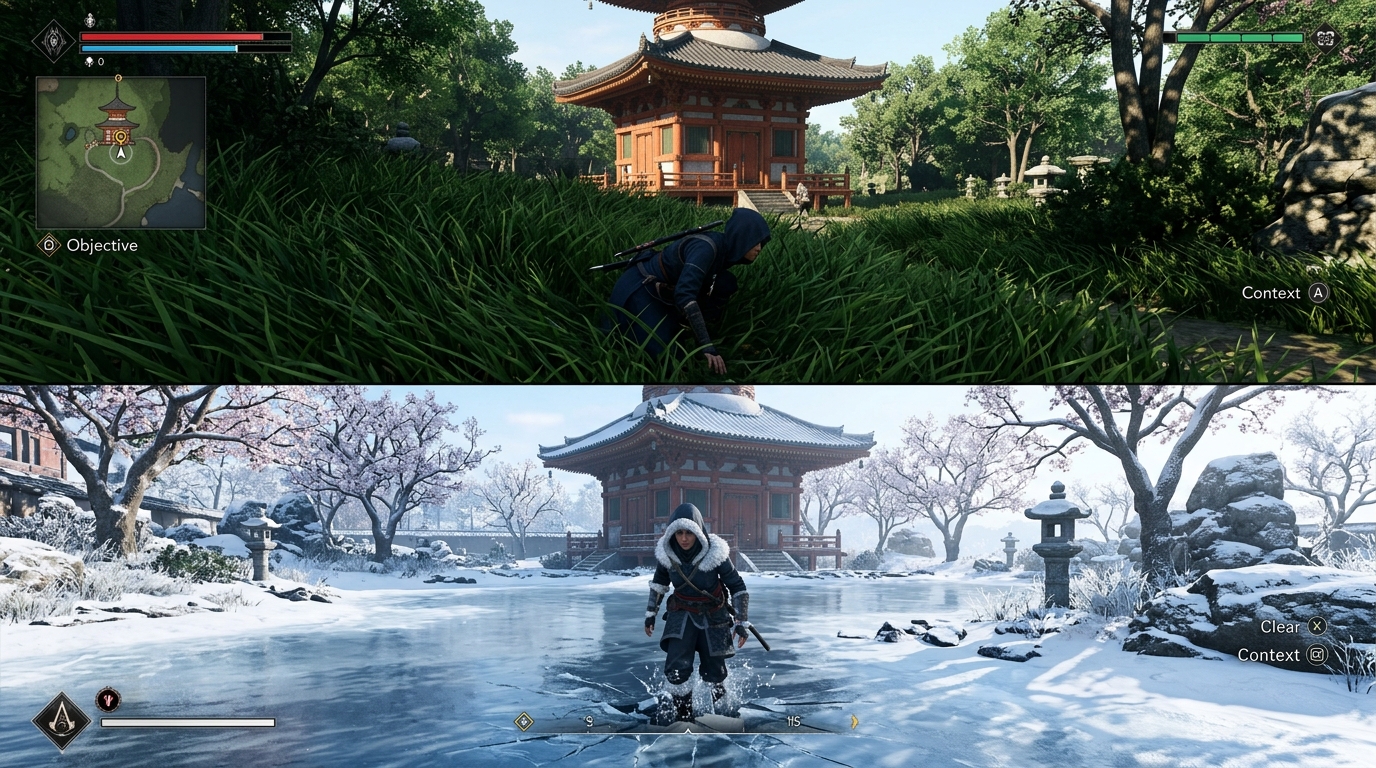
The seasonal system in Shadows is the first time the developers have actually forced us to care about the calendar instead of just chasing icons on a map. In the summer, Naoe can vanish into waist-high grass or crawl through lush greenery to reach a target, but that safety net literally withers away when autumn hits. Once winter arrives, those cozy hiding spots are gone, leaving you exposed to every guard with a functioning pair of eyes. It is a refreshing change of pace that demands you actually look at the environment rather than just holding the sprint button toward the next objective marker.
Navigation takes a massive hit when the temperature drops, turning the world into a tactical nightmare or a shortcut heaven depending on your patience. Those ponds you used to dive into for a quick escape will eventually freeze over, removing your underwater hiding spots and making a splashy getaway impossible. On the flip side, frozen water opens up new paths for Yasuke to stomp across, bypassing the need for clunky parkour that he was never good at anyway. It is a clever way to break the monotony of the series, even if slipping on ice during a high-stakes assassination feels like a personal attack from the developers.
I appreciate that these weather shifts are not just cosmetic filters designed to make your screenshots look pretty. If it starts raining, the noise of your footsteps is muffled, allowing Naoe to sprint behind guards who are too busy complaining about the damp to notice a blade at their throat. However, the same storm that hides your sound also kills your visibility, making it just as easy for you to stumble into a patrol you did not see coming. This push and pull between the player and the environment is exactly the kind of evolution this franchise needs to stop feeling like a glorified chore simulator.
Global Map Scale And Regional Exploration
The studio is touting a 140 square kilometer recreation of feudal Japan, which sounds impressive until you remember that size doesn’t always equal substance. We have been burned before by massive maps that feel more like a digital chore list than a living world worth exploring. With nine distinct provinces to traverse, the real test is whether these regions offer unique gameplay opportunities or just different flavors of the same repetitive outposts. I am looking for more than just a fresh coat of paint on a tired formula that rewards us for vacuuming up icons. If the seasonal system actually alters how we navigate these spaces, there might be hope for a genuine sense of discovery.
The dual protagonist system between Naoe and Yasuke is the only thing that might save this massive landmass from becoming a walking simulator. Since Yasuke cannot parkour his way across rooftops or use a grappling hook, the level design has to work for two fundamentally different types of movement. This means the 140-square-kilometer map cannot just be a generic playground, as it needs to provide tactical depth for both a heavy tank and a nimble shinobi. I want to see if the environment actually forces me to change my approach based on the character I am playing. If the map is just a giant field of grass with the occasional castle to climb, the scale will feel like a burden rather than a feature.
Exploring the late Sengoku period should feel like a dangerous journey through a shifting environment, not a checklist of synchronized viewpoints. Much like the Ghost of Yōtei details that suggest a shift in tone and setting, the dynamic seasons here are a clever touch, but they need to be more than just visual flair to justify the sheer scale of the nine provinces. If winter actually freezes lakes to open new paths or spring growth provides better stealth cover, then the map size starts to make sense. However, if I am just running past beautiful scenery to reach another generic bandit camp, then the developers have just built a bigger treadmill. I am cautiously optimistic, but I am keeping my expectations grounded until I see if these provinces have actual souls.
Naoe’s Hook Saves a Stale Formula
The verdict on Assassin’s Creed Shadows comes down to whether you are willing to ignore the series’ habitual map-clearing chores for the sake of some genuinely clever mechanical upgrades. For the first time in years, it feels like the developers actually remembered that being a shinobi should involve more than just crouching in a bush. Naoe’s grappling hook and the seasonal weather shifts provide a level of tactical depth that finally moves beyond the “climb tower, jump in hay” loop we have been stuck in for over a decade. It is a refreshing change of pace to see shadows actually matter in a game about being an invisible killer, even if the UI still tries to bury you under a mountain of icons.
Yasuke provides the necessary counterweight to the stealth, turning the game into a heavy-hitting power fantasy that feels distinct rather than just a reskinned version of his counterpart. While the series still struggles with its obsession with bloated checklists and repetitive side content, the Assassin’s Creed Shadows dual-protagonist system acts as a safety valve against boredom. If you get tired of crawling through crawlspaces and snuffing out lanterns, you can simply switch to the samurai and start breaking guards with a Kanabo. It is not quite a total revolution for the franchise, but it is a massive step up from the aimless wandering of previous entries.
Ultimately, Shadows manages to save itself from the “same old game” trap by leaning into its setting with more than just a fresh coat of paint. The seasonal changes are not just eye candy, as they fundamentally alter how you approach a fortress, proving that the team put some real thought into the environmental puzzles. You will still find yourself clearing camps and chasing markers, but the tools at your disposal are finally fun enough to justify the effort. If you have been waiting for the series to stop spinning its wheels and actually evolve, this trip to feudal Japan is the first time in a long while that the leap of faith actually lands on solid ground.
Frequently Asked Questions
1. Do I have to play as both characters or can I just stick to one?
You have to swap between them depending on the mission, but the game generally lets you pick your poison for open world exploration. If you want to be a sneaky shadow, go Naoe, but if you want to turn enemies into paste, Yasuke is your man. Just don’t expect the samurai to suddenly grow wings and start doing high level parkour.
2. Is the stealth actually back to the classic style?
Naoe is the closest we have gotten to a real assassin in years, complete with a hidden blade and a grappling hook that actually works. She is designed for players who think getting spotted is an embarrassing life choice. You can finally crawl through grass and use the environment like a proper shinobi instead of just being a brawler in a hood.
3. Can Yasuke do parkour as well as Naoe?
Calling Yasuke’s movement parkour is a generous stretch of the imagination. He is a walking tank who treats rooftops like a suggestion and prefers breaking doors to climbing over them. He is built for combat dominance, so do not expect him to move with the grace of a caffeinated garden snake.
4. What makes the combat different between the two protagonists?
Naoe uses a kusarigama for stylish crowd control and quick strikes that reward precision over brute force. Yasuke settles every debate with a massive Kanabo club that ignores enemy guards and breaks bones. It is a choice between surgical strikes and using a human wrecking ball to solve your problems.
5. How do the dynamic seasons actually affect the gameplay?
The seasons are not just a pretty coat of paint, they fundamentally change how you sneak around. You might hide in tall grass during summer, but that same grass is gone in winter, forcing you to find new ways to stay out of sight. It is a clever system that actually respects your intelligence by making the world feel alive.
6. Is the grappling hook limited to specific points or can I use it anywhere?
Naoe can use the grappling hook to scale most structures and zip around the environment with actual fluidity. It makes the verticality of 16th-century Japan feel like a playground rather than a chore. It is the essential tool that makes her gameplay loop feel distinct from the heavy, grounded style of Yasuke, especially when modern stealth mechanics in other titles often feel so restrictive.