For years, the industry has tried to convince us that climbing radio towers is a personality trait, but they finally traded the haystacks for a blaster in this star wars outlaws review. Set in the sweet spot between Empire and Jedi, this open-world scoundrel simulator lets you play as Kay Vess, a thief who is essentially Han Solo if he had a much cuter pet and slightly worse luck. It is the first time we have been given a massive, seamless galaxy to explore without a lightsaber in sight, and honestly, the lack of space-wizard drama is a breath of fresh air.
While the game launched with more bugs than a Geonosian hive, a steady stream of patches has finally turned this “solid 7/10” into something actually worth your storage space. It is a gorgeous, atmospheric ride that captures the grime of the galactic underworld perfectly, even if the stealth mechanics occasionally feel like they were programmed by a malfunctioning gonk droid. If you have been waiting to see if this scoundrel’s life is a dream or a thermal detonator waiting to go off, it is time to look past the launch-day jitters and see what is actually under the hood.
Key Takeaways
- Star Wars Outlaws successfully captures the ‘used future’ aesthetic of the original trilogy, offering a refreshing perspective on the galactic underworld without the typical focus on Jedi or lightsabers.
- The dynamic between Kay Vess and her companion Nix provides essential emotional stakes and creative gameplay utility that prevents the scoundrel archetype from feeling generic.
- While the atmospheric world-building is top-tier, the gameplay is hindered by dated stealth mechanics, repetitive blaster combat, and restrictive vehicle physics.
- Post-launch patches have significantly improved the technical performance, transforming the game from a buggy release into a worthwhile experience for fans of open-world exploration.
Kay Vess And The Scoundrel Atmosphere
Kay Vess isn’t your typical chosen one or a brooding Jedi with a destiny, and that is exactly why the scoundrel atmosphere in Outlaws actually works. The developers nailed the aesthetic of a lived-in, grime-covered galaxy where everyone is looking to screw you over for a few extra credits. Walking through a crowded cantina feels authentic because the team focused on the small details, like the hum of a faulty power converter or the suspicious glances from a table of Gamorreans. It avoids the clean, sterile look of the prequel era in favor of the original trilogy’s “used future” vibe that makes you want to check your pockets every five seconds. This isn’t a hero’s journey, it is a survival story set in a cosmic dumpster fire, and the game is better for it.
The dynamic between Kay and her merqaal companion, Nix, is the secret sauce that keeps the character work from falling flat. While Kay can sometimes feel like a generic Han Solo archetype, her genuine bond with Nix provides the emotional stakes necessary to make her worth rooting for. Nix isn’t just a cute mascot for merchandising, he is a mechanical necessity that bridges the gap between Kay’s limited combat skills and the overwhelming odds she faces. Watching this scrappy duo outsmart a Syndicate boss feels more rewarding than swinging a lightsaber because they are constantly punching above their weight class. They are messy, desperate, and occasionally incompetent, which makes their small victories feel earned rather than scripted.
Whether or not this atmosphere survives the typical open-world bloat is a different conversation, but the core identity of being an underdog is undeniably strong. You aren’t clearing out outposts because a map icon told you to, you are doing it because you owe money to the wrong people and your ship is held together by prayers. The game succeeds when it leans into this desperation, forcing you to navigate the shifting loyalties of various criminal factions without a moral compass to guide you. It captures that specific brand of Star Wars chaos where the stakes are personal rather than galactic. If you can ignore some of the technical jank, the feeling of being a small fish in a very shark-infested pond is remarkably well-executed.
Stealth Mechanics And The Stealth Takedown Problem
Stealth in Star Wars Outlaws feels like it was ripped straight out of a 2012 design document, and not in a nostalgic, charming way. While I expected to feel like a cunning scoundrel outsmarting the Empire, I mostly felt like a landscaper obsessed with tall grass. The game relies so heavily on “stealth bushes” that it becomes predictable within the first hour of play. If there is a patch of red shrubbery nearby, you can bet your credits that the level designer wants you to crouch in it and wait for a lobotomized Stormtrooper to wander past. It is a tired mechanic that feels incredibly restrictive for a game that boasts about the freedom of an open world.
The actual takedown animations and mechanics are where the frustration really sets in for me. Kay Vess apparently studied at the school of “gentle tapping,” because her stealth takedowns lack any sense of impact or weight. Watching her punch a fully armored scout trooper in the back of the helmet and seeing him go down like a sack of potatoes is unintentionally hilarious. It shatters the immersion when the game forces you into these clunky, scripted animations that feel disconnected from the environment. For a modern title, I expected a bit more variety or at least a system that did not make the galaxy’s most feared soldiers look like they have glass chins.
Nix is the only saving grace in this entire system, but even he cannot carry the weight of such basic gameplay. You spend most of your time sending your little axolotl friend to sabotage panels or distract guards just so you can repeat the same repetitive takedown for the hundredth time. There is no room for creative problem solving when the game effectively punishes you for trying anything other than the “crouch and whistle” routine. It is a missed opportunity to evolve the genre, instead settling for a gameplay loop that feels like a checklist of outdated tropes. If I wanted to spend forty hours hiding in weeds, I would have just stayed in my backyard.
Navigating The Outer Rim Open World
Navigating the open plains of Toshara feels like a constant tug-of-war between genuine Star Wars wonder and the inevitable fatigue of another map full of icons. At first, the sheer scale of the landscape is undeniably impressive, capturing that dusty, lawless vibe that makes the Outer Rim so iconic. You hop on your speeder, the wind whistles past, and for a fleeting second, you actually feel like a scoundrel on the run. Then you look at the map and realize it is basically a cosmic grocery list masquerading as a galaxy. It is the classic paradox where the world is technically beautiful, but your primary motivation for exploring it is checking off icons rather than actual curiosity.
The developers tried their best to hide the gears and pulleys of the standard open-world formula, but the seams still show if you look for more than five minutes. While it is a relief to not be climbing literal radio towers to reveal the map, you are still essentially running errands for syndicates that treat you like a glorified delivery driver. The “discovery” moments often boil down to finding a slightly different flavored loot chest or a crafting material you will forget about in an hour. It is not that the exploration is bad, it just feels like the game is terrified of you being bored for even thirty seconds. If you can ignore the feeling of being a hamster in a very expensive Star Wars wheel, there is fun to be had, but do not expect a revolution in game design.
The real saving grace of these planets is the atmosphere, which manages to carry a lot of the heavy lifting when the gameplay loops start to feel repetitive. Wandering into a scoundrel fantasy or watching an Imperial shuttle land in the distance provides that authentic flavor that most licensed games completely miss. It is a world that looks lived-in and grimy, which goes a long way in making the trek across the dunes feel less like a chore. You will likely find yourself distracted by the scenery more than the actual objectives, which is both a compliment to the art team and a polite critique of the mission design. Ultimately, the Outer Rim is a great place to visit for the vibes, even if the actual activities feel like they were assembly-lined in a factory.
Blasters Speeder Bikes And Combat Clunk
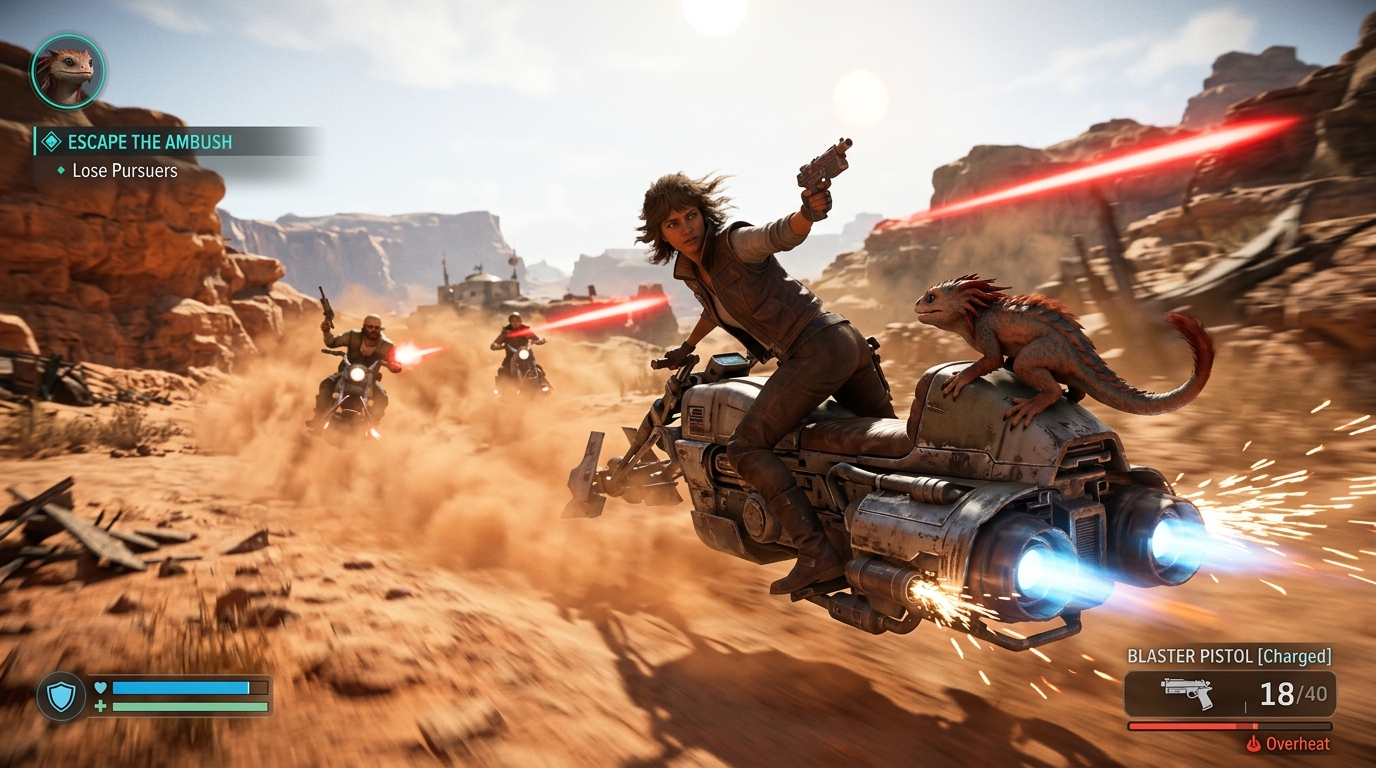
The combat in Star Wars Outlaws often feels like it was pulled straight from 2012, and not in a charmingly nostalgic way. While Kay Vess is supposed to be a scrappy scoundrel, her reliance on a single modular blaster makes every firefight feel like a repetitive chore. You spend half your time waiting for a cooldown meter to reset while hiding behind waist-high crates that seem to be the primary export of every planet in the Outer Rim. The stealth mechanics are equally clunky, frequently forcing you into instant-fail scenarios that feel more like a punishment than a challenge. It is frustrating to see such a vibrant world populated by enemies that have the tactical awareness of a bowl of Tatooine dust.
When you finally hop on your speeder bike to escape the monotony of another base infiltration, the experience is strangely tethered. The game promises the freedom of an open galaxy, but the vehicle movement feels stiff and restricted by invisible walls and awkward physics. Instead of feeling like a cinematic high-speed chase through the jungle, you often find yourself coming to a dead stop because you grazed a small rock or a stray piece of shrubbery. It is a missed opportunity to inject some much-needed adrenaline into the gameplay loop. The speeder should be a tool for liberation, but instead, it feels like driving a hover-tractor that refuses to let you have any real fun.
The gap between how the game looks and how it actually plays is where the frustration really sets in for me. You see a beautiful, sprawling landscape that begs to be explored with flair, but the mechanical limitations keep pulling you back down to earth. Combat lacks the punch and variety found in modern action titles, and the traversal never quite captures the sense of speed you expect from a Star Wars adventure. It is a classic case of open-world filler diluting what could have been a tight, focused experience. While the atmosphere is undeniably thick with charm, the actual act of pulling the trigger or revving the engine feels like a chore you have to complete just to see the next cutscene.
A Scoundrel’s Life for Me
Ultimately, Star Wars Outlaws is a game that manages to escape the gravity of being just another checklist simulator, even if it occasionally trips over its own cape. It captures the gritty, lived-in feel of the underworld perfectly, making you actually feel like a scoundrel rather than a glorified errand runner for the Rebellion. While the stealth can be finicky and the combat does not reinvent the wheel, the chemistry between Kay and Nix provides a genuine heart that keeps the experience grounded. It is a solid adventure that respects your time more than most massive open world titles, offering a dense atmosphere that feels authentic to the original trilogy. If you can forgive some launch day jank that has mostly been polished away, there is a fantastic journey hidden beneath the surface.
You should definitely clear some space on your SSD for this one, especially if you are tired of the usual hero tropes and want to see the galaxy from a different perspective. It is not a perfect masterpiece that will redefine the medium, but it is a confident and stylish entry that finally delivers on the promise of a true criminal sandbox. The reputation system adds enough spice to the decision making to keep things interesting, and the lack of a lightsaber actually forces you to engage with the world in more creative gameplay utility. This is not trash compactor material by any stretch of the imagination, unlike how the KOTOR remake has struggled through its own production hurdles. Grab your blaster, keep your eyes on the credits, and enjoy one of the more refreshing takes on this universe in years.
Frequently Asked Questions
1. Is Star Wars Outlaws just another generic open-world clone with a coat of space paint?
The developers finally put the radio towers out to pasture and traded haystacks for blasters. While you still do plenty of sneaking, the focus on the galactic underworld and the lack of Jedi nonsense makes it feel like its own scoundrel simulator rather than a reskinned historical adventure.
2. When exactly does this game take place in the Star Wars timeline?
You are dropped right into the sweet spot between The Empire Strikes Back and Return of the Jedi. It is the perfect era for a thief like Kay Vess to thrive because the galaxy is a chaotic mess and the Empire is a bit too busy with the Rebellion to notice a few stolen credits.
3. Is the game still a buggy disaster like it was at launch?
The launch was rougher than a ride in a sandcrawler, but a steady stream of patches has smoothed out the experience. It has officially graduated from a broken mess to a solid title that is actually worth the space on your hard drive.
4. Do I have to use a lightsaber or use the Force at any point?
Not even once, and honestly, it is a breath of fresh air. You are a thief with a blaster, a cool pet, and a death wish, which is much more grounded than playing as another space wizard with a destiny.
5. How does the stealth system hold up compared to other open world games?
The stealth can be a bit hit or miss, occasionally feeling like it was programmed by a malfunctioning gonk droid. It gets the job done for a scoundrel, but do not expect the precision of a dedicated stealth title when you are sneaking past stormtroopers.
6. Does the game actually capture the classic Star Wars feeling?
The production team nailed the used future aesthetic perfectly. From the grime in the cantinas to the suspicious glares of Gamorrean guards, the atmosphere is thick enough to cut with a vibroblade.