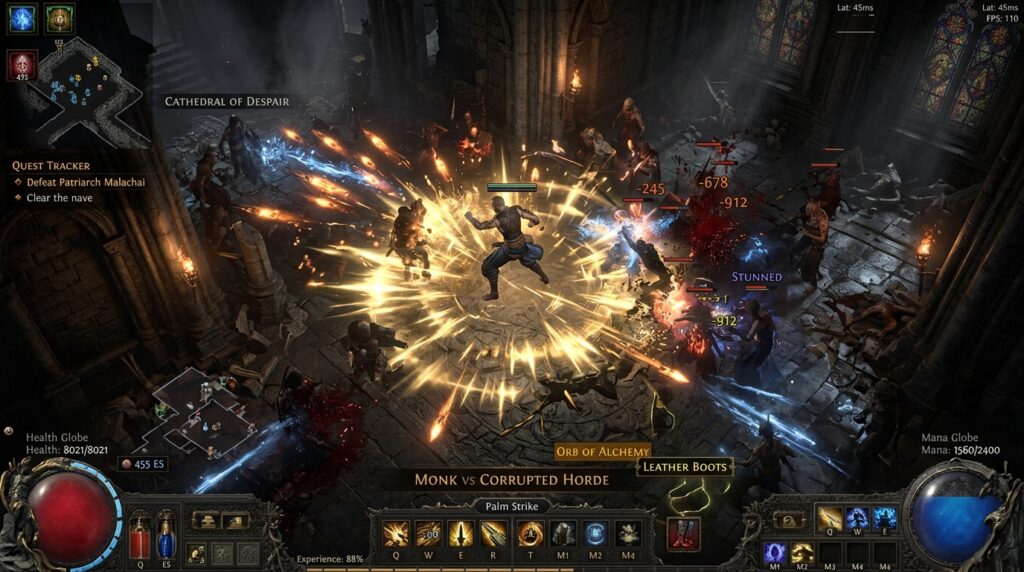
I’ve spent years conditioned to believe that top-down action involves standing in one spot and clicking until a loot explosion blinds me, but the path of exile 2 gameplay has officially killed that era of laziness. With the massive Return of the Ancients update finally live, the game has evolved from a frantic screen-clearing simulator into a tactical, Souls-like dance where one missed dodge roll means a very permanent dirt nap. It’s faster, meaner, and demands I actually use my brain, or at least my reflexes, to survive the chaos.
The new Spirit system and dual-specialization passive tree are glorious middle fingers to the old one-button wonder builds that used to dominate the genre. I can now juggle multiple six-link skills and swap passive sets on the fly, making my character feel less like a stat sheet and more like a versatile god of destruction. It’s the kind of deep, unapologetic complexity that makes other modern releases look like they were designed for toddlers with short attention spans.
Key Takeaways
- Combat has evolved into a tactical, Souls-like experience that prioritizes reflexes and positioning over the traditional ‘one-button’ screen-clearing meta.
- The revamped skill system detaches links from gear and moves them directly into gems, allowing for multiple six-link skills and greater build experimentation without gear-based RNG.
- Dual-specialization passive trees and the new Spirit resource system enable players to swap between two distinct playstyles on a single character based on weapon choice.
- Boss encounters now feature anti-burst protection and telegraphing, forcing players to engage with mechanical patterns and timing rather than relying solely on gear-check power creep.
Dodge Rolls And Tactical Souls-Like Combat
The days of closing my eyes and holding down one button while the entire screen explodes into loot are officially behind us. With the shift into this sequel, the developers finally realized that standing still like a turret is a boring way to play an action game. The addition of a dedicated dodge roll with no cooldown completely changes the rhythm of every encounter from the first map to the endgame. I can now cancel animations mid-swing to avoid a crushing blow, which adds a layer of responsiveness that the original game desperately lacked. It feels less like a spreadsheet simulator and more like a high-stakes Souls-like dance where survival actually depends on reflexes rather than just gear.
This new tactical approach borrows heavily from the punishing combat styles that make me sweat through my shirt during a boss fight. Every enemy wind-up is a telegraph I have to respect, or I will find myself staring at a death screen before I can even complain about the difficulty spike. The game moves away from mindless screen-clearing and forces me to actually engage with the mechanics of the monsters. It is a refreshing change of pace that rewards skill and timing instead of just rewarding the person who spent forty hours trading for the most broken items. While the systems are still undeniably dense, the combat itself finally feels impactful and deliberate.
Managing positioning has become just as important as managing the passive tree, which is a massive win for anyone tired of passive gameplay. The Spirit resource system further leans into this by separating active buffs from the mana pool, allowing for more creative skill usage without sacrificing defensive layers. I am constantly making split-second decisions about when to commit to a heavy attack and when to roll away to safety. It is a sophisticated evolution that manages to make the genre feel modern again without losing the complexity that veterans crave. If you were looking for games with satisfying movement mechanics that actually feel good, you might want to look elsewhere because this sequel demands full attention.
Skill Gems And The Death Of Links
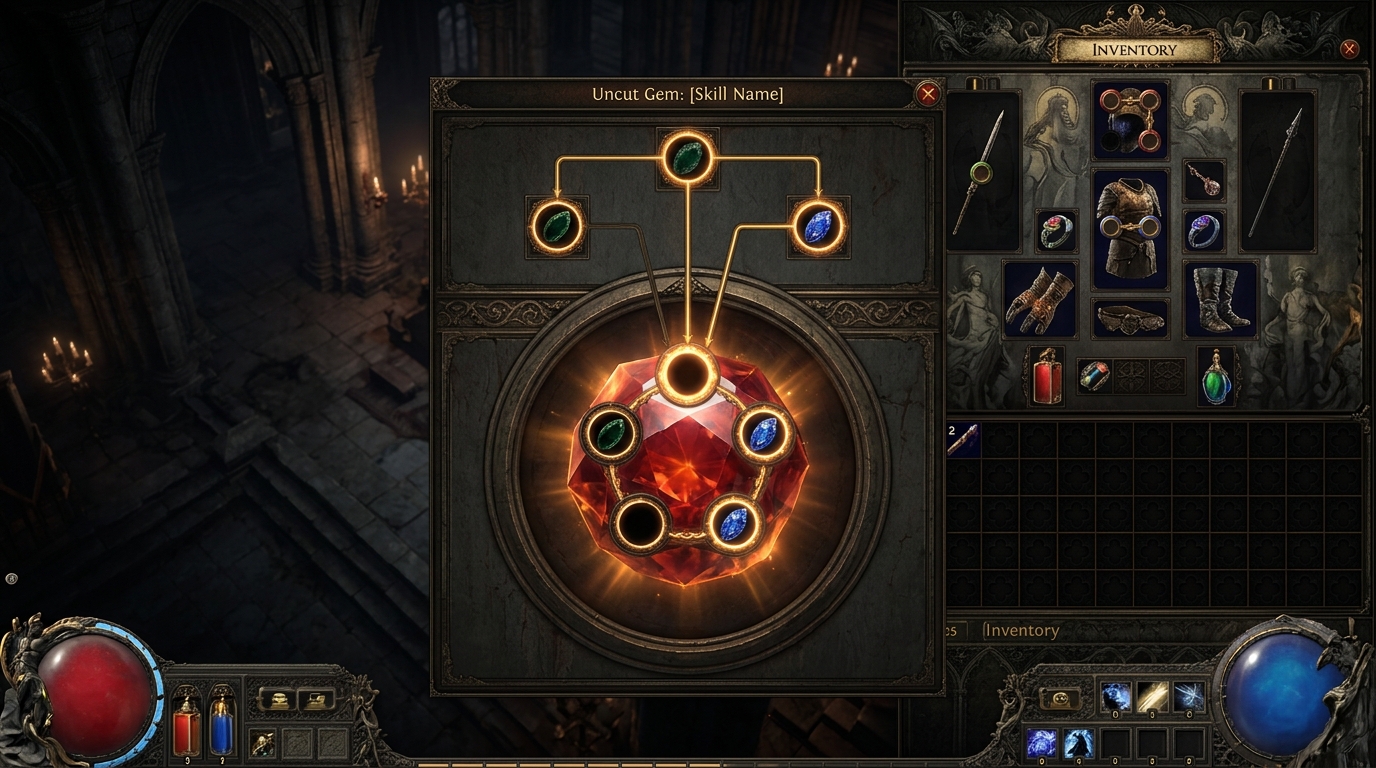
If you have ever spent a literal afternoon clicking on a chestpiece until your wrist developed a permanent twitch, you know the absolute misery of the old Orb of Fusing system. Path of Exile 2 finally puts a bullet in that nightmare by detaching skill links from gear and moving them directly into the Skill Gems themselves. This means armor is actually armor again, not just a glorified socket board that determines whether a build functions or flops. I can finally equip a massive stat upgrade the moment it drops without having to calculate if I have enough currency to make it usable. It is the kind of common sense innovation that makes me wonder why we collectively agreed to suffer through the old way for over a decade.
The beauty of this overhaul is that it rewards experimentation instead of punishing the bank account every time I want to try a new spell. With over 240 active skill gems available in the current build, being able to swap abilities on the fly without re-rolling every piece of gear is a massive quality of life win. I can now run multiple six-link skills simultaneously, which opens up tactical layers that were previously locked behind a wall of pure RNG and grinding. It turns the game from a spreadsheet simulator into a fluid, Souls-like combat experience where choices matter more than luck with a random number generator. Grinding for gear should be about finding cool loot, not about praying to an orb for the basic right to use favorite abilities.
This shift also perfectly complements the new Dual Specialization system, allowing for a pivot between different playstyles without the traditional headache. Because links are tied to the gems, I can seamlessly transition from a heavy-hitting melee setup to a fast-casting elemental build without worrying about sockets matching. It is a rare example of a sequel actually simplifying a bloated mechanic while simultaneously making the gameplay deeper and more engaging. This change respects my time and my sanity, proving that the developers finally realized that clicking a thousand times on a piece of leather is not actually a fun gameplay loop. Path of Exile 2 is much more interested in letting me play the game than making me fight against its own UI.
Dual Specialization And The Massive Passive Tree
The developers have finally done it by creating a passive skill tree so massive that it looks less like a character sheet and more like a map of the observable universe. With roughly 2,000 nodes to navigate, the sheer scale of the system is a beautiful nightmare that would make any sane person reach for a spreadsheet and a bottle of aspirin. It is the ultimate expression of the genre’s obsession with complexity, offering enough granular control to make my head spin while simultaneously making me feel like a mathematical genius for picking the right cluster. While most games are busy streamlining their systems into boring, linear paths, this sequel leans into the chaos by demanding I actually use my brain to build a functional exile.
The real genius of this overwhelming system lies in the new dual-specialization passive tree mechanic, which acts as a sanity clause for the entire experience. By allowing me to allocate two distinct sets of passive points that automatically swap when I switch weapons, the game effectively lets me play two different builds on a single character. I can spec into heavy mace slams for primary clear and instantly transition into a dedicated projectile specialist for bosses without losing a single point of efficiency. It is a brilliant piece of automation that removes the friction of hybrid builds, proving that you can have deep, crunchy mechanics without forcing players to manually micromanage every single stat change mid-fight.
This innovation feels like a direct response to the industry’s tendency to simplify games until they lose their soul. Instead of trimming the tree down to a manageable size, the developers just gave us better tools to prune the branches ourselves. It is unapologetically dense and requires a level of commitment that might scare off the casual crowd, but that is exactly why it works so well. I get all the rewards of a complex, high-effort build with a weapon-swapping system that handles the heavy lifting. It is the kind of meaningful innovation that respects my time while still challenging me to master a system that is frankly a little bit absurd.
Boss Mechanics And Anti-Burst Protection
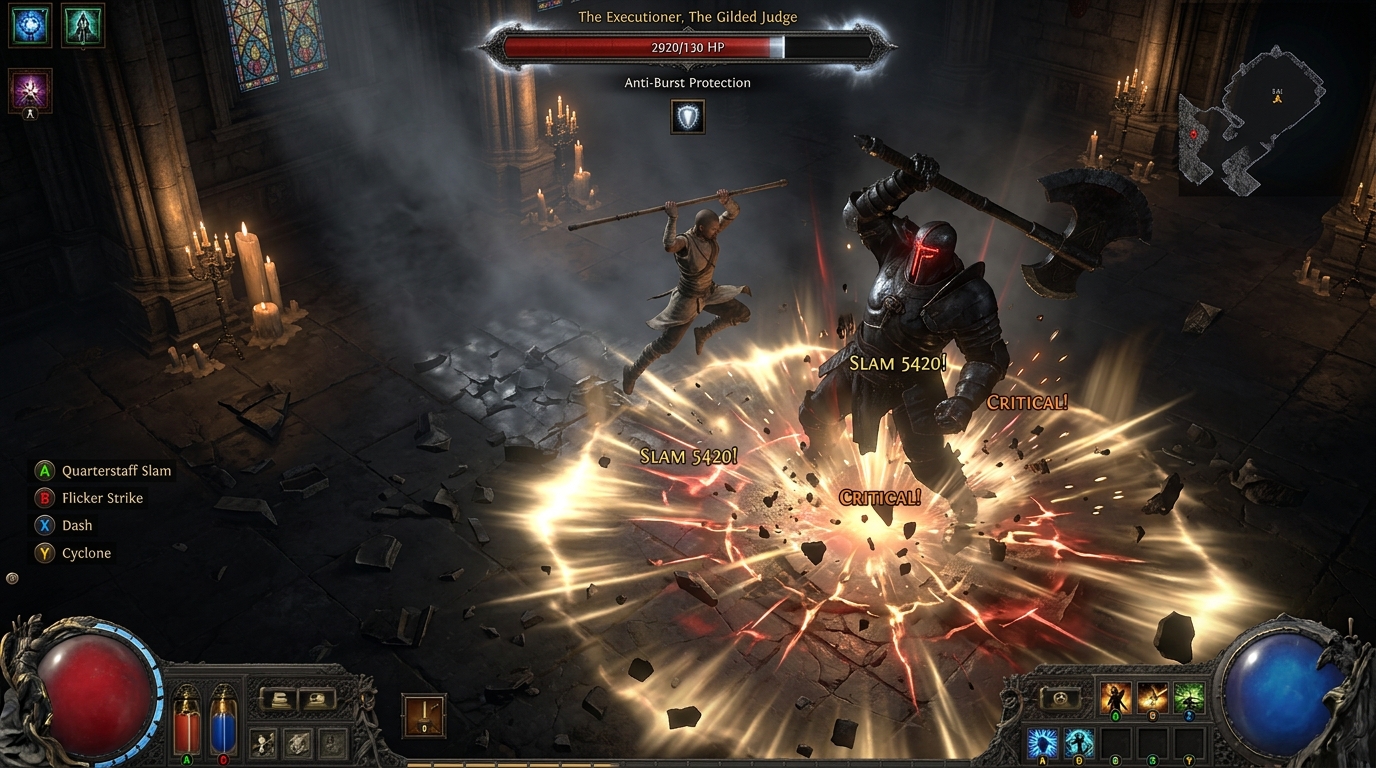
The days of walking into a god’s throne room and vaporizing them before they can finish their monologue are officially over. In Path of Exile 2, the developers have introduced aggressive anti-burst protection that effectively puts an end to the era of one-shotting everything with a single click. These new damage reduction windows act as a mechanical speed bump, ensuring that major bosses maintain their dignity for more than three seconds. It is a bold move that replaces the old gear-check meta with something that actually requires me to use my brain. I can have the most expensive build in the game, but I am still going to have to respect the health bar.
This shift means I am finally forced to engage with the intricate dance of boss patterns instead of just ignoring them. With the addition of the new dodge roll, the combat feels less like a spreadsheet calculation and more like a tactical encounter where positioning matters. I need to learn when to dive through a wave of fire and when to commit to a heavy attack during a genuine opening. It is a refreshing change of pace that rewards player skill over mindless gold-stacking and infinite power creep. If I try to facetank a celestial deity now, I am going to end up as a very expensive stain on the floor.
While some players might miss the feeling of being an unstoppable force of nature, this innovation actually makes the victories feel earned. Every boss fight in the Return of the Ancients update feels like a mini-event rather than a chore I have to automate for efficiency. The game stops being a walking simulator where things just explode and starts being a legitimate test of reflexes and timing. It is a smart piece of design that saves the game from its own tendency toward over-complication by focusing on meaningful interaction. I might actually remember the name of the boss I just killed, which is a nice change of pace.
A New Engine for Pure Chaos
Path of Exile 2 is a massive, beautiful, and occasionally exhausting testament to the idea that more is almost always better, even if it gives my brain a workout. After spending dozens of hours dodging through the Return of the Ancients update, I am convinced that the developers haven’t just flown close to the sun, they have harnessed its core to power a ridiculously complex engine. The new combat pace makes me feel every impact, and the removal of the old mana reservation headache in favor of the Spirit system is the kind of smart innovation that actually respects my time. It is a rare sequel that manages to add layers of depth while simultaneously trimming the fat that made the original feel like a second job.
There is a fine line between a deep system and a convoluted mess, but the dual specialization and revamped skill system somehow stay on the right side of that boundary. Having access to multiple six link skills without needing to sacrifice my firstborn for the right gear sockets is a revelation that makes every other game in the genre look ancient. While the passive tree still looks like a galactic map designed by a madman, the ability to auto swap passives based on weapon choice is a stroke of genius that rewards creativity instead of punishing it. I still need a second monitor and a few spreadsheets to truly master the endgame, but the moment to moment gameplay is finally fun enough to justify the homework.
Ultimately, this game is a masterpiece for the kind of player who wants to drown in mechanics and come out the other side with a god tier character. The developers successfully modernized the formula without losing the gritty, uncompromising soul that made the franchise famous in the first place. It is unapologetically dense and demands full attention, but the payoff of a perfectly executed dodge roll followed by a screen clearing combo is unmatched. If you are looking for a shallow experience to turn your brain off to, you should probably stay far away from this one. For everyone else, Path of Exile 2 is the new gold standard for how to build a sequel that actually evolves.
Frequently Asked Questions
1. Is Path of Exile 2 just a faster version of the first game?
Not even close. We have moved past the era of being a human turret and holding down one button until the screen vomits loot. The gameplay is now a tactical, Souls-like dance that requires actual brain cells and reflexes to survive.
2. How does the new dodge roll actually change the combat?
The dodge roll has no cooldown and lets me cancel animations mid-swing to avoid a getting flattened. It transforms the game from a spreadsheet simulator into a high-stakes encounter where survival depends on my hands, not just gear stats.
3. Are ‘one-button builds’ still the best way to play?
Those lazy days are dead and buried thanks to the new Spirit system and dual-specialization tree. I can now juggle multiple six-link skills and swap passive sets on the fly, making my character feel like a versatile god instead of a one-trick pony.
4. Is the game too difficult for casual players?
It is definitely meaner and demands I pay attention to enemy wind-ups and telegraphs. If you want a game designed for toddlers with short attention spans, look elsewhere, because this sequel is unapologetically deep and complex.
5. What makes the dual-specialization passive tree so special?
It allows me to effectively play two builds at once by swapping passive sets depending on the skill I use. This middle finger to old-school limitations means I can finally be prepared for any situation without feeling like a stat sheet.
6. Does gear still matter if the combat is more tactical?
Gear is still vital, but it will no longer carry me through a fight if I play like a potato. The shift toward responsive, skill-based combat means that even the hardest Souls-like bosses in the game won’t save me from a permanent dirt nap if I miss my dodge rolls. While PoE 2 is a major studio release, fans of this style should also keep an eye on upcoming indie soulslikes that are pushing the boundaries of the genre even further.
The developers have proven that pointless skill bloat is not a requirement for depth, as every new mechanic in this sequel serves a distinct tactical purpose.