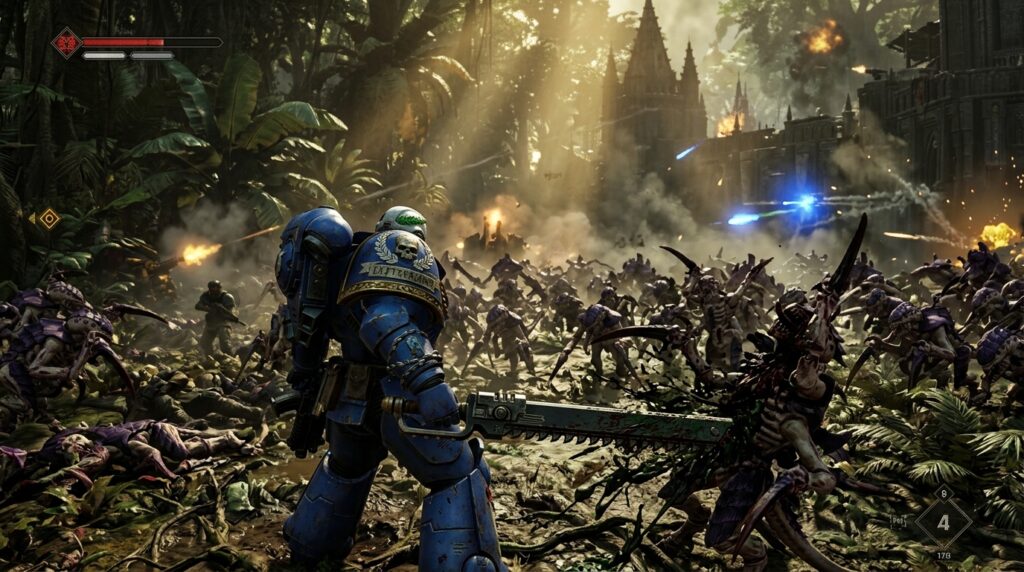
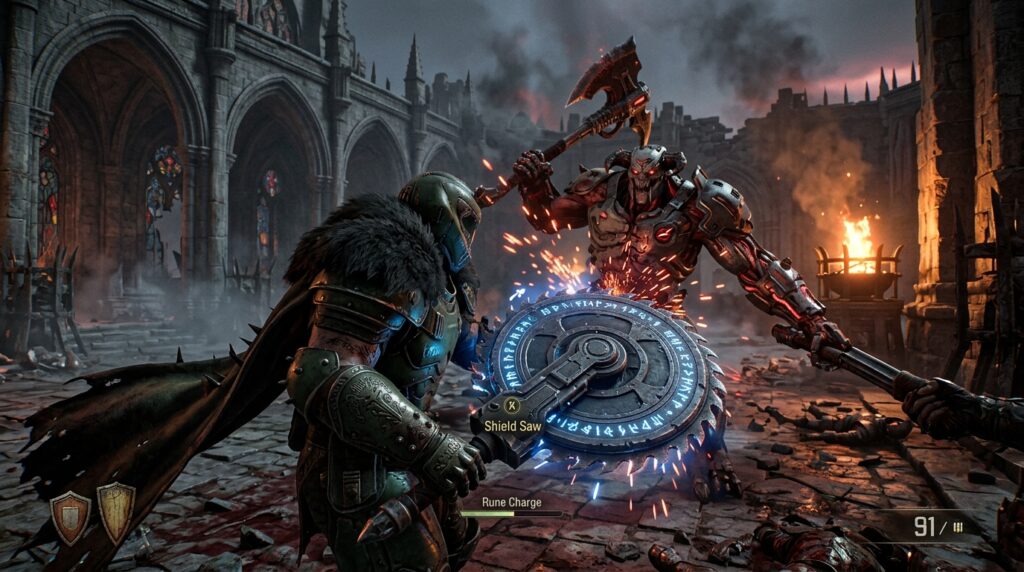
Before you had a double-jumping supersoldier with a guitar-riff fetish, you had a guy with a shield, a flail, and a very bad attitude. Doom: The Dark Ages finally drags us back to the Unholy Wars on Argent D’Nur to show us how the Slayer became the industry’s favorite one-man extinction event. It’s a medieval-inspired bloodbath that trades neon corridors for high-fidelity castle sieges. Seeing three million players jump in during the first week suggests we were all collectively starving for some old-school skull-crushing.
Built on the new id Tech 8 engine, this prequel isn’t just a skin swap; it’s a massive-scale lesson in how to make destruction feel like high art. While the rest of the industry is busy trying to sell you battle passes for digital hats, the developers just handed us a chainsaw-shield and told us to go to work. It’s loud, it’s unapologetically violent, and it’s the first time in years a medieval setting hasn’t felt like a bored trek through a renaissance fair.
Key Takeaways
- Doom: The Dark Ages pivots from the high-speed acrobatics of previous entries to a grounded, heavy-combat style that emphasizes the Slayer’s role as a walking tank.
- The new Shield Saw and skull-grinding weaponry redefine the combat loop, rewarding aggressive parrying and visceral, mechanical destruction over frantic resource management.
- Powered by the id Tech 8 engine, the game replaces claustrophobic corridors with massive-scale planetary invasions and cinematic medieval sieges on Argent D’Nur.
- This prequel successfully evolves the franchise by stripping away complex verticality in favor of a deliberate, crushing momentum that anchors the Slayer’s origin story in dark fantasy.
Heavy Metal Combat And The Shield Saw
If Doom Eternal was a high-speed gymnastics floor routine performed by a caffeinated acrobat, The Dark Ages is a bar fight where you are the only one holding a brick. The transition from air-dashing through neon arenas to the grounded, gritty combat of Argent D’Nur feels like the team finally remembered that the Slayer is a walking tank, not a ballerina. Gone are the days of frantically managing cooldowns just to stay airborne while praying for a stray armor shard. Instead, the game demands you plant your feet and turn every demon in your peripheral vision into a fine red mist through sheer aggression. It is a refreshing pivot that trades frantic twitch-reflexes for a heavy, deliberate pace that feels significantly more violent.
The star of this medieval slaughterhouse is undoubtedly the Shield Saw, a tool that makes Captain America look like he is playing with a frisbee. This thing is the Swiss Army knife of the apocalypse, allowing you to parry incoming projectiles before revving the teeth and launching it into a crowd for some glorious crowd control. It serves as your primary defensive anchor, but it never feels passive because the game rewards you for being as offensive as possible with your blocks. Watching a Hell Knight charge in only to get a face full of spinning serrated metal is the kind of power trip that makes you wonder why we ever bothered with simple double jumping. It is a chunky, satisfying mechanic that anchors the new combat loop perfectly.
This shift toward a stand and fight mentality proves that the studio isn’t just content to iterate on the same formula until the wheels fall off. By stripping away the verticality and focusing on the crushing weight of the Slayer’s arsenal, they have managed to make the combat feel fresh without losing that core Doom DNA. The id Tech 8 engine handles the chaos beautifully, rendering every shattered shield and splintered bone with a level of detail that borders on the obsessive. It is a bold move to slow things down in an era of hyper-mobile shooters, but when the result is this visceral, it is hard to argue with the body count. This is a masterclass in how to evolve a franchise by looking backward at its heaviest, most brutal roots.
Skull Crushers And Medieval Artillery
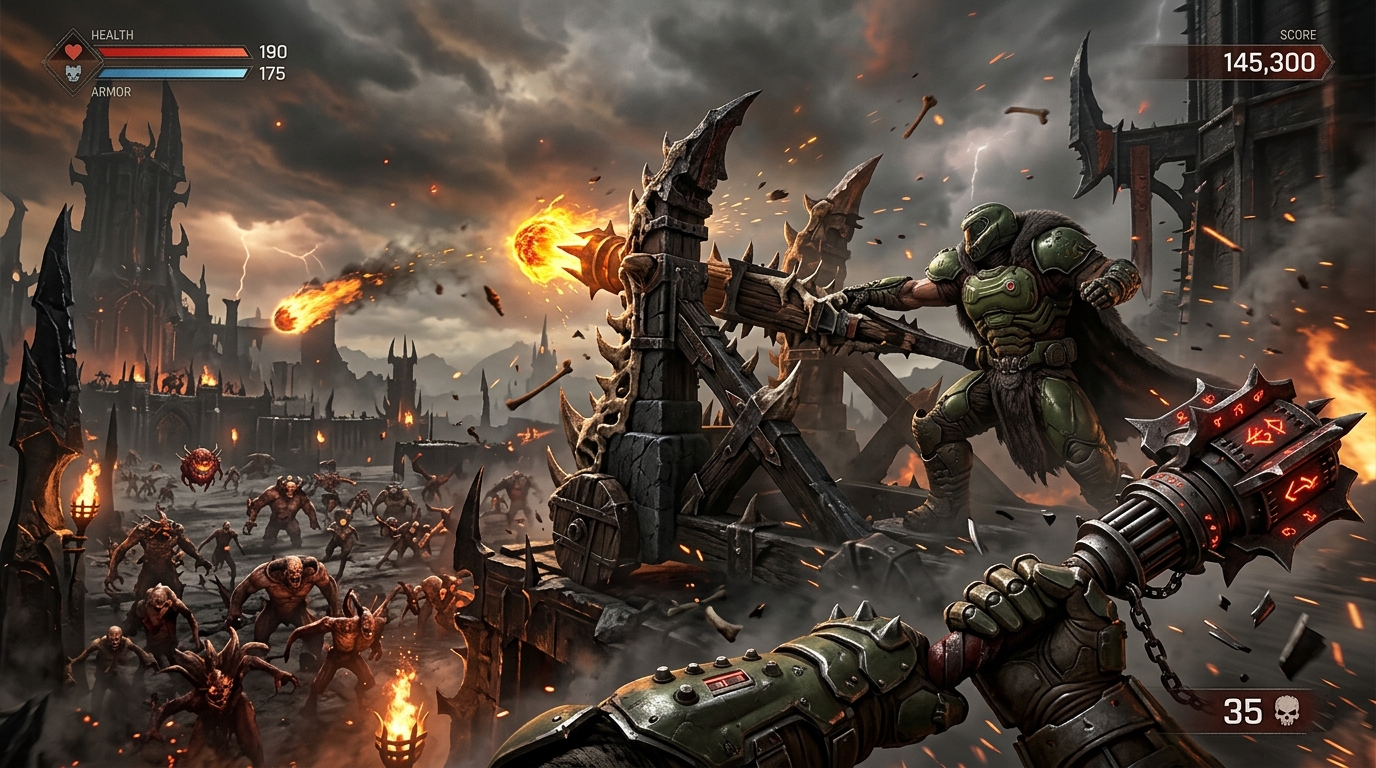
The id Tech 8 engine isn’t just a fancy numbers upgrade for the sake of marketing bullet points, as it actually facilitates some of the most unhinged weapon mechanics I have seen in a decade. While other shooters are busy tweaking recoil patterns for the hundredth time, the Slayer is out here using a shotgun that literally grinds skulls into shrapnel. You pick up a fallen enemy’s head, shove it into the hopper, and watch as the machinery pulverizes bone into a lethal spray of high-velocity calcium. It is the kind of absurd, over-the-top innovation that makes you realize the developers still understand that cool should always trump realistic in a game about fighting literal demons.
The medieval artillery on display here feels heavy and purposeful, moving away from the neon-soaked energy weapons of the previous entries. Every blast from the Shield Saw or the new heavy crossbow feels like it has actual weight behind it, thanks to the high-fidelity destruction physics baked into the new engine. Watching a stone pillar crumble or a demon’s armor shatter under a barrage of medieval-inspired lead is incredibly satisfying and proves the franchise isn’t just treading water. They have managed to make the combat feel fresh by going backward in time, trading sleek plasma rifles for gritty, mechanical monstrosities that look like they were forged in a blacksmith’s fever dream.
This transition to a dark fantasy aesthetic could have felt like a cheap reskin, but the sheer mechanical creativity of the arsenal saves it from being a gimmick. The skull-crunching shotgun represents a level of “why didn’t anyone think of this sooner” brilliance that defines the best entries in this series. It is blunt, it is loud, and it is unapologetically violent in a way that makes modern tactical shooters look like they are playing with water pistols. If this is the direction the Unholy Wars are taking, I am more than happy to stop worrying about ammo counts and start worrying about how many heads I have left to harvest for my next reload.
Argent DNur And The Scale Of War
Argent D’Nur is no longer just a collection of floating ruins and lore entries, because The Dark Ages finally puts us on the front lines of a proper planetary invasion. While the previous games felt like a hyper-violent game of tag in a series of interconnected hallways, this prequel uses the id Tech 8 engine to pivot toward absolute carnage on a cinematic scale. You are not just clearing out a room of possessed scientists anymore, as the game tosses you into the mud of the Unholy Wars alongside legions of Night Sentinels. The sheer verticality and breadth of these dark fantasy vistas make the 2016 corridors feel like a backyard skirmish by comparison. It is refreshing to see a developer actually use new hardware to increase the scope of the world rather than just making the textures of a demon’s liver look slightly more moist.
The shift to massive, open battlefields actually changes the fundamental rhythm of how the Slayer interacts with the environment. Instead of the frantic, twitchy arena combat that defined Eternal, we are getting a more deliberate and crushing sense of momentum that fits a medieval war machine. Watching a skyscraper sized mech stomp through the background while you shield bash through a phalanx of hell knights provides a sense of scale that most shooters are too cowardly to attempt. It is loud, it is heavy, and it feels like the team is finally letting the franchise breathe outside of its usual claustrophobic comfort zone. This is not just a visual upgrade, but a total reassessment of what a Doom level can be when the stakes are planetary.
Whether this massive scale remains engaging for twenty hours or eventually turns into a tedious slog through giant empty fields is the real question. Right now, the spectacle of seeing thousands of combatants clashing under a bruised sky is enough to justify the price of admission for any fan of the series. The developer is clearly betting that bigger is better, and the technical polish on display makes it hard to argue with their logic. It is a bold move to take a franchise known for tight spaces and throw it into a sprawling fantasy epic, but the grit of Argent D’Nur makes the transition feel earned. If you are going to tell an origin story about a god-tier warrior, you might as well give him a stage large enough to actually fit his ego.
More Than Just a Medieval Skin
DOOM: The Dark Ages isn’t just a medieval skin slapped onto a decade-old engine to satisfy a release schedule. While the id Tech 8 engine certainly makes the world of Argent D’Nur look like a heavy metal album cover come to life, the actual gameplay evolution is what keeps this from being a lazy retread. The shift from high-flying acrobatics to a more grounded, shield-bashing brawler style feels like a deliberate and successful attempt to redefine what a Slayer game can be. It manages to capture that visceral, chunky combat we crave without feeling like a mere expansion pack for the previous titles. If you were worried that the franchise was starting to tread water, three million players in the first week should tell you that the formula still has plenty of teeth.
Ultimately, this prequel earns its place in the pantheon by proving that the Slayer’s mythos has more depth than just “angry man kills demons in space.” By exploring the Night Sentinel era, the developers have delivered a dark fantasy epic that feels both fresh and familiar in all the right ways. It is a rare example of a prequel that actually adds weight to the lore instead of just filling in boxes on a wiki page. Whether you are riding a mechanical dragon or just turning a demon into red paste with a mace, the experience is consistently satisfying. If you have a gaming subscription, there is absolutely no excuse to skip this, and if you don’t, it is still worth every cent for the sheer spectacle of the Unholy Wars.
Frequently Asked Questions
1. What exactly is Doom: The Dark Ages?
It is a brutal prequel that takes us back to the Unholy Wars on Argent D’Nur to show the Slayer’s origin story. Forget the neon lights and jetpacks, this is a medieval bloodbath powered by the new id Tech 8 engine.
2. How does the combat feel compared to Doom Eternal?
If Eternal was a caffeinated gymnastics routine, this is a heavy duty bar fight where you are the only one with a brick. The movement is grounded and deliberate, making you feel like a walking tank rather than a ballerina.
3. What is the deal with the Shield Saw?
It is the star of the show and makes Captain America’s frisbee look like a toy. This tool allows you to block incoming fire and shred demons into a fine red mist with zero apologies.
4. Is this just a medieval skin swap for the old games?
Not even close. This is a massive scale redesign that replaces small arenas with high fidelity castle sieges and a completely different mechanical rhythm.
5. Do I still have to manage a million cooldowns to stay alive?
The game trades frantic resource management for pure, unadulterated aggression. You spend less time worrying about armor shards and more time planting your feet to turn enemies into paste.
6. Why should I care about another prequel?
Because the developers actually focused on making destruction feel like high art instead of selling you digital hats or battle passes. It is a rare case where a medieval setting actually feels violent and earned rather than a boring trip to a renaissance fair. Even with the slower pace, it stands out among games with satisfying movement mechanics because every step feels heavy and intentional.