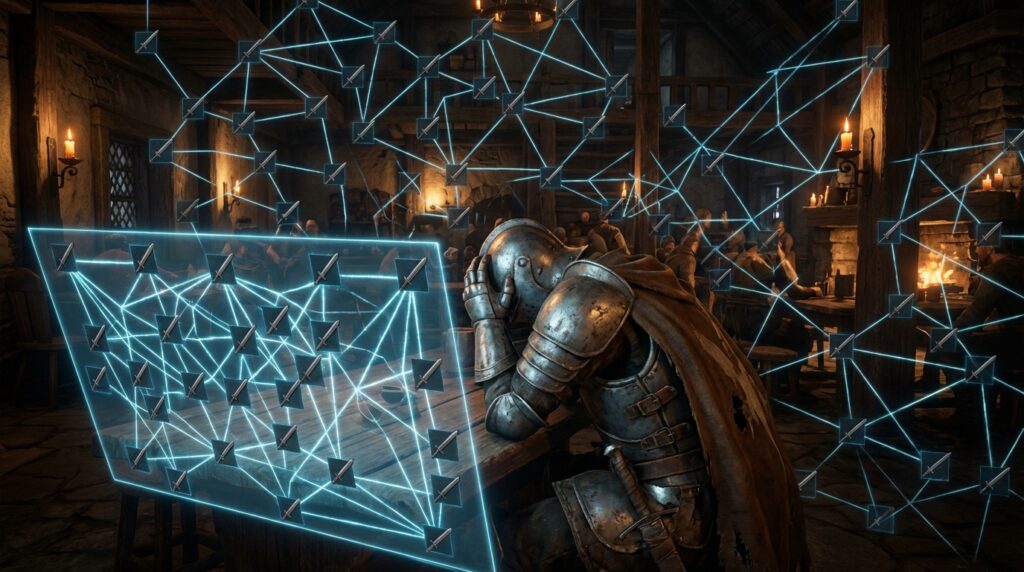
I used to think skill trees were a reward for playing well, but lately, they feel more like a digital chore list designed by a bored HR department. We have reached a point where every protagonist, from neighborhood superheroes to grizzled Vikings, is apparently born with amnesia and needs to spend ten hours grinding just to remember how to do a heavy attack. These useless skill trees do not provide meaningful choices. They are just speed bumps made of filler content and +2% health buffs that nobody asked for.
It is time to stop pretending that clicking a button to unlock sliding for the fiftieth time is compelling gameplay. Developers are obsessed with burying actual fun under layers of glittery icons and artificial progression just to pad out their completion times. If a game forces me to navigate three separate menus just to gain the privilege of basic movement, it is not an RPG, it is a spreadsheet with a marketing budget.
Key Takeaways
- Modern skill trees have devolved into ‘digital chores’ that prioritize artificial playtime padding over meaningful gameplay choices.
- Incremental stat boosts, such as 2% health increases, create an illusion of depth while failing to fundamentally change the player’s experience.
- Developers are increasingly locking basic motor functions and core mechanics behind unnecessary experience point grinds to simulate character progression.
- A well-designed progression system should focus on unlocking transformative new abilities rather than burying fun features under layers of numerical fluff and busywork.
The Illusion Of Choice And Percentage Padding
Nothing screams lazy design quite like a skill tree that treats a 2 percent health boost as a monumental achievement. We have all been there, staring at a sprawling web of icons only to realize that half of them are just incremental stat padding designed to make the grind feel productive. These systems do not actually change how you play the game. They just force you to click a button so your numbers can keep up with the enemy scaling. It is the video game equivalent of a participation trophy, where you are rewarded for your time rather than your tactical decision making. If I have to spend five skill points just to notice a difference in my character’s survivability, the developers have failed to respect my time.
This illusion of choice is a plague on modern RPGs and action titles that feel the need to justify their hundred hour playtimes. You are presented with a massive branching path, but you quickly realize that the choices are meaningless because every upgrade is just a minor mathematical tweak. Real progression should unlock new mechanics or transform your playstyle, not just give you a microscopic reduction in stamina cost. When a game buries the actually fun abilities under layers of boring percentage buffs, it is a sign that the developers prioritize filler over substance. I do not want to do math to figure out if my character is getting stronger. I want to see it in the gameplay.
These bloated systems exist solely to keep you on the metaphorical treadmill for as long as possible. Instead of giving us three meaningful choices that define our character, we get thirty nodes that provide the bare minimum amount of dopamine. It is a cynical way to pad out a menu screen and make a shallow game look deep to the casual observer. We need to stop pretending that adding a tiny sliver of critical hit chance is the same thing as meaningful character development. If the skill tree could be replaced by a simple auto level system without changing the experience, it has no business being in the game.
Burying The Fun Behind A Mandatory Grind
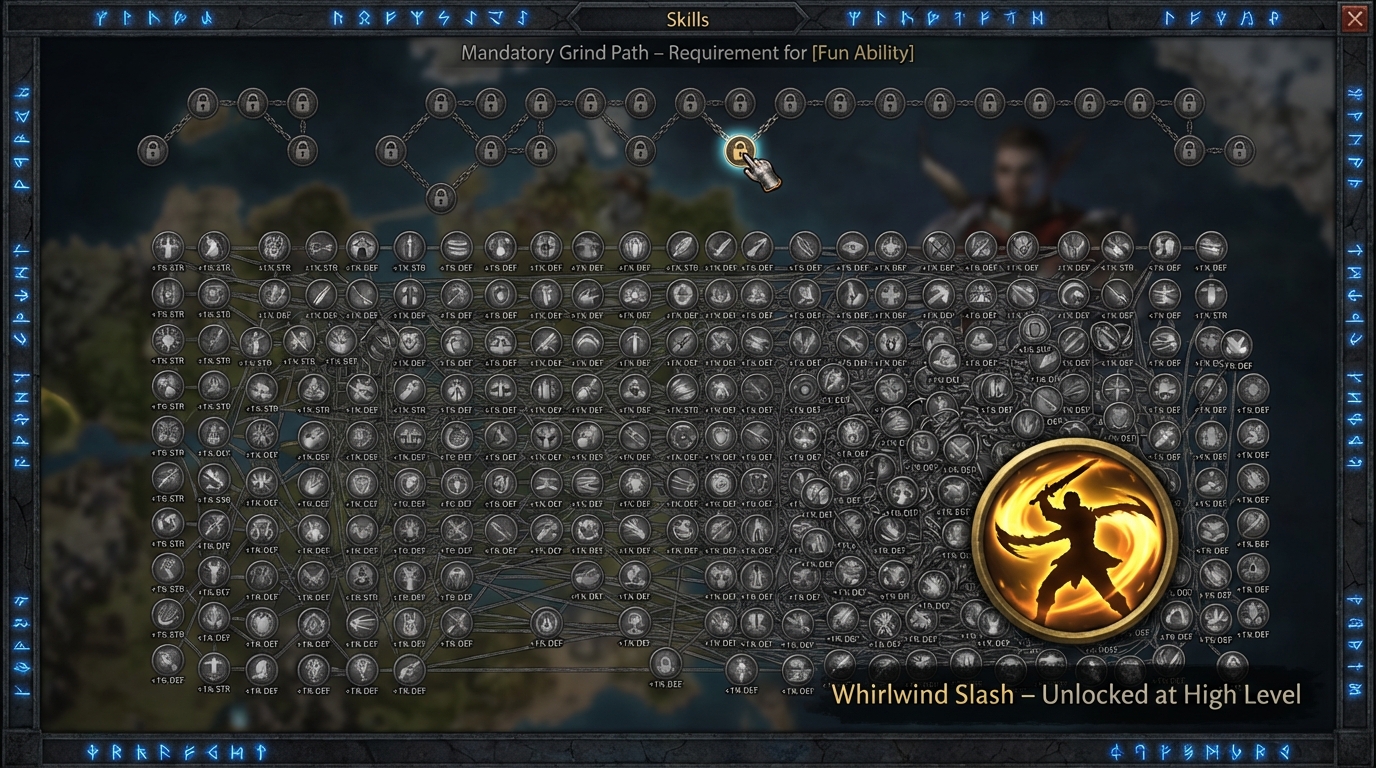
There is a special circle of hell reserved for developers who take a basic human motor function and hide it behind a three hour experience point grind. We have reached a point in modern game design where your protagonist apparently forgets how to crouch or perform a basic parry unless you spend five points in a bloated digital gardening project. It is not a progression system when you are simply reclaiming the standard features that should have been mapped to the controller from the jump. This is nothing more than an illusion of choice designed to make a fifteen hour campaign look like a forty hour epic on the back of the box. You are not becoming a god. You are just slowly assembling a character who is no longer incompetent.
The sheer audacity of locking a 10 percent health increase or a slightly faster reload speed behind a convoluted web of icons is exhausting. Games like Marvel’s Spider-Man 2 throw multiple trees at you, yet half the nodes feel like filler designed to keep you staring at a menu instead of playing the game. When every single upgrade is a mandatory stepping stone to reaching the one actually cool ability, the sense of discovery dies a quick and painful death. I do not feel powerful when I unlock the ability to heal. I feel like I finally finished my chores. These systems are the participation trophies of the gaming world, rewarding you for existing rather than for actually mastering a mechanic.
Linear skill trees have become the industry’s favorite way to pad out playtime without adding a single ounce of meaningful content. Instead of designing clever encounters that naturally test your skills, studios just slap a level gate on a door and tell you to go kill twenty more boobytrapped rats. It is a lazy, transparent tactic that treats the player like a toddler who needs a gold star every time they press the jump button. If your game requires me to spend six hours in a spreadsheet just to unlock a basic dodge roll, you have failed at game design. We need to stop pretending that bigger numbers and more glittery icons equate to a better experience when they actually just get in the way of the fun.
When Skill Trees Become Cluttered Busywork
Modern game designers seem to have a pathological fear of letting you just play their game without forcing you to navigate a digital tax return every twenty minutes. We have reached a point where even basic functions, like the ability to crouch or perform a standard heavy attack, are locked behind a level up wall to give the illusion of depth. These overstuffed maps are less about character growth and more about busywork, designed to trick your brain into thinking you are making progress when you are really just clicking on icons. It is a cynical way to pad out a thirty hour campaign by making you grind for things that should have been in the tutorial. When I see three separate trees for a single character, I do not see options. I see a developer who does not trust their own core mechanics to be fun on their own.
Most of these nodes are the equivalent of a participation trophy, offering a thrilling 2 percent increase to poison resistance or a slightly faster reload speed that you will never actually notice. This stat bloat is a plague on modern action titles, burying the actually cool abilities under layers of boring, numerical fluff that feels like a chore to manage. You spend half your time squinting at a UI that looks like a circuit board just to find the one upgrade that actually changes how the game feels. It is a tragedy of lazy design where quantity is prioritized over quality, forcing us to hunt for glitter and big numbers instead of rewarding gameplay. If an upgrade does not fundamentally change my strategy, it is not a feature. It is just a speed bump on the road to the actual credits.
The industry has become obsessed with the RPG-ification of everything, even in genres where it makes absolutely no sense to have a skill point system. We are now at a stage where a superhero who has been fighting crime for a decade suddenly forgets how to use his equipment unless you collect enough glowing orbs to remind him. This forced implementation creates a boring linearity where every player eventually unlocks everything anyway, making the choice involved completely meaningless. It is time to stop grinding and realize that clicking a tiny box to get a 5 percent health buff is not a compelling gameplay hook. If your skill tree is ninety percent filler, you should probably just give me the abilities and let me get back to the actual fun of playing the game.
Stop Padding Your Game with Digital Taxes
We need to stop pretending that a 2 percent increase to poison resistance is a rewarding gameplay milestone. Developers have fallen into a lazy trap of using these bloated skill trees as a crutch to simulate depth where none actually exists. It is an insulting waste of time to force players through a dozen hours of grinding just to unlock a basic combat move that should have been in the starting kit. If your progression system feels more like doing taxes than becoming a legendary hero, you have fundamentally failed at game design. We deserve better than these glorified checklists that exist only to pad out the play clock for a marketing bullet point.
The industry needs to realize that more choices do not matter if every single one of them is boring. I am tired of staring at a massive web of icons only to realize that ninety percent of them are just incremental stat bumps hidden behind pretty colors. A real skill tree should fundamentally change how I interact with the world, not just make a number float slightly higher above an enemy head. Give us impactful abilities that actually alter our playstyle or just get rid of the menu entirely. Stop burying the fun under layers of endless grind and let us actually play the game you built.
If a developer cannot make a skill feel meaningful, they should have the courage to leave it out of the final product. We are currently drowning in a sea of mediocrity where every action game tries to masquerade as a deep RPG by throwing a few talent points at us. It is time to demand that these systems serve the player rather than just serving the engagement metrics. Either give us a progression system that actually progresses the experience or stop wasting our precious free time with these digital chores. The era of the useless skill tree needs to end so we can get back to games that actually respect our intelligence.