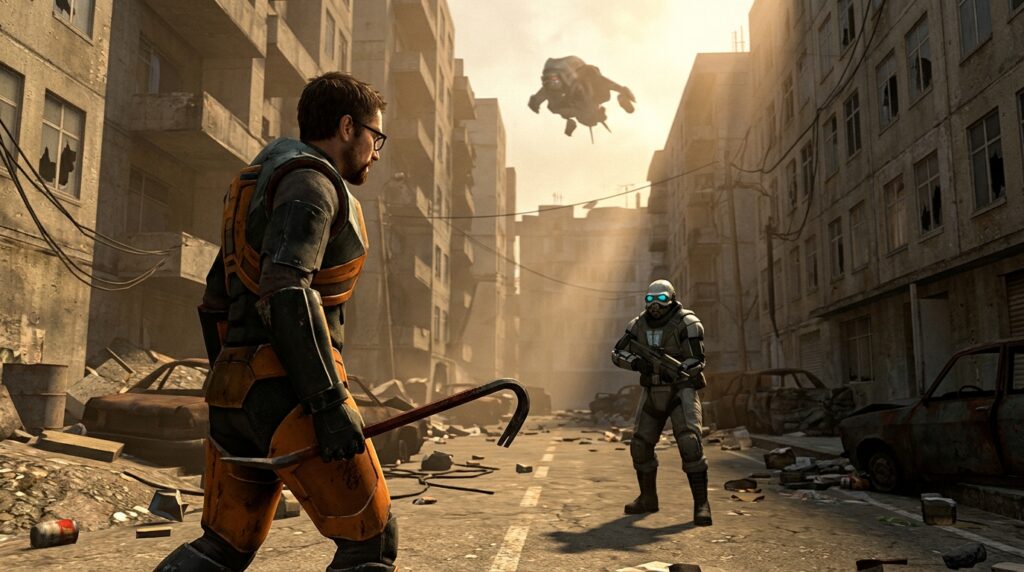
Half-Life 3 rumors keep circulating, and the straight answer as of October 21, 2026 is this: Valve has not announced Half-Life 3. No title, no confirmation, no release date. Just a lot of people squinting at code strings like they’re tea leaves.
The loudest prediction didn’t age well. A December 2025 report said the game would ship with Steam hardware in Spring 2026, and when Valve priced the Steam Machine in June, Half-Life 3 was nowhere on the launch list. Spring came and went, and the rumor mill grabbed a new code string and kept going.
Key Takeaways
- Valve has not announced Half-Life 3 as of October 21, 2026, so there is no official title, status, or release date for the game.
- The December 2025 report that Half-Life 3 would launch with Steam hardware in Spring 2026 missed, because Valve’s June Steam Machine launch did not include the game and Spring 2026 passed without it.
- Valve said in July 2026, as reported by TweakTown citing Bloomberg, that it has no plans for Steam Machine-exclusive games, which includes a new Half-Life game.
- Valve’s own Steam news feed is the only source that counts as confirmation, so Half-Life 3 news from dataminers, fan accounts, or former employees should be treated as unverified until Valve posts it there.
Is Half-Life 3 Actually Happening?
Valve’s Steam page lists Alyx as released on March 23, 2020. It’s a VR-only game set between Half-Life and Half-Life 2, which is a lot of story to squeeze into a headset.
The closest Valve has come to a third episode is older and more interesting. On November 15, 2024, the company marked the Half-Life 2 anniversary with an update saying the expanded edition of Raising the Bar would include ideas and experiments for a third episode. Valve’s anniversary post is worth reading in full, because the key point is that those ideas never became a game.
So Valve has confirmed that a third episode was sketched out at some point. It has not confirmed that anything is in production today. That difference is the whole story. A half-finished idea from 2024 is a fun fact for history nerds, not a launch window. Anyone telling you otherwise is reading letter combinations like a horoscope, and horoscopes have never been reliable for release dates.
Where Did the HLX Rumors Come From?

HLX is the code name at the center of the whole mess. It’s widely assumed, but not confirmed, to be Half-Life 3. Valve hasn’t said so, which means every theory rests on file names and vibes.
Most of the noise traces back to three people, and they don’t all make the same kind of claim:
- Mike Shapiro’s G-Man New Year video, posted December 31, 2024, promised “unexpected surprises.” It never named Half-Life 3. Fans filled in the rest.
- Dataminer Gabe Follower claimed in January 2025 that Valve had started HLX playtests with friends and family. That’s an insider claim pinned to one person, not something Valve announced.
- Tyler McVicker read Source-engine strings in a Dota 2 update as signs of HLX optimization and polish.
Ars Technica’s January 2025 coverage is the one to read if you want the Follower claim laid out with its attribution intact. The reporting keeps the dataminer’s word separate from anything Valve said, which is more discipline than most of the internet manages.
McVicker’s take was a different beast. Code strings can mean test builds, abandoned experiments, or someone’s leftover placeholder. A February 2025 report covered the strings, and even that piece framed the link to Half-Life 3 as an assumption. Text in a file is a clue. It is not a press release.
Why Did the Spring 2026 Steam Machine Prediction Miss?
The prediction missed because it was pinned to a calendar that had already started slipping. A December 2025 report relayed what journalist Mike Straw’s sources expected: Half-Life 3 launching alongside Steam hardware in Spring 2026.
The catch was in the same report. Straw had also heard an earlier date, and that date had already passed by the time the story ran. A forecast that expires on arrival isn’t really a forecast. It’s a warning label nobody read.
Spring 2026 closed, and the game never showed up. Valve’s Steam Machine news came in June, and Half-Life 3 didn’t ride along as a launch title.
The lesson here is about anchors. Most leak timelines hang on an event: a hardware launch, a sale, a convention. When the event happens without the game, the rumor doesn’t die. It just gets reattached to the next event on the calendar. So when someone gives you a window, ask what it’s tied to. If the answer is “a product that already shipped,” the date was never about the game.
Did Valve Really Say Half-Life 3 Is Finished?

No, Valve never said Half-Life 3 was finished or that its developers had moved on. PC Gamer reported on February 6, 2026, that the claim came from the Valve fan account GabeFollower, not from any announcement by the company. Fan accounts are fun. They are not Valve’s press office.
The rumor also got fuel from Chet Faliszek, a former Valve writer whose remarks fans read as hints. In May 2026, he said his Half-Life 3 comments were not meant to signal that anything was happening. A former employee’s remarks are a mood, not a production schedule.
In 2023, a rumor claimed Half-Life 3 would appear at Gamescom. The show’s organizers dismissed it as a mistake, which is the convention world’s equivalent of a shrug. PC Gamer reported that dismissal in 2024.
Does Valve Plan Half-Life Games for Steam Machine?
No, Valve has said it has no plans for Steam Machine-exclusive games, and that statement explicitly includes a new Half-Life game. In July 2026, TweakTown reported, citing Bloomberg, that Valve made that position clear. It cuts against a lot of the chatter, so pay attention.
The Steam Machine theory has always depended on one idea: that Half-Life 3 is the hardware’s big reason to exist, and the game would ship in the box like a free mint on a hotel pillow. Every launch-window story assumed that link. Valve’s answer breaks it. If the company is saying the hardware won’t get exclusives, Half-Life included, then a Steam Machine launch doesn’t automatically mean a Half-Life 3 launch.
Here’s what this doesn’t do. It doesn’t confirm Half-Life 3, and it doesn’t give us a title, a status, or a date. It only removes one of the cleanest pillars under the rumor. The game isn’t waiting on a box to ship with it, and anyone still insisting it is should explain why Valve would say otherwise.
How Do You Tell a Credible Leak From Noise?

Ask three questions, in order, and the answer is usually obvious within a minute. First, who is making the claim? Valve is the only source that counts as confirmation. A named journalist counts as reporting, which can still be wrong. An anonymous account or fan handle is a rumor with a profile picture.
Second, has Valve said anything? Official Valve statements outrank everything else, including every dataminer, every voice actor’s cryptic post, and every thread that’s getting way too excited.
Third, does the claim come with a date, and has that date already slipped? Exact months deserve suspicion, especially ones already in the rearview mirror. Anyone selling a specific window is betting you’ve forgotten the last one.
- Valve on the record: confirmation
- Named journalist with sources: a lead to watch
- Anonymous account, dataminer, or voice-actor hint: a clue, nothing more
Code strings are the favorite toy of this whole rumor cycle. Treat them like a flashlight in a dark room, not a map of the building. Something in a file might mean a test build, a leftover placeholder, or nothing at all.
Where to Watch for Real Half-Life 3 News
Start with the only place that counts: Valve’s own Steam news feed. If Half-Life 3 ever gets announced, it will land there first, not in a dataminer’s thread at 2 a.m. Bookmark it and check it before any other tab.
Next, make a rule for every new claim. Run it through the three questions above: who said it, whether Valve said anything, and whether the date has already slipped. Fan accounts and voice-actor winks go in the maybe pile. Any date gets a calendar reminder so you can check it after it passes. The Spring 2026 window closed quietly, and the next one will too.
Finally, follow reporters who name their sources and keep them separate from Valve’s statements. Ars Technica and PC Gamer have been careful about attribution, so start there. Mute anyone whose whole job is hinting. Your hype budget is finite, and Half-Life fans have already spent years of theirs.